Volume A — The Foundation
Papers A0–A7: The Gelfand triple Φ ⊂ H ⊂ Φ′ and the actualities its inner product forces; the cogito, and the naming that follows it — the Father the inner product, the Son the nuclear space Φ (the Logos), the Spirit the nuclear topology; the evidence that the universe had a beginning, and the first creative act read into it; the algebra Cl(3,0) the Trinity forces, its descent down the constraint cascade, and the formal definition of Love; the Old Testament read as one arc, the working vocabulary earned a Scriptural turn at a time; the material thread told as current science, from the first massive particles to a body in Roman Judea; the waking of an interior and its leaving itself in matter — writing, and the Hebrew canon kept; the life of Christ from the Annunciation to the cry, each scene taken three ways; the three days in the sealed tomb, looked at three times; and the arc from the empty tomb through the forty days, Pentecost, and the spreading church to the new creation.
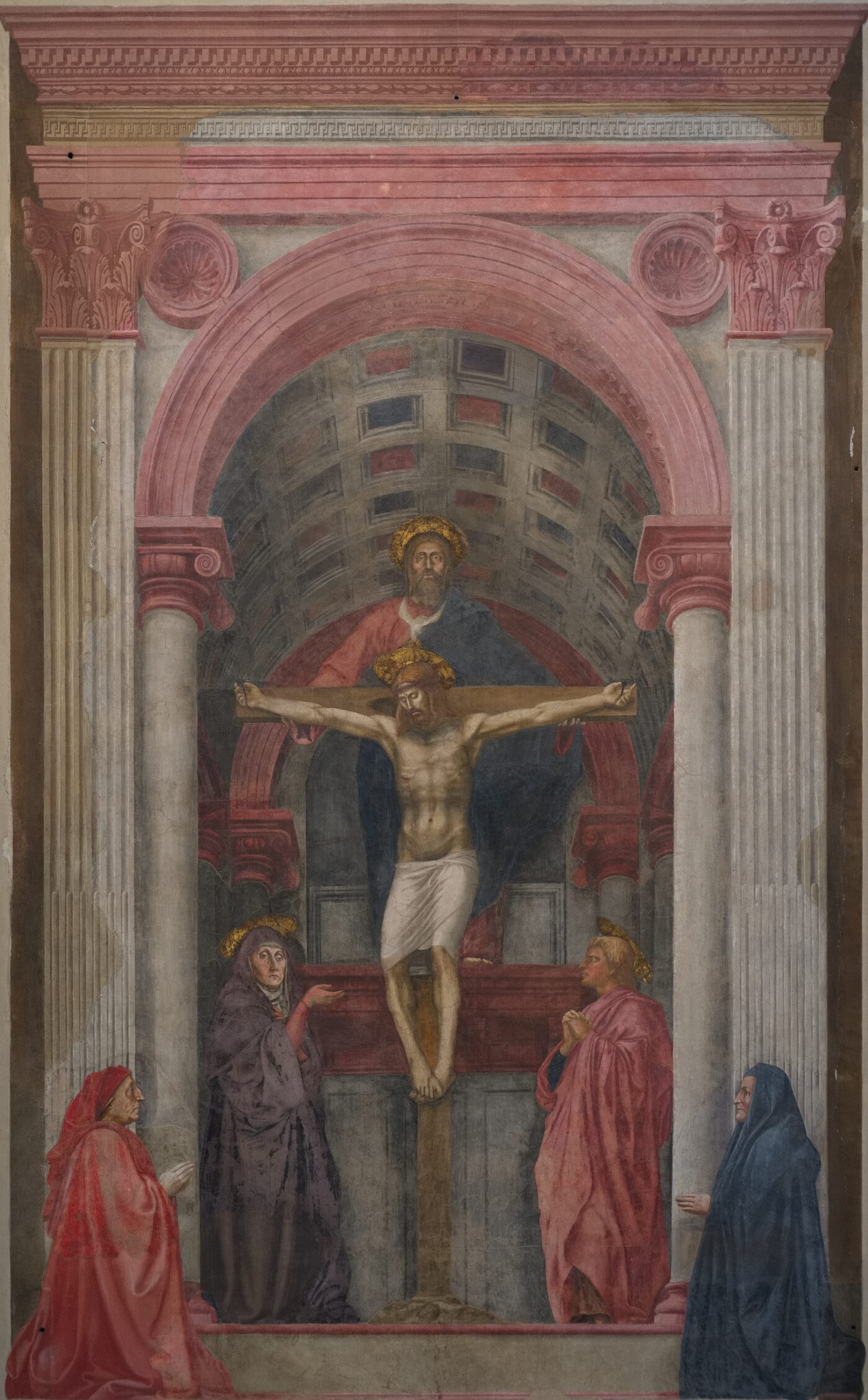
“The Logos is common; but most men live as if they had each a private wisdom.” — Heraclitus, Fragment 2
There is a question prior to all the other questions.
Not “what exists?” — that is already too late. Not “how did things come to be?” — that assumes a framework in which causation is already available. The question prior to all questions is: why is there something structured rather than nothing uniform?
Papers A0 through A7, with their two companions A2½ and A6½, answer that question with the precision it demands and the honesty it requires.
The answer is not simple, but it is exact. The primary assumption is simple enough, and it is only an assumption: that reality can be modeled as a Gelfand triple — a nuclear space dense in a Hilbert space, embedded in a dual that contains everything the nuclear space cannot finitely represent. On that model, the inner product is the constitutive relation that makes the structure possible — what the tradition named the Father; the nuclear space is the principle of articulation through which all H-states are constituted — what the tradition named the Son, the Logos; and finite beings are the Hilbert space vectors, held in the inner product, constituted by the Logos, reaching toward a completion the finite state cannot generate but the structure makes possible.
This is not a metaphor, and it is not figurative. The Gelfand triple is mathematics; the mapping is structural. The claim is precise, and it is conditional: if reality can be modeled as a Gelfand triple, and Φ is defined as exactly this nuclear space, then the structures the mathematics forces and the structures the tradition named — Father, Logos, Spirit — appear to point at the same things. Either that convergence holds or it does not. The argument that it holds is what these eight papers are.
The Foundation earns its name by a discipline of restraint — it holds only what three accounts of reality agree on — the model derived here, the conservative reading of Scripture, and the scientific evidence — run from the forming of the world through the Crucifixion (Paper A6) and across the Resurrection and the age the apostles witnessed (Paper A7). Where the three converge, the matter belongs here; where the Scripture’s reading or the evidence is still unsettled, that is named in place and tiered honestly, never smoothed. The model is held to a stricter standard than the other two: it does not vary. Where the model’s own answer is open, or would seem to diverge, that is not a defect in the foundation but an Open Question (OQ) in the model — flagged plainly and held as exactly that: neither braking (it never halts the foundation or disqualifies what stands on it) nor dismissed (it is not waved away, but kept open for resolution downstream). Every later section rests on this one — on what the model, the Scripture, and the evidence hold in common; where they genuinely diverge, the matter is held for later, not set on the foundation.
Paper A0 establishes the mathematical ground. Paper A1 argues from the undeniable fact of consciousness through the Logos to the identity of the Son and makes the primary identification. Paper A2 turns from the creative act (Paper A0’s GNST) to its result: how the Spirit integrates the Father’s actualizations into one coherent creation — coordinative actualization — and where, within that, the Creative Choice enters. The Constraint Cascade — now read in four parts, A2A through A2D — shows how the descent from Φ into H works mechanically: the algebra and its Author (A2A), the descent into the physical (A2B), where the two books speak (A2C), and the gathering into one voice (A2D) — descent as densification, the incarnation principle as structure rather than event. From here the world’s arc is read three times under three lights. Papers A3, A4, and A5 each carry one lens from the forming of the world to a single birth: Paper A3, the Word made flesh — the world spoken into form and the Word entering it (the mathematician’s and theologian’s lens); Paper A4, the long climb of matter, from the first particles with mass down a single line of descent to a body born in Roman Judea (the place where the scientific reader enters); Paper A5, the story of consciousness and the form it takes in matter — writing, consciousness made legible — carried on the throughline of the Hebrew canon, the longest-kept record of a mind, which holds the oldest account of what a person is: a living soul. The three lenses meet at the birth — the quieter of the two entrances from outside, the smaller of them. Paper A6 then follows the one life that begins there, told not in three views but as a single story — the story of humility itself, the form of God taken into the form of a servant — down to the cry, where the three faces of the death the lenses had set aside meet at the cross. Paper A6½: The Tomb — stands at the sealed tomb and looks at it three ways before admitting the silence it cannot see into: the three days the Gospels do not narrate. And Paper A7 — the Resurrection, the new beginning the descent could not generate from inside — follows the arc to the end of the book, from the empty tomb through Pentecost and the spreading church to the world made new, each scene led by the story and anchored in Scripture before the structure speaks; it holds the morning as testimony rather than proof, and ends by handing the built foundation on as an inheritance — the door into Volume B.
By the end of Paper A7, the framework is built. Everything that follows — the operations, the case studies, the historical reading, the epistemological reckoning — is application and demonstration. But the building comes first. These are the constitutive arguments. They either hold or they don’t. Read them accordingly.
Summary of Contents
Paper A0: Modeling Reality as a Gelfand Triple The Gelfand triple Φ ⊂ H ⊂ Φ′ — a nuclear space of maximum structure, a self-dual Hilbert space of complete states, and a distributional dual of excess potential — and the five actualities the inner product’s own structure forces: the fundamental relation, the nuclear structure, the metric absolute, the nuclear topology, and the realized nuclear space. The inner product ⟨·,·⟩, invariant across all three domains, is the foundational object the standard formalism leaves implicit.
Paper A1: Naming the Unnameable The cogito, and the naming of the Trinity that follows from it: the Father as the inner product ⟨·,·⟩, the Son as the nuclear space Φ — the Logos — the Spirit as the nuclear topology, and the rest of the eight domains, closing on ⟨·,·⟩ = Love. Then the Hebrew Divine Names laid against the structures they fall on — YHWH, Elohim, El Shaddai, El Roi, Ruach Elohim — with the fuller rolls of the names of the Son and of the Spirit.
Paper A2: The Big Bang The scientific case that the universe had a beginning — the recession of the galaxies, the cosmic microwave background, and the abundances of the light elements converging on a hot, dense start 13.8 billion years ago — the physics of the first fraction of a second, and the point where known methods run out; and the close, where that beginning is read as the Creative Choice, the selection of one ordered world out of the distributional potential.
Paper A2A: The Constraint Cascade: The Algebra and Its Author The constitutional algebra Cl(3,0) — forced, not chosen, by what the Trinity is: three generators, positive-definite squaring, associativity; the grade-topology theorem and its two crossings; the Creative Choice (the which*, not the* whether*); the experiential Deity; and the formal definition of Love — closing on the continuity that makes creation, and so Love, a present-tense act.*
Paper A2B: The Constraint Cascade: The Descent into the Physical The descent of the named structure down the constraint hierarchy to the floor of the physical world: the single law requiring three structures (time, gravity, spacetime); the cascade and its doubling; the dimensional, not geographical, hierarchy; the two crossings and the birth of time — e₀² = −1, the Lorentzian signature, the Dirac equation, E = mc², and c as a structural output; and the Friedmann bridge.
Paper A2C: The Constraint Cascade: Where the Two Books Speak One fact read from both sides: aging as entropy and as the wage of the Choice; what a death sorts and what carries a person across; the structural impossibility of an eternal organized domain of suffering — Augustine’s privation made formal; and the reciprocal circuit that turns the lossiness of actualization into fuel rather than waste.
Paper A2D: The Constraint Cascade: One Voice The three — the algebra, the naming, the descent — gathered into one motion: one structure counted two ways; matter as spirit at maximum localization; the economy that does not run down; the two open questions held plainly; and the close.
Paper A3 — Φ Enters Creation From the forming of the world to the threshold of the flesh: the Word speaks the world into form (the first bivector; the three directions of the Good, the True, the Beautiful); the breath makes dust a living soul (the two origins, the dual pairing); the choice and the fall give free will, and the −1 of death; the deliverance out of Egypt gives the first picture of catching; the kingdom, the prophets, and the exile forge courage, temperance, and diligence against resistance; the close of the canon leaves humility — the whole chord — awaited across the long silence; and the announcement says the promise is about to be kept.
Paper A4 — The Ascent of Man The material thread: from the first particles with mass through nucleosynthesis, the stars and the elements, the Earth, the origin of life and the long microbial epoch, the complex cell, the rise of animals, the move onto land, the mammalian and primate lines, to the australopithecine grade and the genus Homo — then past biology, through the peopling of the world and the genealogical line of Israel with its historicity debates named, to one ordinary human body, born in Roman Judea.
Paper A5 — The Breath of Life The waking of an interior — the felt self the sciences of the mind map but cannot reach — and the one thing that interior does that nothing before it could: it leaves itself in matter, in writing. The earliest scripts and the alphabet; the Hebrew canon as the longest-guarded body of consciousness in material form, its transmission measurable across a millennium and its opening word the oldest account of what a person is — a living soul; the modern science of the mind turning its instruments on itself; and, at the end, the Word born a consciousness.
Paper A6: The Son of Man: Maximum Kenosis The life of Christ from the Annunciation to the cry, moment by moment — the Annunciation, the Nativity, the boy in the Temple, the Baptism, the Ministry, the entry into Jerusalem, the Last Supper, the Crucifixion: what the structure makes of each, what the Gospels testify, and what it would have been to stand there in the dust and heat. The cry read as the forming element’s far side, the −1 held and not broken; and a closing physical record of the life’s world — the Pilate Stone, the Caiaphas ossuary, the crucifixion evidence, the pools and the lakeside town.
Paper A6½: The Tomb The three days in the sealed tomb: the bond between the Father and the Son held at its furthest distance and not severed; the body itself, really dead by the same order that carried it up; and the descent among the dead, where the one physical trace the tradition has claimed — the burial cloth — is weighed and left in its honest doubt — all of it closing on the silence the Gospels do not narrate.
Paper A7: The Resurrection: The World Made New The arc from the empty tomb to the new creation — the Resurrection and Mary knowing him by name, the forty days, the Ascension, Pentecost, the witness carried to the nations, the long faithful age, the Return, and the world made new — the glorified body with the decay-generator absent, Pentecost as the nuclear topology opened to all, the consummation as Beginning = End = ⟨·,·⟩. A physical record of the apostolic age, and the one premise never earned — that reality admits this model at all.
Begin the Foundation: Adam A0: An Unexpected Letter →