Paper A2: The Big Bang: When Spacetime Began
The scientific case that the universe had a beginning — the recession of the galaxies, the cosmic microwave background, and the abundances of the light elements converging on a hot, dense start 13.8 billion years ago — the physics of the first fraction of a second, and the point where known methods run out.
Confidence — Math: — (not engaged). Science: concordance — three independent lines (the recession of the galaxies, the cosmic microwave background, the light-element abundances) converging on a hot dense beginning ≈ 13.8 Gyr, to current cosmology. Theology: — (not engaged).
Abstract
The universe was once hot, dense, and far smaller than it is now, and it has been expanding and cooling ever since. That claim is not speculation; it is the convergent reading of three independent bodies of evidence — the recession of the galaxies, the cosmic microwave background, and the cosmic abundances of the light elements — and it places the beginning of the present expansion at 13.8 billion years ago (13.787 ± 0.020 Gyr; Planck Collaboration 2020). This paper reconstructs that beginning as the science now has it: the evidence that there was a beginning at all; the earliest accessible epochs and the Planck wall beyond which general relativity and quantum mechanics, taken together, stop giving answers; the inflationary account of the first instant, which is the leading paradigm and remains observationally unconfirmed; and the present frontier, where the model is under real strain — the Hubble tension hardening into a crisis, hints from large galaxy surveys that the dark energy is not constant, and the surprising brightness of the earliest galaxies. The paper is candid about one thing in particular: modern cosmology does not claim to know what caused the Big Bang, or what, if anything, “before” it could mean. The cause of the beginning is not determined, and is widely held to be not determinable, by current methods.
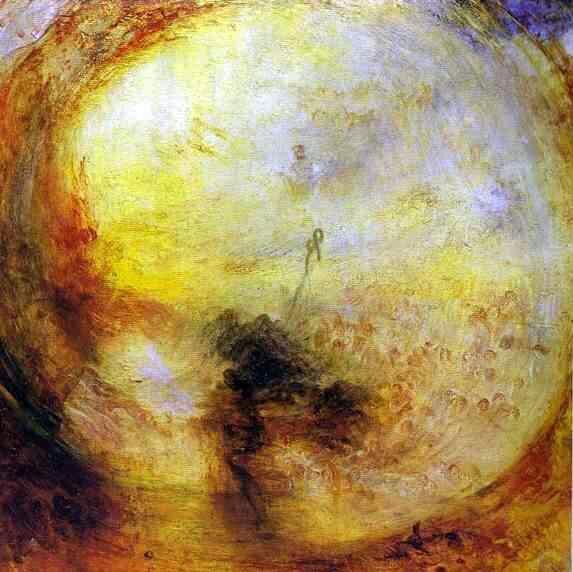
“There was neither non-existence nor existence then; neither the realm of space nor the sky which is beyond. What stirred? Where? In whose protection? … Who really knows? Who will here proclaim it? Whence was it produced? Whence is this creation? The gods came afterwards, with the creation of this universe. Who then knows whence it has arisen?” — Rig Veda X.129 (Nasadiya Sukta)
1. Introduction: that there was a beginning
Nothing in this paper was witnessed, and the earliest part of it was not even illuminated: for its first several hundred thousand years the universe was opaque, and no light from before that time can ever reach an eye. Everything here is reconstruction — inferred from the spectra of distant galaxies, from the faint uniform glow that fills the sky in every direction, and from the precise proportions of the lightest chemical elements. That the reconstruction is possible at all, and that independent lines of evidence agree on the same hot, dense origin and the same age, is among the quieter achievements of the species.
The claim is specific and worth stating carefully, because it is often stated loosely. The Big Bang is not a theory of an explosion in space, set off at a point, scattering matter into a pre-existing void. It is a theory of the expansion of space — the steady increase, everywhere at once, of the distances between things that are not themselves moving — run backwards to a time when those distances were arbitrarily small and the contents arbitrarily hot. Extrapolated far enough, the classical equations reach a moment of formally infinite density and temperature: the initial singularity, conventionally labelled t = 0. Whether that label denotes a real first instant or merely the place where the theory breaks down is the central question of the early universe, and §3 takes it up directly. What the evidence establishes without controversy is the part that comes after: that the universe has a finite age, that it began in a state hot and dense beyond any since, and that it has been expanding and cooling, by understood physics, ever since.
A word on method and confidence. The framework of this paper — general relativity for the expansion, the Standard Model for the contents — is firm, and its quantitative successes are extraordinary. But the subject reaches, at its earliest edge, into regimes where that framework is known to be incomplete, and it touches, at its present frontier, several measurements that do not yet agree. Where the science is settled it is stated plainly; where it is live, the debate is named.
2. The evidence: three independent witnesses to a hot beginning
The hot Big Bang rests on three pillars, discovered decades apart by unrelated methods, which nonetheless converge on one history.
The expansion. In 1929 Edwin Hubble established that distant galaxies recede from us with velocities proportional to their distance — the signature of a uniformly expanding space, anticipated theoretically by Lemaître in 1927. Run backwards, a universe expanding today was denser and hotter yesterday. The expansion is not a local motion through space but a property of the metric itself, and its rate, the Hubble constant, sets the rough timescale of the whole history.
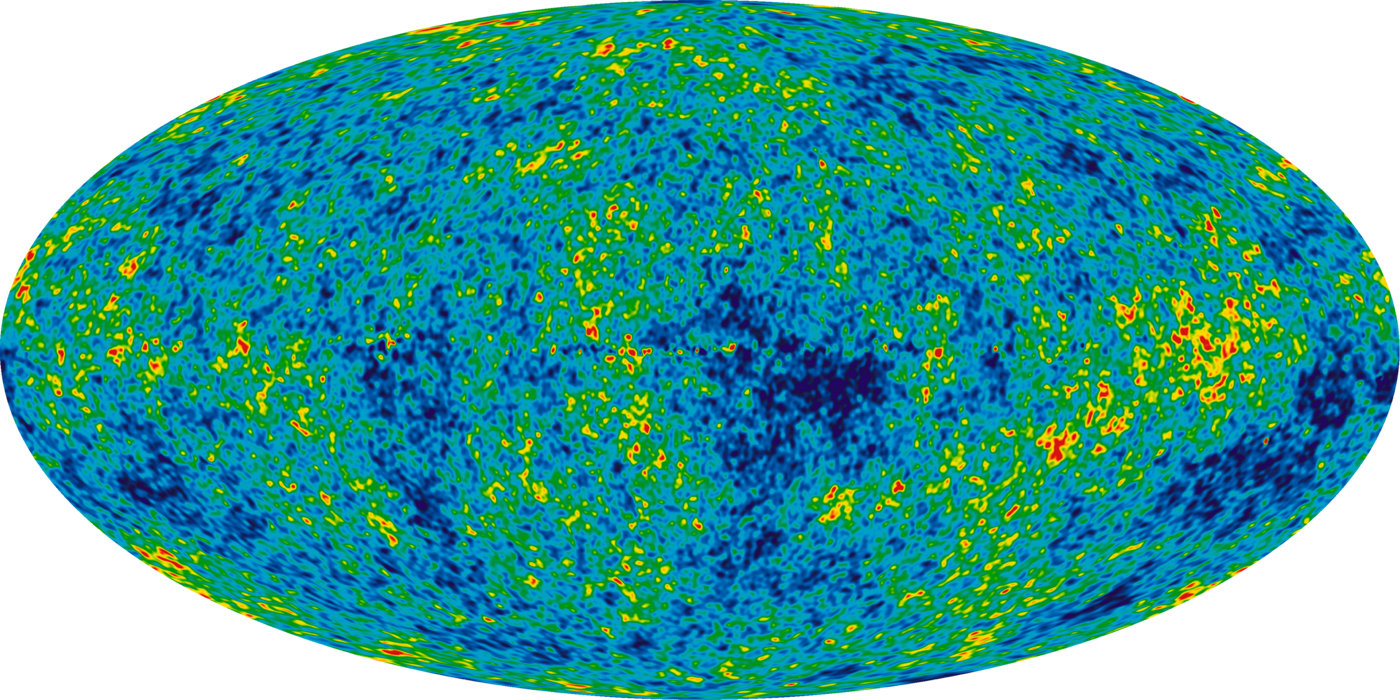
The microwave background. If the early universe was hot and dense, it was also opaque — a plasma in which light could not travel far before scattering off free electrons. As it expanded and cooled below about 3000 K, some 380,000 years in, the electrons and nuclei combined into neutral atoms, the fog lifted, and the light streamed free. That light is still arriving, stretched by the expansion into microwaves: the cosmic microwave background, discovered by Penzias and Wilson in 1965, a near-perfect blackbody at 2.725 K filling the entire sky, uniform to about one part in 100,000 (Hu & Dodelson 2002). It is the oldest light there is, and the most precisely characterized object in cosmology; the pattern of its faint fluctuations fixes the geometry of the universe as spatially flat and measures its composition to the percent.
The light elements. In the first few minutes, while the universe was a cooling nuclear furnace at a billion kelvin, protons and neutrons fused into the lightest nuclei — about 25% helium-4 by mass, with traces of deuterium, helium-3, and lithium-7, and essentially nothing heavier, because no stable nucleus of mass 5 or 8 exists to bridge the gap. This Big Bang Nucleosynthesis is among the great quantitative triumphs of the field: given the single baryon density that the microwave background measures independently, the predicted abundances follow with no free parameters, and the deuterium prediction matches the sky to about a percent (Fields et al. 2020). One crack persists — the predicted lithium-7 is about three times the amount seen in the oldest stars, the unresolved lithium problem (Fields 2011), now generally suspected to be a matter of lithium destruction inside those stars rather than a flaw in the cosmology, though it is not formally closed.
Three witnesses, three methods, one verdict: the universe had a hot, dense beginning, and it is old, and the broad sequence of what happened afterward is understood. The disputes begin at the two edges — the very first instant, and the present-day precision frontier.
3. The first fraction of a second, and the wall
The further back the clock is run, the hotter and denser the universe, and the higher the energy of its typical particle — which means the early universe is a record readable only to the extent that physics knows how matter behaves at those energies. For most of the first second this is well-charted territory, tested in part against particle accelerators. But there is a hard limit.
At about 10⁻⁴³ seconds — the Planck time — the energy density is such that the quantum uncertainty of spacetime geometry itself becomes large. Here the two great theories that govern everything else, general relativity (which describes gravity and the shape of spacetime) and quantum mechanics (which describes matter at small scales), give contradictory and uncontrolled answers, because no working theory unites them. This is the Planck epoch, and it is a wall, not a vista. Candidate theories of quantum gravity — string theory, loop quantum gravity, and others — propose what may lie behind it, and some replace the singularity with a smooth high-but-finite-density transition or a “bounce,” but none is established or tested (Ashtekar; and reviews of the Planck regime, 2013–2024).
This bears directly on the meaning of t = 0. The classical singularity theorems of Penrose and Hawking (1965–1970) prove that, under general relativity and reasonable assumptions, an expanding universe must have a singularity in its past. But a singularity in a physical theory is standardly read as the theory announcing its own breakdown — the place where its variables run off to infinity and it ceases to describe anything — not as a literal physical event the theory has successfully predicted. So the honest statement is double. The evidence for a hot, dense, finite-age beginning is overwhelming. The claim that there was a first instant of infinite density, an absolute t = 0, is not established; it is the extrapolation of a theory past the point where that theory is known to fail. What actually happened in the first 10⁻⁴³ seconds is, at present, unknown, and may be unknowable with current methods. We will return to the weight of that sentence.
4. Inflation: the leading account, still unconfirmed
Between the Planck wall and the well-charted first second sits the early universe’s most consequential idea. The microwave background poses three puzzles for a plain hot Big Bang. It is too uniform: regions on opposite sides of the sky, which on the plain model were never in causal contact, nonetheless share the same temperature to one part in 100,000 (the horizon problem). The geometry is too flat: spatial flatness is an unstable condition that should have run away from itself unless the initial conditions were fantastically fine-tuned (the flatness problem). And certain relics that grand-unified physics predicts in abundance, such as magnetic monopoles, are nowhere seen (the monopole problem).
Cosmic inflation, proposed by Guth in 1981 and developed by Linde, Albrecht, and Steinhardt, resolves all three at once with a single move: a brief episode, somewhere around 10⁻³⁶ to 10⁻³² seconds, in which the universe expanded exponentially, by a factor of perhaps 10²⁶, driven by the energy of a scalar field. A patch far smaller than a causal horizon is stretched to encompass everything we can see (uniformity), driven flat by the sheer expansion (flatness), and diluted of any prior relics (no monopoles). Better still, inflation supplies what the plain model lacked — an origin for structure: quantum fluctuations in the inflating field, stretched to cosmic scale, become the faint density variations imprinted on the microwave background and later pulled by gravity into galaxies. The statistical pattern inflation predicts for those fluctuations — very nearly but not exactly scale-invariant — matches the observed background remarkably well, and the measured slight tilt (the spectral index, near 0.965) is counted among its successes (Planck inflation constraints, 2018).
It must be said plainly that inflation is the leading paradigm and not a confirmed fact. Its sharpest prediction — a background of primordial gravitational waves that would leave a distinctive swirl, a “B-mode” pattern, in the polarization of the microwave background — has not been detected. The premature 2014 BICEP2 announcement of such a signal proved to be polarized dust in our own galaxy; current data (BICEP/Keck through 2025) constrain the signal tightly and show at most a marginal, roughly 2σ hint, which is not a detection. Inflation is also a framework of many models rather than one theory, and in most versions it is eternal once begun, raising questions about what it predicts at all. It is believed because it explains several otherwise unrelated facts with one mechanism and has passed the tests so far available; it is not believed to be proven. The decisive experiments — next-generation B-mode searches — are in progress.
5. The hot Big Bang to the Higgs vacuum: the physical universe as we know it
Whatever happened at the very start, inflation (if it occurred) ended in reheating: the energy of the inflating field decayed into a hot bath of particles, and the universe entered the hot, expanding, radiation-dominated state that the three witnesses of §2 record directly. From here the sequence is comparatively well understood. The quark–gluon plasma cooled; near 10⁻⁶ seconds quarks became permanently confined into protons and neutrons. One fact from this era is the ground of everything after it: a tiny surplus of matter over antimatter — about one part in a billion — survived the mutual annihilation, and everything that now exists is built from that residue. Its origin, baryogenesis, is genuinely unsolved.
The defining event of this stretch — the one that turns a hot bath of massless particles into the world of matter we recognize — comes near 10⁻¹² seconds, at a temperature around 160 GeV. Before it, the electroweak symmetry (SU(2)_L × U(1)_Y) is unbroken and every particle is massless: the spectrum is a gapless continuum, no rest masses, no thresholds. Then the Higgs field acquires a nonzero vacuum value. Its potential is a “Mexican hat” — an unstable maximum at the symmetric point, a ring of true minima around it — and the field rolls off the maximum to settle at a definite magnitude, v ≈ 246 GeV. With that settling, the particles that couple to the field acquire mass: the W and Z bosons through their gauge coupling to the vacuum value, the quarks and leptons through their Yukawa couplings, each fermion’s mass fixed by how strongly it couples. The gapless continuum becomes a structured spectrum of definite rest energies — the mass spectrum of the Standard Model.
One particle does not acquire mass. The photon is the gauge boson of the combination of symmetries the Higgs vacuum leaves unbroken — electromagnetism, U(1)_EM, survives the breaking — so it has nothing to couple to and stays massless: the carrier of the electromagnetic field, the connective structure of the entire later universe, released into a world of newly massive matter as the one thing the symmetry-breaking cannot weigh down.
After this, the universe is recognizable. There is matter with mass; there are the four forces — gravity, electromagnetism, the strong and weak nuclear interactions — in their distinct strengths; there is light. Nucleosynthesis (§2), recombination, the first stars and galaxies, the forging of carbon and the heavier elements, and at length the Earth and life all follow from this substrate by understood physics — the long material story that unfolds from exactly this point. This is where the chronological account of the present paper ends: at the Higgs vacuum, the electroweak crossover that confers mass and leaves the universe the physical world we actually inhabit.
The bridge from the first instant to this familiar world is, after inflation, continuous and lawful. The mystery, as the next sections take up, is concentrated not here at the end but at the start.
6. The frontier: where the standard model of cosmology is under strain
It would be false to present modern cosmology as a closed book. The standard model — six numbers, a flat universe of ordinary matter, cold dark matter, and a constant dark energy (ΛCDM) — fits an enormous range of data with six parameters, which is a real triumph. But as the measurements have sharpened, three strains have appeared, and they are worth naming because honesty about them is part of the scientific stance this paper adopts.
The Hubble tension. The expansion rate measured locally — from Cepheid-calibrated supernovae in the nearby universe — comes out near 73 km/s/Mpc. The rate inferred from the microwave background under ΛCDM comes out near 67. The gap is now about five sigma and has, through 2024–2025, been deepened rather than dissolved: the James Webb Space Telescope confirmed the local Cepheid distances at high confidence, ruling out the most obvious measurement error (crowding) and leaving a genuine discrepancy that some now call a Hubble crisis (Riess et al. 2024; status reports through 2025). It is not yet known whether the resolution is an unrecognized systematic or new physics; the independent map from the Euclid mission, expected to weigh in from 2026, is awaited.
Dark energy that may not be constant. The Dark Energy Spectroscopic Instrument’s second data release (DESI DR2, 2025), combined with supernova samples, prefers an evolving dark energy over a true cosmological constant at up to about 4σ — a direct challenge to the Λ of ΛCDM. The preference depends on which supernova sample is used and is actively contested; it may yet be a systematic. But it is a serious crack in the simplest model, and it concerns the very energy that dominates the universe’s present and future.
The early galaxies. The James Webb Space Telescope has found galaxies in the first few hundred million years that are brighter, more massive, and more numerous than pre-launch models predicted (and has spectroscopically confirmed galaxies within ~280 million years of the beginning). The mainstream reading is unusually efficient early star formation rather than a failure of the cosmology; whether it is more than that is, as of this writing, openly debated.
None of these unsettles the central result — the hot, expanding, 13.8-billion-year beginning — but each is a reminder that the model is an approximation under active revision, and that the universe’s largest-scale story is not finished being written.
7. The limit of method
Every account in §§1–6 is physics, and the reader who wishes to stop there should stop there; nothing above requires anything below. But it is worth being precise about exactly where physics stops, because the place is sharper than is usually admitted.
Cosmology does not explain the beginning so much as it describes the universe given a beginning. Several things are, in the standard account, not derived but assumed — taken as brute inputs from which everything else follows:
- That there was an initial state at all, and that the laws of physics applied to it. Physics describes how a system evolves; it does not, and by its form cannot, explain why there is a system to evolve, or why there are laws.
- The initial conditions, and in particular the extraordinarily low entropy of the early universe — the single most fine-tuned fact in all of physics, the precondition for there being any ordered history at all, and itself unexplained.
- The cause of the beginning. As §3 established, what lies at or behind t = 0 is beyond the reach of current theory. Some physicists go further and argue that because the Planck epoch is a regime where causal order itself dissolves, the question “what caused the Big Bang?” may have no answer even in principle — the first event would then be, in the strict sense, uncaused.
This is not a defect peculiar to cosmology; it is the form of every physical theory, which takes some starting point as given and explains the rest in terms of it. But it is worth saying without euphemism: at its foundation, the scientific account of the universe rests on givens it does not derive — an initial state, a set of laws, an improbable order, and a beginning whose cause it cannot reach. Physics takes these as given because its method requires a starting point; why there is an ordered universe to describe at all is not a question its instruments can reach.
“We may speak of this event as of a beginning. I do not say a creation. … Standing on a well-chilled cinder, we see the slow fading of the suns, and we try to recall the vanished brilliance of the origin of the worlds.” — Georges Lemaître, The Primeval Atom (1946)
8. Conclusion
The universe had a beginning, hot and dense and finite in the past, and the fact of it is established beyond serious doubt by three independent witnesses. The first fraction of a second is partly charted and, at its earliest edge, walled off by the absence of a theory of quantum gravity. The first instant itself — its cause, its conditions, whether “before” it means anything — lies past where current methods can go, and physics says so. The account is offered whole, and it ends where the methods end.
“Science can explain the workings of the cosmos, but not the fact of its existence.” — Paul Davies, The Mind of God
References
-
Planck Collaboration (2020). “Planck 2018 results. VI. Cosmological parameters.” Astronomy & Astrophysics, 641, A6. [Age 13.787 ± 0.020 Gyr; spatial flatness; the six-parameter ΛCDM model.]
-
Hubble, E. (1929). “A relation between distance and radial velocity among extra-galactic nebulae.” PNAS, 15(3), 168–173. [The expansion of space.] See also Lemaître, G. (1927), Annales de la Société Scientifique de Bruxelles, A47, 49.
-
Penzias, A.A., and Wilson, R.W. (1965). “A Measurement of Excess Antenna Temperature at 4080 Mc/s.” Astrophysical Journal, 142, 419–421. [Discovery of the cosmic microwave background.]
-
Hu, W., and Dodelson, S. (2002). “Cosmic Microwave Background Anisotropies.” Annual Review of Astronomy and Astrophysics, 40, 171–216.
-
Fields, B.D., et al. (2020). “Big-Bang Nucleosynthesis after Planck.” JCAP, 03, 010. See also Fields, B.D. (2011), “The Primordial Lithium Problem,” Annual Review of Nuclear and Particle Science, 61, 47–68.
-
Penrose, R. (1965). “Gravitational Collapse and Space-Time Singularities.” Physical Review Letters, 14, 57. Hawking, S.W., and Penrose, R. (1970). “The Singularities of Gravitational Collapse and Cosmology.” Proc. R. Soc. Lond. A, 314, 529. [The classical singularity theorems.]
-
Guth, A.H. (1981). “Inflationary universe: A possible solution to the horizon and flatness problems.” Physical Review D, 23, 347. Linde, A. (1982); Albrecht, A., and Steinhardt, P.J. (1982). [The inflationary paradigm.]
-
BICEP/Keck Collaboration (2021–2025). Constraints on primordial gravitational waves / the tensor-to-scalar ratio from CMB B-mode polarization. [No confirmed primordial B-mode detection; at most a marginal hint.]
-
DESI Collaboration (2025). “DESI DR2 Results: Baryon Acoustic Oscillations and Cosmological Constraints.” [Preference for evolving dark energy over a cosmological constant, sample-dependent and contested.]
-
Riess, A.G., et al. (2024). JWST observations confirming the local Cepheid distance scale and the persistence of the Hubble tension. [The tension deepened, not resolved.]
-
Ashtekar, A., et al. Loop quantum cosmology and the Planck regime; reviews of the resolution of the cosmological singularity in candidate quantum-gravity frameworks (2013–2024). [Speculative; none established.]
-
Lemaître, G. (1946). The Primeval Atom: An Essay on Cosmogony. [The originator of the expanding-universe beginning, cautioning against conflating the physical beginning with creation.]