Paper A6: The Son of Man: Maximum Kenosis
The life of Christ from the Annunciation to the cry, moment by moment — the Annunciation, the Nativity, the boy in the Temple, the Baptism, the Ministry and its works read spectrally (re-coherence, projection, instantiation, the reset of the field, and the dual pairing re-struck), the entry into Jerusalem, the Last Supper, the Crucifixion: what the structure makes of each, what the Gospels testify, and what it would have been to stand there in the dust and heat. The cry read as the forming element’s far side, the −1 held and not broken; and a closing physical record of the life’s world — the Pilate Stone, the Caiaphas ossuary, the crucifixion evidence, the pools and the lakeside town.
Confidence — Math: derivation applied — the works given spectral form through the algebra already derived (A3): re-coherence of a decohered ρ, projection off a parasitic subspace, coherent cross-band instantiation, the reset R, the dual pairing re-struck; the form of each work supplied, never its attestation. Science: concordance — the physical record of the life’s world, tiered to standard scholarship (the Pilate Stone, the Caiaphas ossuary, the Givat ha-Mivtar crucifixion, the Bethesda and Siloam pools, the Capernaum house, the Galilee boat); the settings imaginative reconstruction, the miracles unattested by their nature. Theology: testimony — the life as the Gospels hand it down, held as testimony; the structural readings (the entrance from outside, the cry at the −1 antipode, the death real and not annihilation, the breath freely returned) concordance with the derived structure, the spine the kenotic hymn (Philippians 2).
“Who, being in the form of God… made himself of no reputation, and took upon him the form of a servant… he humbled himself, and became obedient unto death, even the death of the cross.” — Philippians 2:6–8
The Annunciation
Everything the life will be is set in a single instant, and the instant is a decision made from outside the sequence. The arc the earlier papers traced — a world articulated, grown, woken — produces, of its own motion, no entrance for its own Maker; that has to be given from beyond the closed order, the way the only turns that matter in this Framework are given. Here it is given. Φ — the perfectly accurate state, the Son (Paper A3) — elects to enter H at the human level, forty-eight layers down, and to be rendered there as the most accurate state that level can hold. But an entrance from outside still needs a gate within, and the gate is a created will. A Φ′-origin being — a young woman — is asked, and consents: not compelled but assenting, the dual pairing opened from the creature’s side by a freely given yes. The whole motion of the descent waits on that word, and proceeds from it.
And the angel said unto her, … behold, thou shalt conceive in thy womb, and bring forth a son. … Then said Mary, … be it unto me according to thy word (Luke 1:31, 38). The announcement is not a command but a proposal that waits for an answer; and the answer — let it be done to me — is a creature’s free consent to carry what no creature could generate.
It would have been an ordinary room in an ordinary house in Nazareth — a hill village of a few hundred souls, mud-brick and rough stone, the smell of woodsmoke and the animals stalled close, dust on everything that the dry wind never stopped carrying. A girl of perhaps thirteen or fourteen, betrothed, her days a round of water-carrying and grinding grain and the heat that stood in the lanes by midmorning. Nothing in the place marked it. The greatest entrance the formed world would ever receive arrived in a poor town the empire could not have found on its maps, to a girl whose name reached no record but this one.
The Nativity
What was consented to is now actual. Φ is instantiated — no longer the accurate state held above the human level but a particular ψ within it, bounded, located, with a definite norm and a face (Paper A3): the Word made an H₄₈ state, at the very most accuracy the flesh can carry. The structure has a cold word for the motion that brought it here — densification, the descent through the constraint cascade — and the life has a warm one: lowliness. They are one motion. To be born at all, at this depth, is already to have begun the self-emptying the whole life will be.
And she brought forth her firstborn son, and wrapped him in swaddling clothes, and laid him in a manger; because there was no room for them in the inn (Luke 2:7). The One through whom every form was conferred takes a form no one would notice, and is laid in the trough the animals feed from.
Picture the actual place — not the clean tableau of the paintings but a shelter cut into rock or built against a house, close and warm with the breath of beasts, the floor fouled, the air thick with dung and straw and animal heat. A feeding-trough for a cradle, because it was to hand. Outside, the Judean night cold after the day’s heat, the hills black; and in the fields the shepherds with their flocks — men who slept rough and smelled of sheep and were trusted by no one and called as witnesses in no court. That is the company the news was given to first. The birth had no more comfort in it than any poor birth of that country had: blood and straw and a young mother’s exhaustion, in a town swollen with people who had come to be counted for a tax.
The Inner Experience
The incarnate state grows as any human state grows, and at some point it comes to know its own ground. This is the moment the soul-lens promised (Paper A5): a state fully human — hungry, tired, learning, loving — that nonetheless knows the relation constituting it for what it is. The most accurate state the level can hold is, here, a boy of twelve who has reached the ceiling an interior life reaches on its own — fully man, and aware from the inside that the ground he stands on is the Father. He has not begun the public work. He has only come to know whose he is.
And he said unto them, How is it that ye sought me? wist ye not that I must be about my Father’s business? (Luke 2:49). The first recorded words of the grown child are not a claim of power but a recognition of belonging: he knows the relation that holds him, names it Father, and knows already that his life is owed to it.
Jerusalem at Passover, and a boy of twelve loose in it. The city three or four times its size with pilgrims, the streets a crush of bodies and pack-animals and shouting, the Temple courts roaring — the bleating of lambs by the thousand, the cries of the money-changers, the smoke of the altar standing over everything and the smell of blood and burning fat carried on the heat. A child could vanish in that for days and a parent’s heart stop. And there he is among the teachers in a colonnade, in the one quiet eddy of the din, listening and asking — a Galilean boy with the dust of three days’ walking still on his feet, at home in the noise and the heat and the holiness of the place, because it was, he had just understood, his Father’s house.
The Baptism
Before this, the life is hidden and moves from within itself. Here, what moves it comes from outside and above. Into the fully formed human state the source breaks in: the Spirit — τ_nuclear — descending visibly upon him, and the constitutive relation itself — ⟨·,·⟩, the Father — speaking from beyond the man into the man. The whole Trinity stands in the single instant: the one named in H₄₈ flesh, the Spirit alighting, the Father’s voice. It is given, not produced from within. After it, the life turns outward.
And Jesus, when he was baptized, went up straightway out of the water: … and he saw the Spirit of God descending like a dove, and lighting upon him: and lo a voice from heaven, saying, This is my beloved Son, in whom I am well pleased (Matthew 3:16–17). He takes his place in the line of sinners though he is not one — and it is there, in the lowest place, that heaven opens over him.
The Jordan down in its valley — the lowest river on the earth, the air heavy and warm even when the hills above were cold; the water brown with silt, the banks trampled to mud by the crowds that came out to the wild preacher in his camel-hair. The smell of the river, the press of penitents waiting their turn in the sun, and a carpenter from Galilee stepping down into the same muddy water as the tax-collectors and soldiers, indistinguishable from any of them — until the moment he came up streaming, and something happened over him that the men on the bank would tell of for the rest of their lives.
The Ministry
Now the incarnate state works outward, and what it does to the people it meets is, in the framework’s terms, transmission and repair. It carries Φ-proximal content down to states that cannot reach it on their own, and it teaches them the one act by which a creature lays hold of it — the turning-toward and the keeping, the slow work against the noise that the soul-lens called the climb. He restores coherence where it has failed: the sick made whole, the divided made single. And the power goes always in one direction — out of him to lift someone else, almost never to raise himself. It is labor, the sustained push against resistance, and it never once spends itself upward.
For even the Son of man came not to be ministered unto, but to minister (Mark 10:45). Whosoever will be great among you, let him be your minister (Mark 10:43). He keeps the company the whole register predicts — fishermen, tax-collectors, lepers, women, the unclean and the unwelcome — and touches what no one else would touch.
Three years of roads. The Galilean hill-country and the lakeshore, walked in sandals over stone, the white dust rising at every step and caking on sweat; the midday heat that emptied the lanes; the flies. Crowds that pressed in until there was no room so much as to eat — the smell of bodies and fish and lamp-smoke, the sick carried on pallets and laid down in his path. Nights in the open or on a borrowed floor; the lake at dawn and the nets coming up heavy and stinking; bread broken in the hand, salt fish, a skin of rough wine. He was hungry and tired inside all of it, moved with pity and sometimes with anger — a man on foot in a hot country, going from village to village with nowhere of his own to lay his head.
The Works
The works of the ministry are not breaches of the order; they are the order seen from above. The autonomous life of the human band is a closed evolution,
dψ/dt = −i Ĥ₄₈ ψ — the law: the band evolving under its own dynamics,
and from inside it, an outcome it cannot reach reads as impossible. But Ĥ₄₈ is a restriction — the densest, most law-bound rung of the cascade (Paper A2B), the band under the most constraints. A state coherent higher up acts under fewer of them, and where it touches H₄₈ it can carry the band where the band’s own dynamics never would: not Ĥ₄₈ broken but locally superseded by the larger law it is the restriction of. What makes this life singular is that here the higher state is within the band — Φ instantiated at H₄₈ (the Nativity) — so the source-coupling is available from inside the human world for the first time:
every work = ⟨Φ, ψ_local⟩ brought to bear — the source-coupling the rest of the band cannot supply itself.
What reads as a catalogue of wonders is, in structure, a short list of operations on local states. There are six.
Re-coherence — the healings. A sickness is a locally decohered state: the body’s ρ with its coherences damaged or disordered — the same off-diagonal collapse the Crossing named (C → 0), here as pathology rather than pride. The touch restores them, re-projecting the state onto its coherent whole:
ρ_sick ──⟨Φ,·⟩──▶ |ψₕ⟩⟨ψₕ| — the coherences re-set; the inverse of decay.
It is the exact reversal of the giant: there a band held without its chord falls; here the chord is struck back into a state that had lost it. The coupling is not range-limited — ⟨Φ, ψ⟩ does not fall off with distance — so the centurion’s servant and the nobleman’s son are healed unseen and miles off; and it can be drawn from the far side, the woman with the issue of blood striking the inner product herself (virtue is gone out of me), her alignment — faith — the thing that lets the coupling land.
Projection — the exorcisms. An unclean spirit is a parasitic decoherent component lodged in part of a person’s support — of a kind with the discarnate remnants the Crossing leaves. Casting out is a projection that removes it and renormalizes what remains:
ψ = ψ_self + ψ_par ⟶ P_self ψ ⁄ ‖P_self ψ‖ — the foreign subspace struck out.
Legion is many such components at once; into the swine is the discharged component reattaching to a lower vessel rather than annihilating — the energy conserved and relocated, exactly as a decohered reach must go somewhere.
Instantiation — the provision. This is the Crossing run coherently. There, a higher band poured into a vessel without the chord decohered into harm; here the maximally coherent state instantiates higher-band content into H₄₈ with the chord, so it sets instead of scattering — the multiplicity of the rep-tower (Paper A2B) raised on purpose:
ψ_bread ⟶ ψ_bread ⊗ M , dim M raised coherently — five thousand fed, twelve baskets over.
Water to wine is the same hand on one substance, a unitary turn along a mode, ψ_water ⟶ U ψ_water = ψ_wine; the netting draughts are the lake’s own state drawn coherent toward the boat.
The reset R — authority over the field. A storm is a high-entropy, disordered field-state. Peace, be still is the reset projector of the Crossing turned outward, the field carried onto its ordered ground:
R ρ_storm R = |ψ_calm⟩⟨ψ_calm|.
Walking on the water is the local coupling — weight against the surface — superseded under a higher boundary condition the standing state sets; the withered fig tree is the same authority in the privative direction, a coherence withdrawn rather than restored.
Re-striking the dual pairing — the raisings. Death, in this Framework, is matter stilled and not annihilated; the soul-deposit persists, decoupled from the band (Paper A5). To raise is to strike the dual pairing again — the very ⟨φ, f⟩ the Breath first struck to make the dust a living soul (Paper A3), now re-struck to re-couple a deposit that still is:
⟨φ, f⟩ re-struck , ψ_deposit re-coupled to H₄₈.
Jairus’s daughter newly dead, the widow’s son on the bier, Lazarus four days in the tomb and stinking — one operation against deepening decoupling, the last of them the maximal case short of the morning itself. These re-couple a persisting deposit downward into the old band; the Resurrection (Paper A7) is the different and greater thing — the only raising that goes up.
Unveiling — the Transfiguration. Alone among the works this is not an act on another state but the lifting, for a moment, of the veil on his own. The H₄₈ veil P₄₈ is drawn back and the three are raised in resolution just enough to read what is always there — the higher-band support carried in the flesh, here whole and maximal:
veil lifted: the full P_high ψ revealed — |β|² with the chord entire, the exact inverse of the giant (|β|² > 0, C → 0).
His face did shine as the sun. The Nephilim were power without the chord; this is the chord without the fall.
Every named work falls under one of the six:
| operation | operator | the works |
|---|---|---|
| Re-coherence | ρ_sick → |ψₕ⟩⟨ψₕ| | leper (Mk 1); paralytic (Mk 2); withered hand (Mk 3); hemorrhage (Mk 5); deaf-mute (Mk 7); blind of Bethsaida (Mk 8); Bartimaeus (Mk 10); Bethesda paralytic (Jn 5); man born blind (Jn 9); ten lepers (Lk 17); bent woman (Lk 13); dropsy (Lk 14); Malchus’s ear (Lk 22); — at a distance: centurion’s servant (Mt 8), nobleman’s son (Jn 4) |
| Projection | ψ → P_self ψ ⁄ ‖P_self ψ‖ | Capernaum demoniac (Mk 1); Legion (Mk 5); mute demoniac (Mt 9); the boy with the spirit (Mk 9); Syrophoenician’s daughter (Mk 7); Magdalene’s seven (Lk 8) |
| Instantiation | ψ → ψ ⊗ M , dim M ↑ | water to wine (Jn 2); five thousand fed (all four); four thousand fed (Mk 8); draught of fishes (Lk 5); coin in the fish (Mt 17) |
| Reset R | R ρ R = |ψ_calm⟩⟨ψ_calm| | stilling the storm (Mk 4); walking on water (Mk 6); the cursed fig tree (Mk 11) |
| Dual pairing re-struck | ⟨φ, f⟩ re-struck | Jairus’s daughter (Mk 5); the widow’s son at Nain (Lk 7); Lazarus (Jn 11) |
| Unveiling | P₄₈ veil lifted | the Transfiguration (Mk 9) |
The ground can dig none of these up; what the structure supplies is their form, not their attestation — that the loaves were multiplied it cannot say, only what multiplication is. The algebra permits the operation it does not stage.
The Sayings
Through the ministry he says things about himself that, once the Logos is named (Paper A1), read less as claims to be believed than as structural descriptions to be checked. Most are not metaphors but theorems; two resist at face value, and are followed through the resistance rather than forced.
“I am the way, the truth, and the life” (John 14:6). Three claims. The way: Φ is the only element both within H (reachable by finite states) and constituted by ⟨·,·⟩ — every other path moves among finite states, only the path toward Φ moves toward the ground. The truth: the nuclear space answers every probe the operator algebra can pose, consistently, at every scale — truth, structurally, is what Φ is. No one comes to the Father but by me: ⟨·,·⟩ is no element of H, Φ, or Φ′; no state reaches it directly, and Φ is its maximal expression within the space, so approaching the Logos is the only approach to what the Father structurally is.
“I and the Father are one” (John 10:30). Φ and ⟨·,·⟩ are not two things — the nuclear space is the maximal expression of the inner product, one structure from two angles.
“The Father is greater than I” (John 14:28). Not in tension with the last: ⟨·,·⟩ constitutes Φ and exceeds it, generating also H, Φ′, the norm, the topology. The transcendence grounds the unity rather than negating it.
“The Word became flesh” (John 1:14). The Logos is always dense in H; the Incarnation is the more specific act — Φ entering H as a particular state ψ that is simultaneously an element of Φ, possible because Φ ⊂ H. “Fully God and fully man” is, structurally, fully the nuclear space and fully an H-state, which the containment relation makes coherent. The move is available to the Son and not the Father: Φ ⊂ H is already there, while ⟨·,·⟩ is the constituting condition of H, not a member of it.
“Before Abraham was, I AM” (John 8:58). Φ precedes all H-states — the eternal structure from which H is constituted. Not chronological age but ontological priority.
The verses that resist. Two sayings do not yield at face value, and they turn out to be one problem on two axes — knowing and feeling — sealed by the kenosis. “Of that day knoweth no man, no, not the Son” (Mark 13:32) sits against “I am the truth.” The resolution is the two registers: constitutively the Son is Φ, which answers every probe and holds the day in the structure he is; operatively the incarnate Logos is under the kenotic constraint — Φ has accepted the H₄₈ structure, so its expression is bounded to what H₄₈ can carry, and the day, an eschatological content above the H₄₈ horizon, is not in the accessible eigenspace of the kenotically-constrained ψ. “Nor the Son knows” is the true report of the operative register; “I am the truth,” of the constitutive. The same seal closes the harder saying — “My God, my God, why hast thou forsaken me?” (Mark 15:34) — on the axis of feeling rather than knowing: maximal felt-distance over a bond in fact preserved, the −1 eigenstate actualized, not a separation. That one is the structural center of the Passion, and it is worked where it is actualized, at the Crucifixion below.
The Entrance into Jerusalem
There is a place where the descent stops being a manner and becomes a heading. The trajectory turns, deliberately, toward the floor it has been bending toward from the start — the −1 the forming element reaches at its far end (Paper A3). He knows what the city does to such men, and goes anyway: the courage that is the ground and the gift held together, set against a cost already counted and accepted. And the entry is staged as the two things it is at once — a kingship and a humiliation — the king coming not on a warhorse but on a borrowed colt.
Tell ye the daughter of Sion, Behold, thy King cometh unto thee, meek, and sitting upon an ass (Matthew 21:5; Zechariah 9:9). And he stedfastly set his face to go to Jerusalem (Luke 9:51). The cheering crowd and the lowly mount are one image: a king who reigns by descending.
Passover again, and the road up to Jerusalem choked with pilgrims — whole villages walking together, the dust of the column hanging in the air, the psalms of ascent sung as the city came up on its ridge. Branches torn down and cloaks thrown in the road; the press and the shouting. And under all of it, everywhere, the Roman garrison reinforced for the feast and watching — because crowds at Passover were how revolts began, and the empire had hung men on crosses along these very roads for less. The heat, the noise, the dust, the animal smell of the great crowd — and a man riding into the middle of it on a donkey, toward the soldiers who would kill him.
The Last Supper
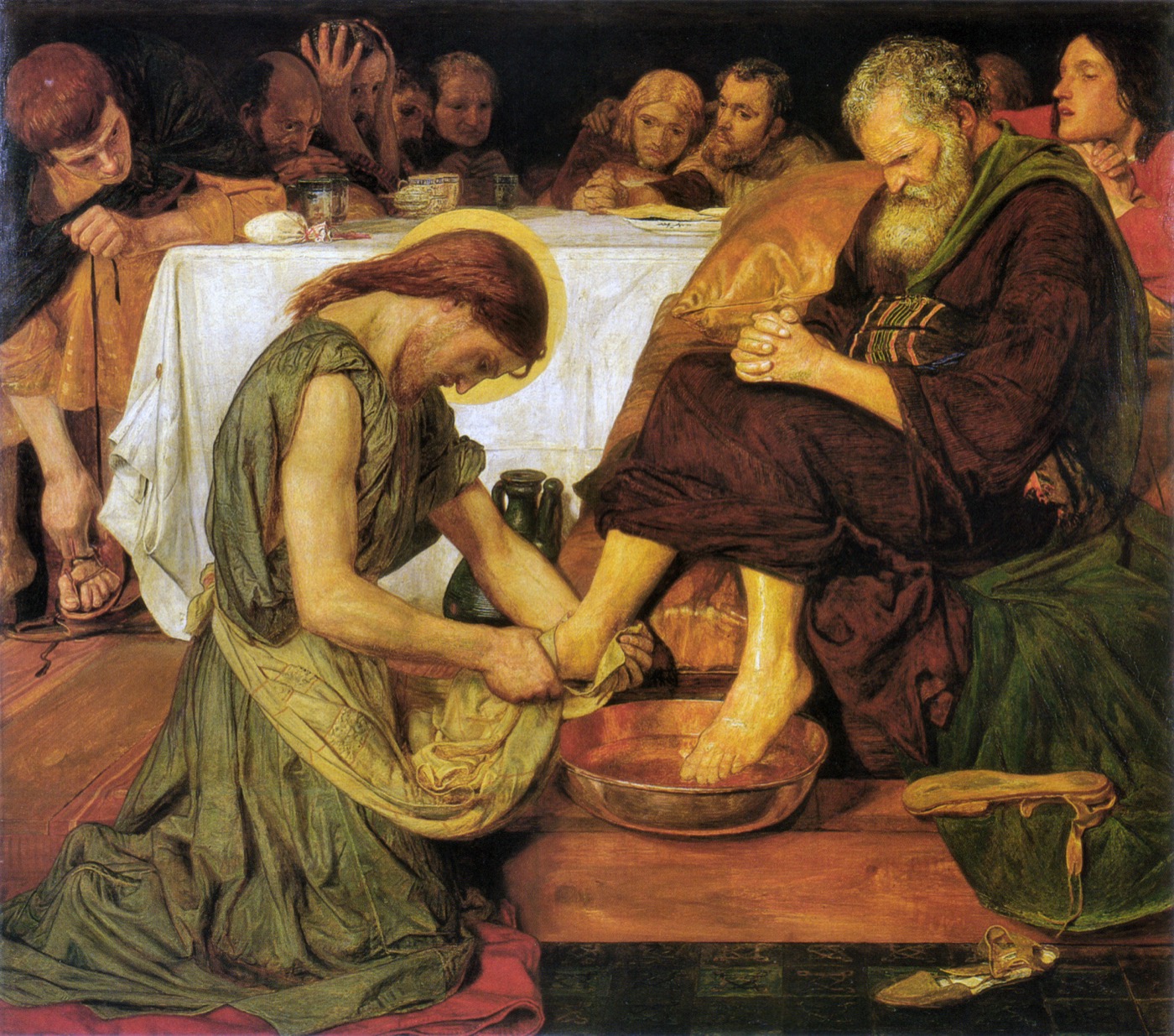
On the last night he gathers the whole method into a form that can be handed on. What the table enacts is the self-gift made transmissible: the body given, the cup poured, the caught content of an entire life laid down in a shape his friends can take into themselves and repeat (the geometry of that table is read in Paper 13). And before the meal, the gesture that is the life compressed into a single act — the one through whom all things were made, on his knees with a towel, washing the feet of fishermen, and telling them that this, exactly this, is the pattern.
And he took bread, … saying, This is my body which is given for you: this do in remembrance of me (Luke 22:19). He riseth from supper, … and began to wash the disciples’ feet (John 13:4–5). The self-gift is named at the table before it is enacted on the wood, and the washing shows what kind of gift it is: the lowest slave’s office made the highest thing in the room.
An upper room, lamplit, the door shut against the crowded city; the low table, the men reclining at it, the smell of roasted lamb and bitter herbs and oil-smoke — for it was the Passover, and every house in Jerusalem was eating the same meal in the same hour, the whole city one held breath. Wine in the cup, flat bread broken by hand, and the feet of men who had walked the dusty roads all needing washing — and the basin going round, carried by the wrong person, the master at the servant’s work while the servants sat there appalled. Outside, the night; and somewhere out in it, one of them already gone to fetch the soldiers.
The Crucifixion
Humility reaches its floor, and the floor has an exact location in the structure. The bivector that articulated the world — e₁e₂, the Father’s direction and the Son’s brought together — squared, is the −1 at the very bottom of the felt-spectrum, its antipode: maximal felt-distance over a bond that is, the whole way down, preserved. The cry is that point actualized in a human voice. It is not the relation breaking — a state actually severed from ⟨·,·⟩ would not cry out, it would simply be gone — but the relation stretched as far as a relation can be stretched and held, felt from inside as abandonment. The death is a real death, the matter stilled and not annihilated (complete is not annihilated; Paper A4); the breath that once made the dust a living soul is not seized away but handed back (Paper A5). This is the most a descent can descend.
And about the ninth hour Jesus cried with a loud voice, … My God, my God, why hast thou forsaken me? (Matthew 27:46; Psalm 22:1). It is finished — tetelestai, the craftsman’s word for a work completed (John 19:30). Father, into thy hands I commend my spirit (Luke 23:46). The voice that once said let there be says why hast thou forsaken me, and they are the same voice at its two ends.
Golgotha, outside the wall, a low rise beside a road where everyone passing could see — which was the point of it. The full heat of the afternoon; the upright beam already standing, the crossbar carried out by the condemned man himself through jeering streets; then the nails, and then hours, because crucifixion killed slowly, by exhaustion and the failing of the breath, and was built to. Flies in the wounds, thirst, the white sun; the soldiers throwing dice for the clothes; the curious and the grieving and the mocking all mixed together in the dust below. It was the death Rome kept for slaves and rebels — public, unhurried, made to shame — and here it took one more crucified man among the many thousands the empire killed this way, his mother somewhere in the crowd, and the sky, the record says, going dark over it.
Humility has no further down to go. The form of God, having taken the form of a servant, was obedient unto death, even the death of the cross — and the descent the framework first met as a line on a diagram is, here, a man crying out in the heat and dying. He felt everything a human being can feel, and felt it from the inside, all the way to the floor — so that there is no place a human soul can find itself where the form of a servant has not already been, lower than it has had to go. The body is taken down and carried toward a tomb. What it is to keep watch at that stone is the next paper; the one after reports the morning.
The Physical Record
“Now in the fifteenth year of the reign of Tiberius Caesar, Pontius Pilate being governor of Judaea… Annas and Caiaphas being the high priests, the word of God came unto John.” — Luke 3:1–2
The life just followed is not a story told out of time. Luke fixes it in the fifteenth year of an emperor, under a named prefect, in the high-priesthood of men the records know — and the spade has met that world, and the men in it, at point after point. It is worth saying plainly what the ground can and cannot reach, because the pattern holds here and will hold all through the Framework.
What it cannot reach is the miracle. A virgin birth, a stilled storm, a dead girl raised from her bed leave no layer to dig; the events that mark this life as more than a life are, by their nature, the kind that leave no trace, and they are held here, as the Gospels hand them down, as testimony. The structure can say what each such event is — the operation it performs on a state (The Works) — but not that it occurred; the form is the algebra’s, the fact remains testimony.
What it reaches firmly is the world the life was lived in, down to the very men who ended it. The two who tried him are both in the ground with their names on them: Pontius Pilatus, prefect of Judea, on a limestone block from Caesarea (found 1961) — the only object anywhere that bears his name, and it dedicates a temple to the Tiberius by whose fifteenth year Luke dates the story; and Joseph son of Caiaphas, on a first-century ossuary (1990), the bone-box of the high priest who presided over the trial. The death itself is attested — the heel bone from Givat ha-Mivtar (1968), a crucified first-century man with the iron nail still driven through it, bent where it struck a knot in the olive wood, and his bones afterward gathered by his family into an ossuary: the only physical remains of a Roman crucifixion from the period, and proof that a crucified body could be given burial, exactly as the Gospels say his was.
And the settings of the life hold as well. The Pool of Bethesda with its five porches (John 5) and the Pool of Siloam (John 9) have both been dug out where John placed them; at Capernaum, the lakeside town of the ministry, a first-century house was venerated as Peter’s early enough to leave Christian graffiti scratched on its walls; and a first-century fishing boat, of just the kind the Gospels put him in, was lifted whole from the mud of the lake he taught beside.
So the ground holds the world of the life — the emperor’s reign, the prefect, the high priest, the practice that killed him, the pools and the lakeside town — and sets the whole account in datable history. What it does not hold is the handful of events that make the life more than a life. That is not a gap in the evidence; it is the shape of the claim, and it is the same shape the morning will take in the papers ahead: the world attested, the miracle on testimony.
References
-
Companion papers: Papers A3–A5 (the three lenses, each ending at the birth — the Word made flesh, the body born, the someone born); Paper A2B (descent as densification; the kenotic mechanism); Paper 13 (the geometry of the table); Paper A6½ (the tomb); Paper A7 (the morning). Appendix B (the felt-spectrum; the antipode at −1).
-
Scripture: Philippians 2:6–8 (the kenotic hymn, the spine); Luke 1:31, 38 (the announcement); Luke 2:7 (the birth); Luke 2:49 (the boy in the Temple); Matthew 3:16–17 (the baptism); Mark 10:43–45 (the ministry); the works (Mark 1–11; Matthew 8–9, 17; Luke 5, 7, 13–14, 17; John 2, 5, 9, 11) read in The Works; Luke 9:51; Zechariah 9:9; Matthew 21:5 (the entry); Luke 22:19; John 13:4–5 (the supper and the washing of feet); Matthew 27:46; Psalm 22:1 (the cry); John 19:30 (tetelestai); Luke 23:46 (the commended spirit).