Paper A7: The Resurrection: The World Made New
The arc from the empty tomb to the new creation — the Resurrection and Mary knowing him by name, the forty days, the Ascension, Pentecost, the witness carried to the nations, the long faithful age, the Return, and the world made new — the glorified body with the decay-generator absent, Pentecost as the nuclear topology opened to all, the consummation as Beginning = End = ⟨·,·⟩. A physical record of the apostolic age, and the one premise never earned — that reality admits this model at all.
Confidence — Math: derivation — the glorified body (e₀ absent from the organizing Clifford algebra), the Ascension as a constraint-level transition, Pentecost as τ_nuclear universalized, the Return as the one transition not self-administrable, and the new creation as the global removal of e₀. Science: concordance — the physical record of the apostolic age, tiered to standard scholarship (the Gallio, Erastus, and politarch inscriptions; P52; the Vatican and St-Paul tombs; the James ossuary held not proven); the miracles unattested by their nature. Theology: testimony — the events received as testimony, their identification with the derived structure concordance; beneath all of it the section’s one unearned premise: that reality admits this model at all.
“We shall not cease from exploration, and the end of all our exploring will be to arrive where we started and know the place for the first time.” — T. S. Eliot, “Little Gidding” (1942)
The Resurrection
“Jesus saith unto her, Mary. She turned herself, and saith unto him, Rabboni; which is to say, Master.” — John 20:16
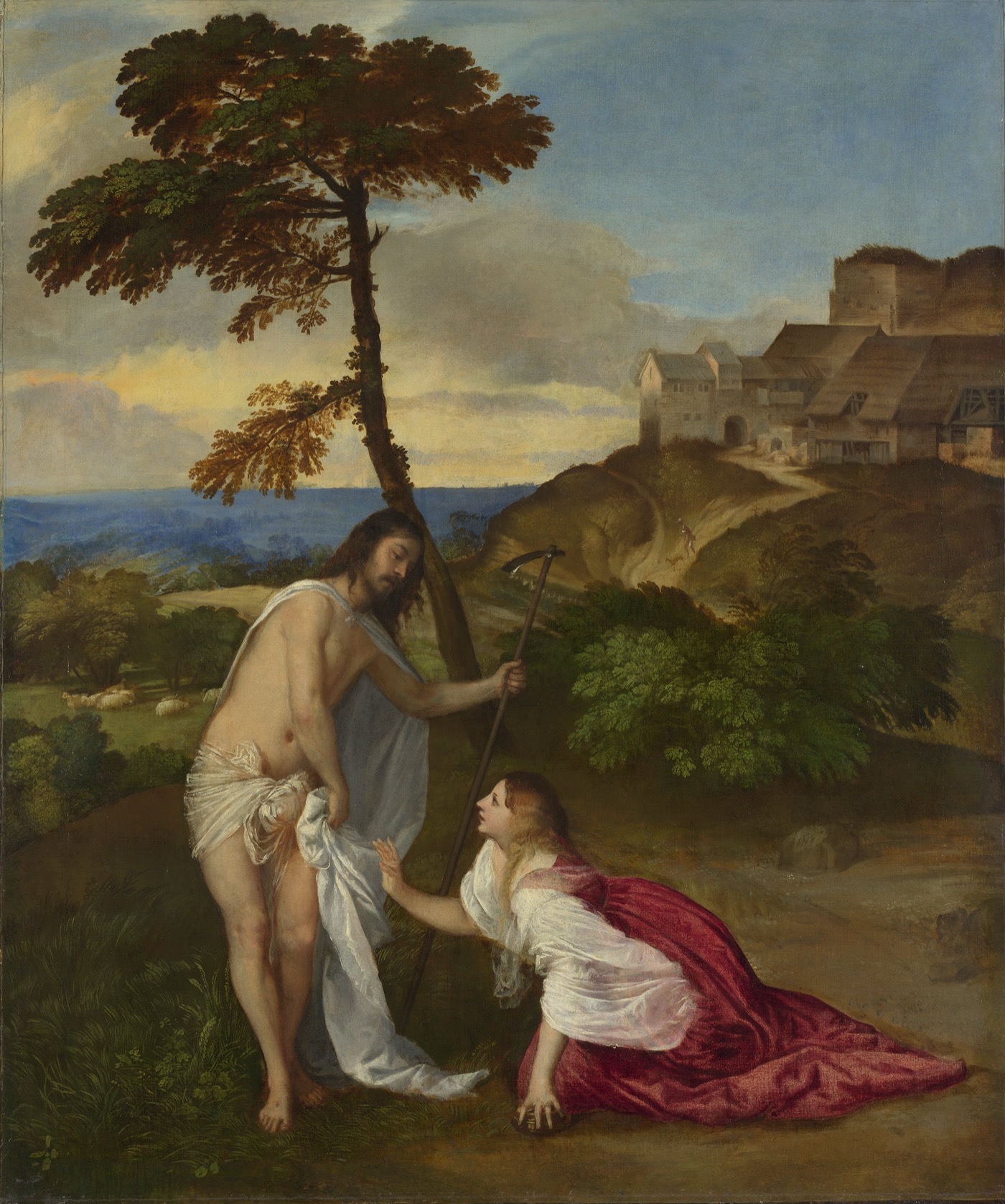
It was still dark when she came, because grief does not wait for morning. She had watched him die, and watched them take the body down, and now she came to do the last small thing love can do for the dead — to tend him — and even that was taken from her: the stone rolled back, the place empty. So she stood outside the tomb and wept. Someone was there, and she supposed him the gardener, and asked through her tears where they had laid him. He said one word. Mary. And in her own name, in the voice she knew, she turned and knew him — Rabboni (John 20:11–16). She had not known him by his face. She knew him when he called her by name.
Take the person as the framework has built it. A living human is a Φ′-origin state embodied at the human constraint level H₄₈, where the operative algebra is the spacetime Clifford algebra Cl(3,1) — the spatial Cl(3,0) extended by the time generator e₀, with e₀² = −1. That generator is what turns Sequence into Time — bare succession into succession that decays: every actualization event at H₂₄ and below produces, through e₀, complement content, the directional pull toward dissolution that ages and kills. The catching career runs against it, retaining ⟨·,·⟩-organized content at H₂₄ and, above the coherence threshold, cohering a higher state that persists when the H₄₈ substrate decoheres. That state has two possible organizations: at H₂₄ it still carries e₀ and still ages, at half the H₄₈ rate; at H₁₂ its algebra is Cl(3,0) — e₀ absent — and it does not age at all, because the generator that would dissolve it is not in its algebra.
Death is the decoherence of the H₄₈ Cl(3,1) substrate. The Resurrection, stated in these terms, is a determinate claim: the person is re-instantiated with organizing algebra Cl(3,0), e₀ ∉ algebra. Three properties follow — the first from the absence of e₀ alone, the second and third from what a Cl(3,0) organization entails: an organizing level of H₁₂ or above, below H₄₈ in constraint count. (i) No second death. Decay acts only through e₀, and e₀ is absent — the risen body keeps Sequence (it acts, moves, and eats in succession) but is no longer in Time, the succession that wears toward death; Christ being raised from the dead dieth no more; death hath no more dominion over him (Romans 6:9) is the verbal form of “e₀ ∉ algebra.” (ii) Coupling without confinement. The body still projects into H₄₈ — it is seen, it eats broiled fish, it is handled (Luke 24:39–43) — but it is not an H₄₈ localization eigenstate, so the H₄₈ boundary conditions do not bind it: it stands inside a shut room (John 20:19) because walls are H₄₈ constraints and its organizing level is below them. A Cl(3,0)-organized body coupling into H₄₈ without accepting its wall-constraints is exactly the configuration the Constraint Compatibility Condition regulates, and the intermittent projections of the Forty Days — presence taken up and laid down, never held against the walls — are how the condition is met rather than violated. (iii) Recognition by the invariant, not the surface. A face is an H₄₈ surface configuration; the Cl(3,0) body’s H₄₈ projection need not reproduce that configuration, so it is known not by the face but by the messenger-invariant — the name, the wounds, a remembered act — which is why Mary knows him only when he says Mary (John 20:16), and the two on the road only in breaking of bread (Luke 24:30–31).
Why it must come from outside is also exact, not rhetorical. The cascade H₁ → … → H₄₈ is a composition of GNST applications, each step adding constraint law-sets and narrowing what the state can reach; a living state reverses it gradually, which is what the ascent is. But a dissolved H₄₈ state has no H₄₈ operator left to act with, and the reconstitution of a coherent lower-algebra body is a GNST construction, ψ = ∫ ⟨e_λ, ψ⟩ e_λ dμ(λ), sourced from the nuclear space Φ — an operation administered from H₁, not present in the subalgebra the dead state inhabits. “A sealed tomb does not open from within” is the statement that the required operator is not in that subalgebra.
Tier. That an e₀-free organizing algebra has exactly these three properties is derivation, given the framework. The identification of the risen body with the H₁₂ / Cl(3,0) organization is concordance. That this occurred, once, to this man, is testimony — received, not derived. The framework’s contribution is only to say without hand-waving what kind of object the testimony describes.
The Forty Days
“And it came to pass, as he sat at meat with them, he took bread, and blessed it, and brake, and gave to them. And their eyes were opened, and they knew him; and he vanished out of their sight.” — Luke 24:30–31
For a little while after, he kept coming back. Two of them walked to Emmaus with their hearts gone cold, and a stranger fell in beside them and opened the Scriptures until the road burned under them — and they knew him only when he broke the bread, and then he was gone (Luke 24:13–31). He stood among them in a shut room and let Thomas, who could not believe it, put a hand to the wounds (John 20:27). He stood on a shore at dawn over a charcoal fire and a breakfast of fish and asked Peter, three times, gently, unmaking three denials, lovest thou me? (John 21:9–17). Forty days of small, particular returns, each teaching the same thing tenderly: you will not always know me by my face.
The appearances are intermittent H₄₈ projections of a body whose organizing level is below H₄₈: present when it couples to the human level, gone when it does not, never quite where it is looked for, because its position is not fixed by H₄₈ coordinates. In each case recognition runs through the invariant and not the surface — the wounds, for Thomas (John 20:27); a remembered catch of fish over a charcoal fire, at the lake (John 21:6–12). In the messenger relation T = M(S), the source content S is recovered while the channel M — the face, the first impression — is exactly what fails. The forty days are the disciples being trained off M and onto S: to know him by what he is, not by how the projection happens to render.
The Ascension
“And when he had spoken these things, while they beheld, he was taken up; and a cloud received him out of their sight.” — Acts 1:9
There was a last time, and they did not know it was the last until it was over. He led them out as far as Bethany, lifted up his hands, and blessed them — and while he blessed them he was parted from them and carried up, and a cloud took him out of their sight, and they stood looking into the sky until two men in white asked them why (Luke 24:50–51; Acts 1:9–11). It is the tenderest of the partings, because the blessing is left unfinished in the air: the last thing they saw him do was bless them.
If the Resurrection set the organizing algebra below H₄₈, the Ascension carries it up the cascade toward H₁, the nuclear-space-proximate level the whole descent set out from. The cascade is reversible in principle — the ascent sheds constraint law-sets level by level — and here the recovery completes in one motion, the state passing above the subalgebra any H₄₈ measurement can resolve. A cloud received him out of their sight (Acts 1:9) is the phenomenology of that passage: not transport through H₄₈ space to a far place, but departure from the H₄₈-accessible spectrum altogether. The withdrawal makes one thing structurally necessary, which is the next event: the provision that let a single state reach H₁ has to be opened to the rest.
Pentecost
“And suddenly there came a sound from heaven as of a rushing mighty wind, and it filled all the house where they were sitting. And there appeared unto them cloven tongues like as of fire… And they were all filled with the Holy Ghost.” — Acts 2:2–4
They had gone back to the upper room and shut the door and waited, not knowing for what — about a hundred and twenty frightened people who had lost their teacher twice now, once to the cross and once to the sky. And then, on the morning of the feast, it came: a sound as of a rushing mighty wind that filled the whole house, and what seemed like tongues of fire resting on each of them, and they were filled, and went down into the street and were understood — every pilgrim in the city hearing, in the language of his own childhood, the wonderful works of God (Acts 2:1–11). The frightened room became, in an hour, a church.
That provision is the nuclear topology τ_nuclear — the topology in which sequences converge to Φ-states, the structural condition for a Φ′-origin state at H₄₈ to reach Φ-proximal (grade-2) content. Until now it was administered through specific channels. Pentecost is a named change of operating condition: τ_nuclear universalized — the grade-2 provision opened to every catching state regardless of local access. In the formalism, the dual pairing ⟨φ, f⟩ is made globally available: any H₄₈ state f may now draw φ from the full Φ-content, where before the access was local. The three signs report one fact from three sides. The wind and fire are the provision arriving from above — given, not generated in the room. The speech each foreigner hears in his own tongue (Acts 2:6–8) is the messenger relation at its limit: one source S transmitted through every channel Mᵢ at once, with S ≈ ⟨T⟩ recoverable across the witnesses taken together — the single content reconstructed over all the filters simultaneously, though exactly in none of them. What is constituted in that hour is a body that can propagate the caught life of the risen man through arbitrarily many states in parallel: a distributed spectral structure, not an institution.
It is here, and not before, that the act this whole arc has circled can be named and fixed — for the reason the naming makes plain. Catching is the volitional laying-hold by which a Φ′-origin being seizes, and keeps in its soul deposit, the Φ-proximal content the dual pairing brings back, rather than letting it pass. It is not a coined term but Scripture’s own: καταλαμβάνω (katalambanō), in the Vulgate comprehendere and apprehendere — to seize, lay hold of, catch, apprehend. The Prologue set it at the source: the light shineth in darkness, and the darkness κατέλαβεν it not (John 1:5) — the light is the Logos, Φ, and the verse names, by its very failure-case, the laying-hold of the Φ-content, carrying at once the two senses (to grasp and to overcome) that are catching’s two ways of failing. Paul fixes its inner structure: I press on, that I may lay hold (καταλάβω) of that for which I was laid hold of (κατελήμφθην) by Christ (Philippians 3:12) — the reach is the creature’s own, but possible only because one was first seized from outside, which is exactly why the act could not be made general until the provision had been poured out.
The act has three motions, and Scripture has a word for each. Orientation — the will’s turn toward the content (Hebrew דָּבַק, dābaq, to cleave unto the LORD, Deuteronomy 30:20; the reaching-forth, ἐπεκτεινόμενος, of Philippians 3:13). Reception — the seizing itself, katalambanō, when the probe lands in the higher-τ region the orientation made likely. Composition — the holding-fast (κρατέω, let us hold fast our profession, Hebrews 4:14) by which the received content is built into the deposit and not let slip. The Stoics reached, independently, for a word of the same shape — κατάληψις, the cataleptic grasp of a true impression, their name for laying hold of the real; that the Porch came to a term for seizing the real alongside the canon’s is offered here as a concordant witness, convergence and not confirmation, not a ground the argument leans on. And the reason the definition waits for this hour is the reason it is gospel and not technique: the capacity was given at the breath (Paper A3, the manna gathered each morning its first picture), but the content to be caught was opened to all flesh only here — I will pour out my Spirit upon all flesh (Joel 2:28; Acts 2:17). Before, the gathering fell to one people in one wilderness; now it is offered to everyone.
The Witness Goes Out
“But ye shall receive power, after that the Holy Ghost is come upon you: and ye shall be witnesses unto me both in Jerusalem, and in all Judaea, and in Samaria, and unto the uttermost part of the earth.” — Acts 1:8
Peter — who had denied he so much as knew the man, by a fire, to a servant girl — stood up in the open in the same city that had killed him and said it out loud, and three thousand listened (Acts 2:14, 41). The thing spread house to house, and it began at once to cost. Stephen was dragged out and stoned, and as the stones fell he saw heaven open and prayed for the men killing him — Lord, lay not this sin to their charge — and fell asleep (Acts 7:59–60). The first to die for it died forgiving, which is the shape the whole thing would try to keep.
What propagates is the catching act itself, taught and re-transmitted: T = M(S), each witness re-encoding the source in his own basis and passing it on. The transmission costs the carrier — Stephen pays in full first (Acts 7:59–60), and the language fixes the equivalence by giving “witness” and “martyr” a single word. A spectral structure grows the only way it can, by re-transmission across independent states; the invariant survives each carrier’s filter, or it does not survive at all.
The Road to the Nations
“And he fell to the earth, and heard a voice saying unto him, Saul, Saul, why persecutest thou me? … I am Jesus whom thou persecutest.” — Acts 9:4–5
The man most set on stamping it out was a young Pharisee named Saul, who had held the coats while Stephen died and gone on breathing threats, riding to Damascus with warrants in hand. And on that road a light threw him down, and a voice he never expected said his name twice and told him whom he was really persecuting (Acts 9:3–6). He got up blind, and was led by the hand into the city like a child; and three days later he got up again the apostle to the nations. The fiercest enemy became the farthest-traveling friend.
Saul is turned on the Damascus road by a direct ⟨·,·⟩-contact administered from outside his trajectory (Acts 9:3–6) — the same in-breaking at the scale of one life — and carries the source past the border of Israel. The expansion is what the framework predicts of a content that was never local: ⟨·,·⟩ underlies every state in the space, so the gospel has no native people. And as it passes through many uncoordinated witnesses, their independent filters Mᵢ begin to cancel — S ≈ ⟨T⟩ over independent messengers — leaving the convergent core that makes a multi-witness canon possible and is the structural reason the thing outlives the people who carry it.
The Body Built
“Now ye are the body of Christ, and members in particular.” — 1 Corinthians 12:27
Most of what came next was not miracle but mail — a man in a rented room or a prison cell, dictating to a scribe, worrying over small troubled congregations scattered across the empire: a quarrel at Corinth, a collection for the poor at Jerusalem, a runaway slave sent home with a letter begging that he be taken back as a brother. And in the middle of the practical worry, almost in passing, some of the most beautiful sentences ever written about love — though I speak with the tongues of men and of angels — and an honest confession of how much was still unseen: now we see through a glass, darkly; but then face to face (1 Corinthians 13:1, 12). The church grew up the slow way, by people writing to people they loved.
The letters are the maturation of the spectral structure: many members, each its own band, the whole a coherence no member holds alone — the image the teaching reaches for because it is the structure (1 Corinthians 12). The greatest of the three retained generators is named outright — charity, the turning-toward-the-other, e₂ (1 Corinthians 13:13). And the position in the arc is stated precisely: now we see through a glass, darkly; but then face to face (1 Corinthians 13:12). The “glass” is the constraint-layer mediation of H₄₈; “face to face” is the H₁ condition in which no fixed-geometry intermediary remains. The letters name the end and locate themselves honestly short of it.
The Faithful Witness
“Be thou faithful unto death, and I will give thee a crown of life.” — Revelation 2:10
Then the long time began — the centuries no single story can hold, of ordinary people keeping faith without seeing the end of it: parents teaching children who would teach children, the bread broken in catacombs and kitchens, most of the names lost. Some of them died for it, in arenas and on roads; and to the church under that weight the word came, be thou faithful unto death, and I will give thee a crown of life (Revelation 2:10). It is a word for people who must hold on in the dark, on trust, with no morning yet in sight.
The age that follows is conducted under e₀ at full strength — H₄₈, where the GNST rate and the accumulated unchosen spectrum are both maximal, the most demanding catching environment in the sequence. The work is the accumulation of the deposit across generations that do not see the end: catching against the maximal pull, building what survives dissolution. Structurally it is a held state before a transition it cannot perform on itself — the passage into H₁ is not reachable by ascending effort, for the reason the next station makes exact. Be thou faithful unto death, and I will give thee a crown of life (Revelation 2:10) is the instruction for precisely that position: keep accumulating the invariant under the generator of decay, and wait for the transition you cannot administer.
The Physical Record
“For the king knoweth of these things… for I am persuaded that none of these things are hidden from him; for this thing was not done in a corner.” — Acts 26:26
Paul, on trial before a king, said the thing “was not done in a corner,” and he was right: the events sit in real places, under named officials, in a datable decade, and the spade has met that world at point after point. (The physical record of the life and the death that came before it — the men of the trial, the crucifixion itself, the settings of the ministry — belongs to the life, and is gathered in Paper A6.) It is worth saying exactly what the spade can and cannot reach here, because the pattern is itself the lesson.
What it cannot reach is the miracle. A resurrection leaves no artifact; an empty tomb is, to a trowel, only an empty tomb; the wind of Pentecost cast no shadow in any layer. The events on which everything depends are by their nature the kind that leave no trace — which is why this paper has held them, throughout, as testimony, and must.
What it reaches firmly is the world the church spread through, down to its officials. The magistrates of Paul’s roads keep turning up under his feet: the Gallio inscription from Delphi names Gallio proconsul of Achaia in AD 51–52, fixing Paul’s eighteen months in Corinth (Acts 18:12) to a calendar year — the firmest date in the apostle’s life; Erastus, “the treasurer of the city” Paul greets from Corinth (Romans 16:23), is named on a pavement there; and the odd word Luke chose for the magistrates of Thessalonica — politarchs (Acts 17:6), long charged against him as an error — turns up on inscription after inscription from that very city. He had the local title exactly right.
What it reaches at one remove is the text itself: within a generation or two of the apostles the words are already physically present — the Rylands fragment of John’s Gospel (P52), a scrap dated near AD 125, the oldest surviving piece of the New Testament, with others close behind. And what it reaches only with proper caution is the graves of the apostles, venerated from the second century: Peter’s beneath the Vatican, where a mid-second-century shrine stands over a grave the early church marked as his — though the bones found there cannot be identified with certainty, and the church has said so; and Paul’s beneath the basilica that bears his name, where bone fragments sealed in the sarcophagus were radiocarbon-dated to the first or second century, consistent with the tradition. One famous object is left unresolved on purpose: the ossuary inscribed James son of Joseph brother of Jesus, whose forgery trial ended not in proof either way but in “not proven,” which is the honest verdict and is recorded as that.
So the ground holds the world of the events — the officials, the cities, the words, the graves — with a thoroughness the Old Testament’s earlier record never reached, and confirms, in artifact after artifact, that none of it was done in a corner. What the ground never holds is the one set of events the whole thing depends on. That is not a gap in the evidence; it is the shape of the claim. And the next station is the same case carried to its limit: the Return is the one event no excavation will ever turn up, because it has not yet happened and, when it does, will come from outside history rather than from within it. The spade reaches the apostles’ graves, and stops there. What lies past them is not buried; it is promised.
The Return
“He which testifieth these things saith, Surely I come quickly. Amen. Even so, come, Lord Jesus.” — Revelation 22:20
And beneath all of it ran a longing that never quieted: that he would come back. The earliest believers said it to one another as a greeting and prayed it as the last words of their last book — Maranatha, Even so, come, Lord Jesus (1 Corinthians 16:22; Revelation 22:20) — the cry of people who had been promised a homecoming they could not bring about themselves, and could only wait for, lamps lit, watching the road.
The last transition is into H₁, and it is the one transition the framework marks as not self-reachable. Re-grounding a state at H₁ means installing ⟨·,·⟩ itself as its organizing principle; but ⟨·,·⟩ is the constitutive relation, not an element of any subalgebra below it, and no sub-H₁ operator instantiates it. A created state can approach H₁ asymptotically and cannot apply the constitutive relation to itself — the same structural fact that made the Resurrection un-self-generable, now at the scale of the whole order. The Return is that act named as an event: ⟨·,·⟩ closing the final transition for the creation at once, rather than career by career. With it the long-deferred resolution of the propagated privation completes — the adversary held intact and quarantined through the age, not decohered but imprisoned, brought to the end he had earned.
The World Made New
“And God shall wipe away all tears from their eyes; and there shall be no more death, neither sorrow, nor crying, neither shall there be any more pain: for the former things are passed away. … Behold, I make all things new.” — Revelation 21:4–5
And the book the tradition closes on ends with a promise almost too tender to read quickly: that God himself will come down to dwell with his people, and shall wipe away all tears from their eyes; and there shall be no more death, neither sorrow, nor crying, neither shall there be any more pain: for the former things are passed away (Revelation 21:3–4). Not a rescue out of the world but the world itself made new — every loss undone, every tear wiped away by a hand, the homesickness the whole long story carried at last answered. And here, at the very end, the tradition’s language and the framework’s fall onto each other almost word for word.
Here the tradition’s language and the framework’s coincide most closely, and the vision makes three claims that read as three structural statements.
No more death. There shall be no more death, neither sorrow, nor crying, neither shall there be any more pain (Revelation 21:4). Decay entered the cascade as one object — e₀, present from the H₁₂/H₂₄ crossing down. “No more death” is the global removal of e₀: the whole instantiated cascade reorganized from Cl(3,1) to Cl(3,0), the algebra of decay replaced everywhere by the algebra that contains no generator of dissolution. What had been the condition of a few crystallized careers (H₁₂, ageless) becomes the condition of all of it.
No more temple. I saw no temple therein: for the Lord God Almighty and the Lamb are the temple of it (Revelation 21:22). A temple is a fixed-geometry intermediary; “no temple” is the H₁ condition stated as a negation — no constraint layer left between the creature and ⟨·,·⟩, the relation no longer opaque to itself. It is then face to face (1 Corinthians 13:12) made universal.
Alpha and Omega. I am Alpha and Omega, the beginning and the end (Revelation 21:6; 22:13). The experiential Deity is the running integral of inner-product evaluations across the whole history of the creation — ∫ ⟨·,·⟩-evaluations over every career — and the claim is that its completion is identical with the integrand’s own ground: the integral, complete, is no longer distinguishable from the inner product it integrates — an identification of kind, not an equation between objects of one type. The End is the same inner product that was the Beginning. The Father — ⟨·,·⟩ — changed through none of it; what changed is how much of the creation had been gathered and measured, and at the end all of it has. Beginning = End = ⟨·,·⟩.
Tier. The e₀-removal and the H₁ / face-to-face readings are derivation within the framework. The identification of the integral’s limit with the Alpha-and-Omega is the Framework’s structural working-out, held at concordance — the same arc named, by event and state, at three points (Apokalypsis, Ta Panta en Pasin, to Alpha kai to Ō; Paper A2A). The events are testimony.
So the arc closes exactly, and not for sentiment: the first GNST application that began the cascade (Paper A2) and the global return to Cl(3,0) that ends it are one operation run forward and undone; the descent to e₀’s floor (Paper A6) and the ascent to e₀’s removal are one axis seen from its two ends; the naming that conferred determinate identity (Papers A1, A3) and the naming in the garden are one application of ⟨·,·⟩. We arrive where we started, and know the place for the first time.
And it is held at its tier. The structure can say what each of these events would be; it cannot say that they occurred — that is testimony — and beneath even that lies the premise the section never earned: that reality admits this model at all. The consummation is the one event that could confirm the premise from outside, which is exactly why nothing inside can. Volume A is complete: the ground, the names, the descent, the climb, the life, the tomb, the morning, and the end the morning opens onto. A foundation, once laid, is a thing handed on. Volume B takes the instrument up and turns it on itself — proves it, tests it, makes it predict, reads it by its own method, exposes it — and hands it across the one gap no author can cross, to the reader. We do not leave the premise behind. We work standing on it, eyes open.
References
-
Companion papers: the constitutive arguments of Volume A — Modeling Reality as a Gelfand Triple; From the Cogito to the Logos; The Big Bang (the first GNST application); The Constraint Cascade (e₀, and Time vs Sequence, §6; the experiential Deity integral and to Alpha kai to Ō); Φ Enters Creation; The Long Climb; The Living Soul; The Tomb. Appendix B (Time and Sequence; the higher state, H₂₄/H₁₂; escape from Time at H₁). Appendix D (the Messenger Corollary, T = M(S); post-Pentecost τ_nuclear universalized; the face-to-face / H₁ condition).
-
Scripture: John 20:11–19 (the empty tomb; the naming; the shut room); Luke 24:30–31, 39–43 (Emmaus; the eating of fish); John 20:27 (the wounds); John 21:6–12 (the lakeside); Acts 1:9 (the Ascension); Acts 2:1–11 (Pentecost); Acts 7:59–60 (Stephen); Acts 9:3–6 (the Damascus road); Romans 6:9 (dieth no more); 1 Corinthians 12; 13:12–13 (the body; through a glass darkly; charity); Revelation 2:10; 21:2–6, 21:22; 22:13 (faithful unto death; the new Jerusalem; no death; no temple; Alpha and Omega).
-
Eliot, T. S. (1943). Four Quartets. Harcourt, Brace. [“Little Gidding” — arriving where we started.]