Paper A5: The Breath of Life: When Matter Becomes a Person
The waking of an interior — the felt self the sciences of the mind map but cannot reach — and the one thing that interior does that nothing before it could: it leaves itself in matter, in writing. The earliest scripts and the alphabet; the Hebrew canon as the longest-guarded body of consciousness in material form, its transmission measurable across a millennium and its opening word the oldest account of what a person is — a living soul; the modern science of the mind turning its instruments on itself; and, at the end, the Word born a consciousness.
Confidence — Math: — (not engaged) (bare-minimum, by register). Science: inference — the science of mind turned on itself and the documentary history of writing and the alphabet; the Hebrew canon’s transmission measurable across a millennium. Theology: concordance — a living soul as the oldest account of what a person is, the canon as the longest-guarded body of consciousness in material form, and the Word born a consciousness.
Abstract
Paper A4 carried the body the whole way and named, but did not enter, the one transition it could not treat as physics: the arrival of an interior — a someone for whom the body is a point of view. This paper takes up that thread and follows it through its material expression. On one side is what the sciences of the mind actually know, which is a great deal and growing fast: the mechanisms of perception, memory, and attention, the integrated and self-modeling brain. On the other is what those sciences, by their very method, do not reach — the felt interior itself, the plain fact that there is something it is like to be the system at all. This paper resolves neither and claims neither resolved. What it adds is the thread between them: that consciousness, once it exists, does a thing nothing before it could — it leaves itself in matter, in writing, consciousness made legible and able to outlast its body. The story of consciousness is therefore told in its material forms, from the earliest marks to the modern science of the mind; and the throughline is the Hebrew canon, the longest-guarded body of consciousness-in-material-form there is, which kept across millennia the oldest exact account of what a person is — a living soul. The arc ends where the section’s lenses end, at the birth: the Word — the meaning toward which every mark ever made was reaching — entered as a living soul made flesh.
Confidence. The science of the mind is presented as a large and growing body of real knowledge whose one open residue is the felt interior — not as a mystery wholesale, and not as support for any conclusion. The history of writing and the physical record of the Hebrew canon follow standard scholarship, tiered where the evidence is contested. The identification of the integrated, knowing self with the living soul of Scripture is offered as concordance — two descriptions facing the same way — explicitly not as derivation and not as an answer to either mystery. The reading of the birth — the Logos entering as a complete human interior — is concordance held beside structure, in the manner of the section.
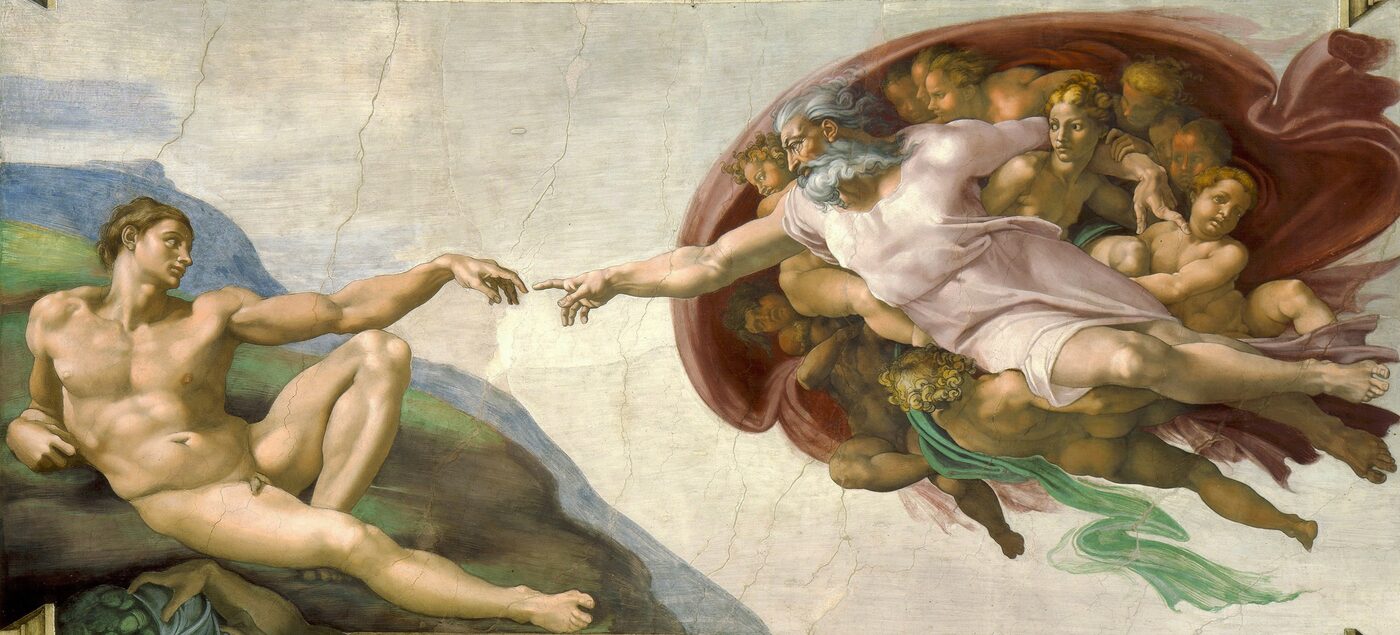
“And the LORD God formed man of the dust of the ground, and breathed into his nostrils the breath of life; and man became a living soul.” — Genesis 2:7
1. When matter becomes someone
The body’s account, followed to its end in the companion paper, never had to mention that anyone was home. It could describe the brain as it described the kidney — an organ of great complexity doing physical work — and leave it there. But somewhere along the climb the lights came on. There came to be, in at least one kind of body, an interior: a point of view, a felt world, a someone for whom things are a certain way. This is the transition the material thread could name and not cross — and naming it requires care, because it is easily mistaken for the claim that consciousness is a mystery the science has not touched, and that claim is false.
It has touched it deeply. The sciences of the mind — psychology, neuroscience, cognitive science — have mapped the workings of consciousness in vast and fast-accumulating detail: the neural signatures that mark whether a stimulus is consciously perceived or processed unseen; the global broadcast that distinguishes a conscious thought from the enormous unconscious traffic beneath it; the way attention, memory, emotion, and the body-sense are assembled into the moment-to-moment field of awareness; the staged emergence of a self-aware child who comes to know itself in a mirror and to model the minds of others; and the precise ways the field can be dimmed, divided, distorted, or switched off — by sleep, anesthesia, a lesion, a severed corpus callosum. How the mind works is not a blank. It is one of the great research frontiers of the age, and it is moving fast.
What all of that has not closed — and what may not even be the same kind of question as the rest — is a single residue. Grant the fullest account neuroscience will ever give of how the brain integrates information into one processed, reportable, self-modeling whole: there remains the question of why any of it is undergone — why there is something it is like to be the system, rather than all that machinery running in the dark with no one home. That is the hard problem (Chalmers 1995; and Seth & Bayne 2022 for the present state of a productive field), and it is not a gap the science is lazily leaving open but one its methods, which explain function by mechanism, may not be framed to reach: every mechanism they describe could, so far as the description goes, have run unfelt. The structure of the interior is studied and increasingly known; that there is a felt interior at all is the part the long material account names and cannot itself supply.
And there is one fact on the near side of all that uncertainty that is not in the dark at all — that is, in fact, the most certain thing any of us has. Whatever can be doubted about the mind from outside, from inside there is one thing that cannot be doubted: that there is an inside. You cannot doubt without proving there is doubting going on, and so a someone doing it; I think, therefore I am (Paper A1 built on this) is not a clever argument but the one report that cannot be false in the making of it. The science looking in from outside can say a great deal about how the self is built and very little about why it is lit; the self, looking out from inside, has no difficulty being sure that it is lit. And the first thing that lit interior did, somewhere on the long climb, that no body before it had ever done — was to reach out of itself, and leave a mark.
2. Consciousness in material form
That mark is what this paper rests on, because of what it is. An interior is, by its nature, sealed: the most certain thing from within and unreachable from without, a felt world no instrument can enter. Writing is the one move that breaks the seal. In writing, the contents of a mind are externalized — fixed in matter that outlasts the body that held them — so that an interior can, for the first time, be made present to interiors it will never meet, across distances no voice carries and times no life spans. Memory is placed outside the skull. A someone three thousand years dead speaks, in his own words, to a someone not yet born. Writing is consciousness in material form: the soul made legible.
It is a young thing, far younger than the body that does it. For the whole of the long climb there was no such trace; then, in a narrow window near 3200 BC, it appears twice at once and apparently on its own each time — Sumerian cuneiform pressed into clay in the cities of southern Iraq, and Egyptian hieroglyphs cut in stone along the Nile, the two so different in structure that scholars take them to have been invented independently. These first scripts were heavy machinery, hundreds of signs for words and syllables, the property of a scribal few. The lighter thing came later: around 1900 BC, in the turquoise mines of Sinai where Semitic workers labored under Egyptian overseers, someone reduced the hundreds of signs to a couple of dozen, one for each consonant sound — the alphabet (the Proto-Sinaitic script), the first writing a child could learn in an afternoon. It was invented, as far as the evidence runs, exactly once; nearly every alphabet in use on earth descends from that one event, the Hebrew script among them. The behavioral trace the body’s account could only read as a shadow (Paper A4) becomes here the thing itself — not the shadow a someone casts but the marks a someone makes, on purpose, to outlast himself.
3. The canon as the throughline
One body of that writing carries the move further than any other, and it is the throughline of this whole account: the Hebrew canon. A people took their interior life — their covenant, their long quarrel and communion with the God who had claimed them — and committed it to the alphabet, and then guarded that writing as no other ancient text was guarded. The care is itself part of the evidence. The Masoretes of Tiberias, across the seventh to tenth centuries, fixed the vowel-points the consonantal text had never carried and counted the letters of each book to catch a single copyist’s slip; the great codices their labor produced — Aleppo, about 920, and Leningrad, about 1008 — were the best Hebrew witnesses for a thousand years. Then, in 1947, the Dead Sea caves gave up manuscripts a full millennium older — the Great Isaiah Scroll among them, about 125 BC — and the text proved to have been carried across that thousand years with a stability that can be measured rather than merely asserted. Older still are two tiny rolled silver amulets from Ketef Hinnom near Jerusalem, about 600 BC, carrying the priestly blessing of Numbers 6 — the oldest surviving piece of the Bible, five centuries before the scrolls. This is consciousness in material form at its furthest reach: not a mind merely written down, but a mind’s account of itself transmitted, legibly and demonstrably, across a hundred generations.
The people who did the keeping leave a physical record of their own, and honesty requires it be told exactly — thin where it is thin, firm where it is firm. Of the founders — Abraham, the patriarchs — there is no direct trace: no inscription names the men of Genesis, and the Exodus as a mass departure from Egypt is, on the present evidence, unattested and widely doubted. But by about 1208 BC the Egyptian Merneptah Stele names Israel as a people in Canaan — the earliest mention of Israel anywhere outside the Bible. From there the record firms. The Tel Dan Stele, about 840 BC, names the House of David — the first reference to David outside Scripture, the find that effectively ended the scholarly argument over whether he existed (only the scale of his kingdom is still genuinely debated). And from the eighth century the Bible’s history and the imperial records intersect at point after point: Sennacherib’s own prism boasts of shutting King Hezekiah up like a bird in a cage in 701 BC; the siege of Lachish it describes is carved on the walls of his palace at Nineveh and burned into the ground of the site itself; Hezekiah’s water tunnel under Jerusalem, with the inscription its diggers left where they met in the middle, can still be walked through today (2 Kings 20:20). The Cyrus Cylinder, about 539 BC, records the Persian policy behind the exiles’ return. The founders are unrecovered; the people, from the divided monarchy onward, are documented history.
But the throughline is not only that the canon was kept. It is what the canon kept — because the account it carried, across all those guarded centuries, was an account of exactly the thing this paper is about: what a person is. And the LORD God formed man of the dust of the ground, and breathed into his nostrils the breath of life; and man became a living soul (Genesis 2:7). The verse divides where the science divides. There is the dust — the formed body, complete as a body, the matter of the long climb. And there is the breath — neshamah, the same word as wind and spirit — which is not a second body added to the first but the principle by which the dust becomes one living, knowing self. The result is named with precision: not a body that has a soul as a man has a coat, but a living soul, nephesh chayyah — the integration itself, the unity by which a heap of cells is a person with a point of view. And the account folds in a second word the breath alone does not carry: that this living soul is made in the image of the One who is the Word, the principle of meaning (Genesis 1:27) — which is to say a person is not only integrated but addressable, a someone who can be called by name, and can mean, and can answer. The oldest writing a people ever guarded held, at its very opening, the most exact short account of consciousness anyone has given: a self that is one, that knows, and that can be spoken to.
And it does not leave the first such someone unnamed. Where the material record can show only a thickening behavioral shadow, with no first moment in it (Paper A4), the account names a beginning and gives it a face — Adam, and Eve, the first beings in whom anyone was home, the first living souls. Neither is the other’s proof. A gradual dawn seen from outside and a first waking named from within are exactly what a single threshold looks like from its two sides; they face each other across the same gap the body’s account and the soul’s account have faced across all along. The longest-kept body of consciousness in material form turns out to keep, as its first word, consciousness’s own deepest description of itself.
4. Consciousness studies itself
The last material form consciousness has taken is the strangest: it has turned its instruments on itself. The science that studies the mind is young — younger than the railway — and it is the same long arc reaching its present end, the interior that learned to leave itself in clay and on parchment now writing itself into laboratories and case records. It is worth setting its short, quarrelsome history down, for two reasons: it is the empirical map of the human substrate the rest of the Framework stands on, and the practical tools that Volume G later puts into a person’s hands, for the actual work of the ascent, are its hard-won fruit.
Psychology as a discipline is usually dated to 1879, when Wilhelm Wundt opened the first laboratory devoted to the mind, in Leipzig, and began timing reactions and training students to report, carefully, what passed through their own awareness. A decade later William James, in America, wrote the Principles of Psychology — still unsurpassed as prose — and gave the field its lasting images: the stream of consciousness, the self as something continually done rather than merely had, the will as attention sustained against distraction. Then the young discipline split, and split again, each school seizing one real part of the self and, in the seizing, letting the others go — which is what a science circling something larger than its method does.
The first split went downward. Freud, in Vienna, found that the self is not transparent to itself: that beneath the lit room of awareness runs a vast dark traffic the conscious mind does not author and barely glimpses, a house divided against itself. Jung carried the dark further down and out, into the archetypes and the long labor of individuation, the integration of the divided self toward a center. Whatever one makes of their machinery — and much of it has not aged well — they had caught something true and permanent: the self the cogito knows it is is not a self it transparently sees.
In reaction came the behaviorists, who judged all talk of an unseen interior unscientific and resolved to study only what could be measured — the relation of a stimulus to a response. Pavlov’s conditioned dogs, Thorndike’s cats working the latch, Watson’s manifesto, and above all B. F. Skinner’s patient mapping of how reward and consequence shape what a creature does, built a rigorous and genuinely powerful science of conditioning — of how the substrate is trained. And here the Framework’s own thesis is confirmed from the inside: the school that, on principle, bracketed the felt interior out of its method produced real and durable knowledge of the mechanism and reached, by design, exactly nothing of the someone undergoing it. The behaviorist mapped the learning of the H₄₈ substrate with great precision and could not, in his own terms, say that anyone was home — which is not a failure of the work but the boundary the work drew around itself.
The interior returned in two waves. The “third force” humanists put meaning and the higher reaches of the self back at the center: Abraham Maslow with his hierarchy of needs rising to self-actualization and, in his last work, to self-transcendence and the peak experiences he studied at the summit of it; Carl Rogers with the person met simply as a person; and Viktor Frankl, who carried his theory into Auschwitz and brought it back out again as logotherapy — the finding that a human being can endure almost any how if he has a why. And the cognitive revolution of the 1950s and after — George Miller, Ulric Neisser, Herbert Simon, and Noam Chomsky’s demolition of Skinner’s account of language — recovered the inner machinery the behaviorists had banned, now modeled as information: attention, memory, representation, the mind as a processor of structured content.
Out of all of it came the part the later sections of the work actually use. The field’s clinical edge learned, by trial and outcome more than by theory, how to help a divided self do the work of changing — and that operational knowledge is the toolkit Volume G draws on, openly and gratefully, as the human-level how of the climb. From the cognitive therapy of Aaron Beck and Albert Ellis came the so-called third wave: Marsha Linehan’s dialectical behavior therapy, built to hold a self being torn between extremes; Steven Hayes’s acceptance and commitment therapy, which teaches a person to stop wrestling the contents of his own mind and act toward what he values anyway; Jeffrey Young’s schema therapy; the narrative therapies that let a person re-author the story he is living inside. Beside them the body’s own regulation was charted — Stephen Porges’s polyvagal account of how safety and threat tune the nervous system beneath all deliberate thought — and the structure of skill itself was studied, in Anders Ericsson’s work on deliberate practice, the patient, feedback-corrected effort by which any capacity is actually built. How the substrate bonds, conforms, and errs was filled in too: Bowlby and Ainsworth on attachment, Asch and Milgram on the crowd’s pull, Kahneman and Tversky on the biases folded into ordinary judgment.
Read together, the whole quarrelsome history is the one science circling the H₄₈ self — each school catching a genuine piece of the substrate and none of them, by the nature of the instruments, reaching the two things this paper set at the edge: the felt interior, and the free volitional turn that the sections below name as the deepest thing a soul is for. And read against the throughline, the most striking thing about this late science is how much of it is rediscovery. The divided self Freud found beneath the lit room of awareness, the kept canon had named three thousand years before — the heart is deceitful above all things (Jeremiah 17:9), the inclination split against itself. The meaning-need Frankl carried out of the camps — that a person can bear almost any how with a why — is the canon’s own diagnosis of the creature made in the image of meaning. The laboratory, circling the H₄₈ self with its instruments, keeps arriving where the throughline already stood: the self as integration, divided in itself, and made for something it must turn toward freely.
5. What a person is for
A self integrated enough to know, and addressable enough to be called, is a self that can do the things that are the whole substance of a human life — and not one of them is the kind of thing the instruments reach. It can love, and know itself loved. It can make: a tool, a sentence, a child, a piece of music that was not in the world before. It can mean — hold a purpose, give itself to something, find a life worth or not worth the living. These are not soft words laid over the hard facts of neurochemistry; they are the facts, the ones each of us actually lives among, and the methods that can trace every mechanism beneath them fall silent before the experience of them. No measurement reaches what it is to be loved. This is the second mystery, the one on the inward side, and it is as deep as the one the science names on the outward side — and the person is exactly the place the two meet. Only a someone can stand there: not a smear of possibility, not a process running in the dark, but a unified, knowing being who can turn, as a whole, toward another. The coherence of a self is not its own end; a self holds together so that there is someone there to give, and to be given to, freely, because nothing in the integration forces the turn. That free turn toward the Good is the deepest thing the living soul is for, and the whole reason it was worth the long climb to make a someone rather than only a something.
And once more the most extreme thing follows. The companion paper watched the One through whom all things were made enter the formed world as a body. Here the same descent is seen from the side of the person: he entered it as a living soul — a real human interior, a someone with a point of view, who knew and chose and loved as a man, and who carried the capacity for the free turn toward the Good not to its average human exercise but to its limit.
6. The someone born
And so the third lens lands where the other two land: at the birth. Paper A3 watched the Word made flesh; Paper A4 watched the body, drawn out of the long climb and the line of Israel; and here, from the side of the person, the same entrance is the arrival of a someone — a living soul made flesh, a complete human interior begun. The one born is not only a Word and not only a body but a self: an interior with a point of view, who will know and choose and love as a man, and who will feel from the inside the whole range a human can feel.
And the throughline closes here. Every mark a mind ever left was a reaching — an interior straining to make itself present beyond its own sealed walls, to be known and to mean. The canon was that reaching at its most faithful, a people keeping, across a hundred generations, the word and the image of the One they were waiting for. And the One toward whom all of it reached — the Word, the very principle of meaning that the image was made in — did not stay a word on a guarded page. He was born a consciousness: the breath of Genesis 2:7 given to one more dust-formed creature, who is also, this once, the Logos rendered to the very limit of what a human soul can hold. The three lenses meet at the cradle and set down there what each has carried — the Word, the body, the soul — and hand it to the life that begins.
Cross-reference: Paper A1 (the cogito; the Son as the Logos, the principle of meaning); Paper A3 (the Word made flesh — the same entrance seen as form); Paper A4 (the material thread; the human body, born; the behavioral shadow of the interior); Paper A6 (the life that someone lives, where the whole felt interior — and the cry — is followed). §4 lays down the short history of modern psychology — Wundt and James; the psychoanalytic, behaviorist, humanistic, and cognitive schools; and the clinical “third wave” (DBT, ACT, schema and narrative therapies, polyvagal regulation, deliberate practice) — as the empirical map of the H₄₈ self whose practical tools Volume G takes up as the human-level means of the ascent. The Old Testament’s transmission and the church’s reception of the canon are two halves of one story; the post-Birth half — the early letters, the New Testament churches, the councils, and the canon’s division — is Paper B1. Scripture: Genesis 1:27, 2:7 (the living soul, the image); Jeremiah 17:9. The science of the mind is cited as a large, active field whose one open residue is the felt interior (Chalmers 1995; Seth & Bayne 2022); the history of writing (cuneiform and hieroglyphs c. 3200 BC; the Proto-Sinaitic alphabet c. 1900 BC) and the physical record of the Hebrew canon (Merneptah c. 1208 BC; Tel Dan c. 840 BC; Sennacherib’s prism, the Lachish reliefs, and Hezekiah’s tunnel, 701 BC; the Cyrus Cylinder c. 539 BC; Ketef Hinnom c. 600 BC; the Dead Sea Scrolls c. 125 BC; the Masoretic codices) follow standard scholarship, tiered where contested. The concordance of the integrated self with the living soul of Genesis is offered as a fit, not an answer.