← Paper G6½: The Octave Change
Paper G7 - Full Integration (Draft)
You Can’t Get There from Here
The one move the climb cannot make. The summit reached at the top of the ascending career is the height of the climb, not its completion: full integration — the grade-3 life carried into the next octave — is not a higher rung but a crossing of another kind, reached not by ascent but by an act from outside the one ascending. What that means (the canon’s two who walked to the edge were taken, not left to carry it; and only One held the content in the flesh and remained, because he descended as it rather than climbed into it), what it looks like when it comes (death, the Father’s completing act, the note that opens the next octave) — and then the men gathered, the program named, and the one move that was always going to be left to the reader.
Confidence — Math: inference — the crossing identified as the octave change (Paper G6½): the grade-3 element closes Cl(3,0), so the next octave is reached only by a new generator from outside it, never by further climbing. Science: — (not engaged). Theology: concordance, closing in synthesis — death as the Father’s completing act; Enoch and Elijah taken; the bestowal as the one in-flesh crossing; the seven gathered, turning to the reader, asserting nothing past the papers it recapitulates.
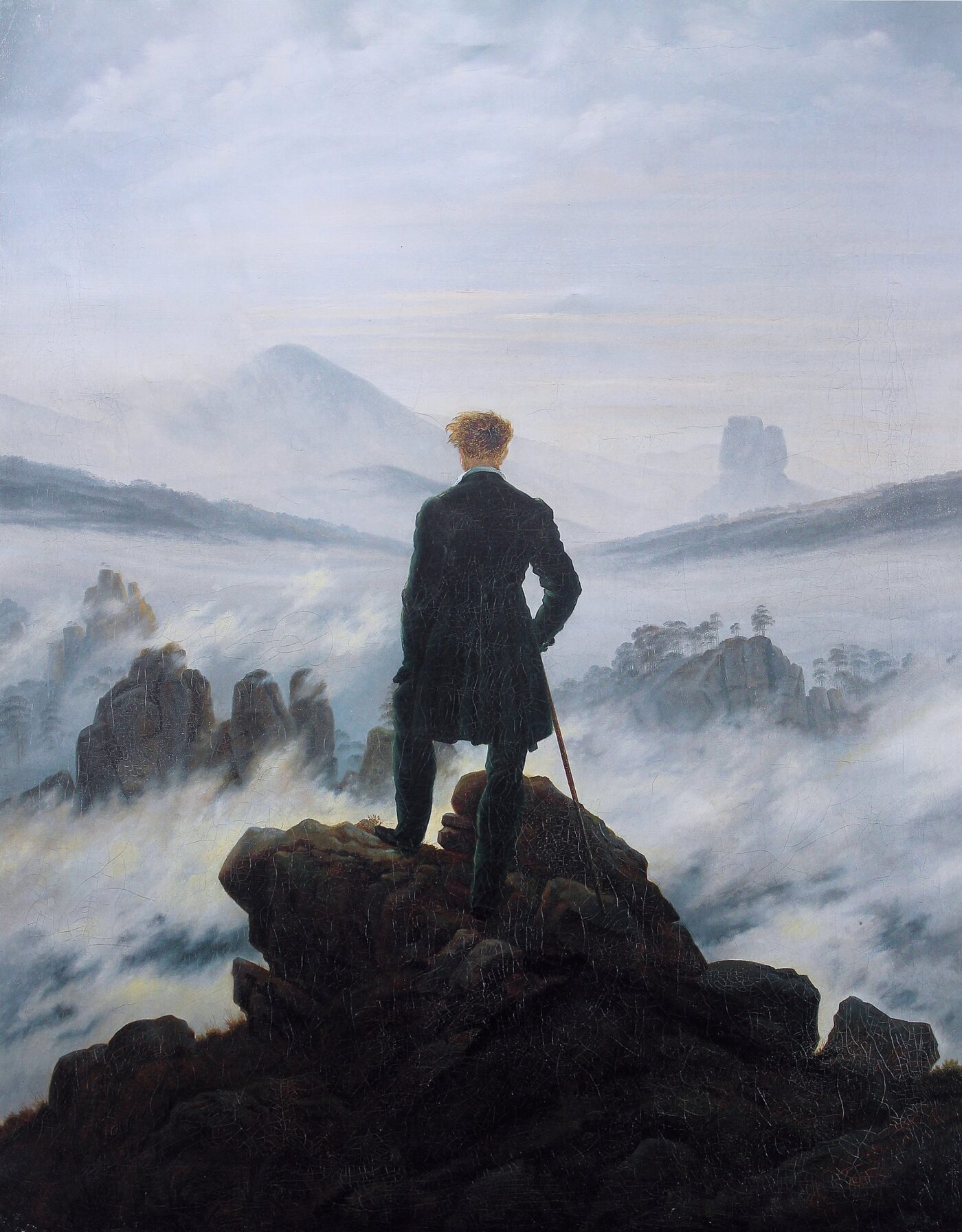
“And Enoch walked with God: and he was not; for God took him.” — Genesis 5:24
1. The ceiling is not the top of the stairs
The previous paper put footprints on the summit: people reach it, the humility that is the whole integration held in an open hand. But the summit of the climb is not the completion of the ascent, and the difference is not one of degree. Every stage from the first to the last was reached by catching — by the volitional act that draws lower-constraint content into a higher-constraint life, the work the whole section has been teaching. The next thing is not more of that. It cannot be.
The reason is exact, and it was set down in Paper G6½. The summit is the grade-3 element, the pseudoscalar — the integration of the three, the closure of the algebra. There is no grade above it; the algebra is exhausted at the whole. To go on is therefore not to climb to a higher grade — there is none — but to begin a new octave at the next constraint level, and that requires a generator the present algebra does not contain. It must enter from outside. No amount of the catching that built the climb assembles it, because catching composes what is within reach, and this is by construction not within reach. You cannot get there from here. Not because the climber is too weak, but because the destination is not on the ladder he is standing on. The ladder ends at its top, and the top is exactly where he is.
This is the one structural fact the whole ascending career finally runs into, and it is not a defect. It is the same shape the Framework found at the top of every octave it read — the individual career, the historical octave, the Law of Seven itself: a last note that cannot turn itself into the first note of the next from its own resources. The climb does everything a climb can do, and arrives, honestly, at the place where climbing is no longer the thing.
2. What it looks like when it comes
So the crossing is made, when it is made, from the other side. The canon is precise about how rare it is to even reach the edge of it in the flesh, and about what happened to the two who did. Enoch “walked with God: and he was not; for God took him” (Genesis 5:24). Elijah went up “by a whirlwind into heaven” (2 Kings 2:11). Both walked all the way to the lip of the seventh state — and neither stayed in it embodied and went on; each was taken, lifted out of the flesh rather than left to carry that content within an ordinary life. That detail is structural: the grade-3 content pressed to the substrate’s limit is precisely what an H₄₈ body cannot hold and remain, and the two nearest figures are the two who were carried out rather than left standing.
And one alone held the whole content in a human substrate and remained within it: the Lord — placed by this Framework not at the summit of the human climb but past it, at the bestowal register, Φ entering H, the unique Incarnation. He is not the proof that a climber crosses by climbing; he is the one case in which the far side came to the near side, because he descended as the crossing rather than ascended into it. For everyone else — including every one of the masters in the paper before this — the crossing is not made in life at all. It is death: the Father’s completing act, the note the climber’s octave could never sound for itself, the close that is also the first note of whatever comes next. The summit is held, as long as it is held, awaiting that act — not as defeat but as the one thing rightly left in another’s hands.
3. The seven gathered
That is the whole shape of Volume G. It took a person — the person reading — and asked where in the ascending career he stands, and what from there the work is. It answered seven times, once for each position the structure makes available within this life, and twice more for the two places the octave does not continue by degrees.
G0–G2 gave the three generators — the moving-and-instinctive ground where the work must actually begin; the emotional center and its oscillation, with the dark night of the senses located as the first grade change of its arc; the intellectual framework and its trap, the willingness to be wrong as the way past it. G2½ treated that first crossing in full: no grade-1 work produces grade-2 structure, so the help must come from outside — available, since one particular morning, to everyone.
G3–G5 gave the three bivectors — the first type that must be achieved and not born into, requiring a real school; the phase change at which the soul deposit becomes permanent and the transmuting field begins; both higher centers in joint operation, with the last vulnerability the intoxication of the heights, answered only by the return downward to the low place. G6 gave the summit itself — humility, the whole integration, reached and shown by the cloud of masters. G6½ gave the crossing past it, which no climb supplies.
That is the road, walked the whole way up and described as far as a description can go. You have learned the seven modes.
4. What the whole apparatus was for
It is worth being exact about what learning them is, and what it is not. To have read the seven modes is to hold the map. The map is good — built carefully, checked against the tradition’s whole record. But the map is not the country, and reading the map is not the walk. Everything in this section was a description of catching; none of it was the catching. The understanding it delivered is not the deposit; it is, at most, the lowered noise floor against which a deposit might now be made. A text can describe everything the catching is and what a whole life oriented toward it looks like — and it cannot catch on anyone’s behalf.
The Logos states the entire practical program in three sentences:
Do not store up for yourselves treasures on earth, where moths and rust destroy and where thieves break in and steal… but store up for yourselves treasures in heaven, where neither moth nor rust destroys and where thieves do not break in and steal. For where your treasure is, there your heart will be also. — Matthew 6:19–21
Read structurally: treasures “on earth” are accumulations at the human level — wealth, status, comfort, security — and the moth and the rust are the dissipative force, time itself, grinding without malice on everything built at that level; the thieves are the competition of others for the same finite pile. Nothing stored there outlasts all three. Treasures “in heaven” are the Φ-proximal accumulations that survive the body’s dissolution and persist toward their home where the inner product is the only structure left; the dissipative force does not reach them. And “where your treasure is, there your heart will be also” is the catching principle stated by the one who structurally is the source: the will follows the investment; it does not lead it. So the command is not to feel differently. It is to invest differently — and the orientation will follow.
5. The note left for you
Which leaves exactly one thing for this work to say, and it is not a finding. It is a question, and it is addressed to the reader and to no one else:
Are you going to begin?
The text cannot answer it. That is not its failure; it is the shape of the thing. Every octave in the Framework held a note it could not strike from within its own resources, and this one is no exception — except that the note it cannot strike is the reader’s own. The map is finished. The summit is climbed and described; the country past it is named, along with the honest fact that no climb reaches it and no text can take anyone across. The one move the whole structure was never able to make — whether the next moment catches or merely holds, whether the treasure, and so the heart, goes up or stays — was always going to be left here. It is left here now, with you, where it has been waiting all along.
References
- Companion papers — the seven modes (G0–G5), the summit (G6), and the two crossings (G2½, G6½). This paper gathers them and adds nothing of its own.
- Paper A5 — the catching principle: the will follows the investment.
- Genesis 5:24; 2 Kings 2:11. Enoch and Elijah — taken rather than left to carry it.
- Matthew 6:19–21. Treasures on earth and in heaven; where your treasure is, there your heart will be also.