← Paper A2B: The Constraint Cascade: The Descent into the Physical
Adam A2C: Down the Staircase
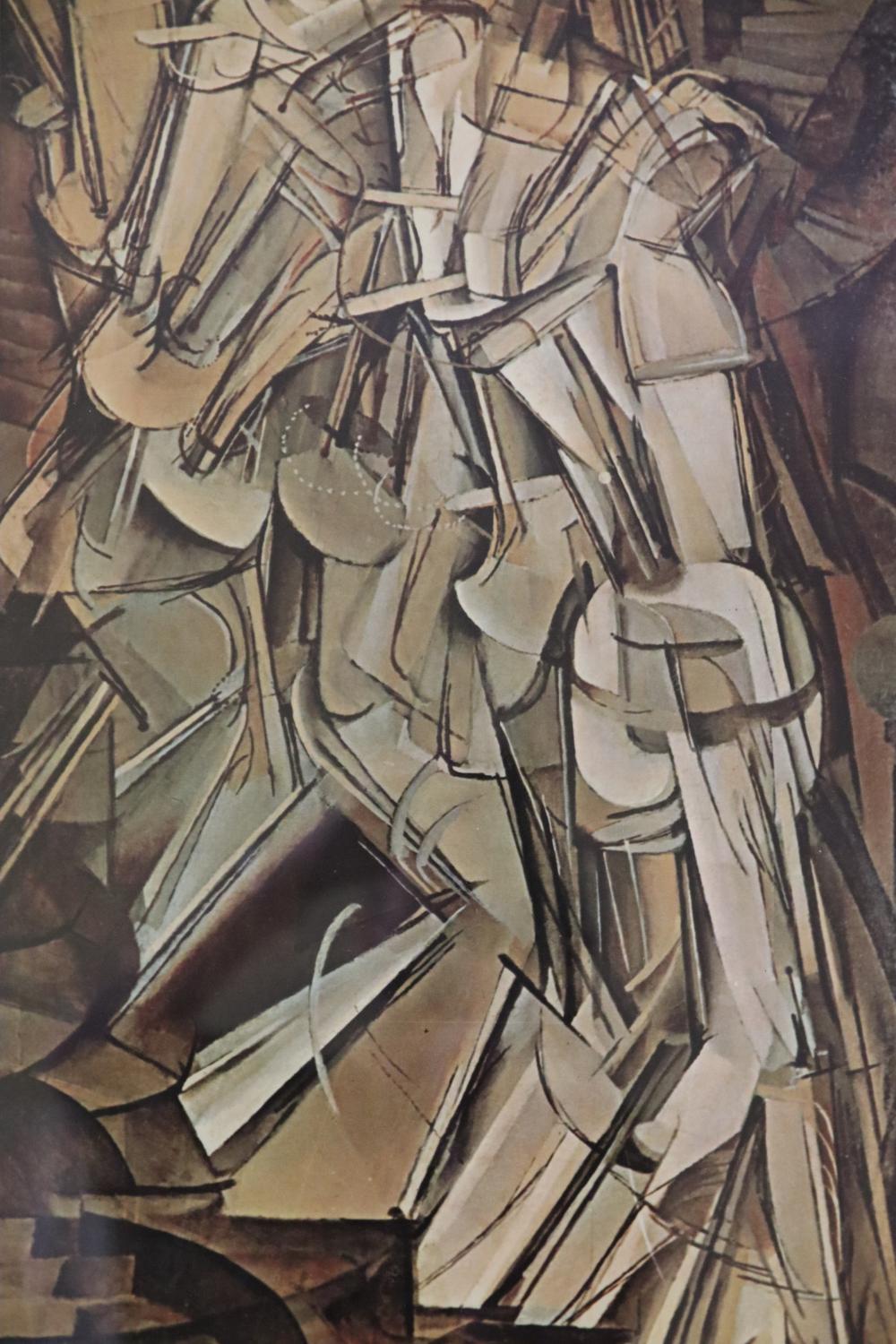
The charm survived the Dirac equation. That was the trouble.
He had gone into the second part the way he used to go into deep water as a young man — sure of himself, on his own ground, certain his feet would find the bottom. And they had walked the structure straight down into Cl(3,1): the spacetime algebra, Hestenes’, the very form of the Dirac equation he had lived inside for fifteen years. They had not got there by writing it down — the way every physicist since Dirac has simply written it down because the experiments demand it — but by counting. Three Persons and no anti-Persons; three positive generators and the single negative their complement leaves behind; therefore three dimensions of space and one of time; therefore the Lorentzian signature, the +,+,+,− that the world insists upon and that no one has ever been able to say why. And out of it drops E = mc², as it must. And out of it drops the photon, massless because it sits exactly on the seam where the two sides meet.
He knew every one of these objects. He had handled all of them his whole working life. What he had never once done — what he could not remember anyone doing — was ask why the signature was that signature and not another. You do not ask. You write down the minus sign because the measurements put it there, and you get on with the day’s work. And here was a stranger claiming the minus sign was the algebraic shadow of a choice — the one undifferentiated negative that any act of definite selection leaves behind it. The minus sign is the Fall. He read the sentence and felt the hair stand up along his forearms, which had not happened to him over a piece of mathematics in longer than he could say.
Now. He made himself sit up straight. Retrodiction. That was the word, and the word was also the defence, and it was a good one — the best he had. Everything they had “derived” was already on the books: Dirac in 1928, Friedmann in 1922, the sky measured flat before they drew their first circle. You can walk backward from any answer you already hold and dress the walk up as a discovery; he had failed undergraduates for exactly this. A framework that hands you back what you already own has performed a conjuring trick, however lovely to watch. It has told you nothing you did not have.
So show me one thing I don’t already own, he told the empty room, and I will sit up. And the part, almost in passing, in a parenthesis, offered him one: that c — the speed of light, the most fixed number in all of physics — ought to drift, because on their account it is not a postulate but an output, a ratio that has been shifting since the beginning. There. That was a neck laid on a block. That was falsifiable. That was not retrodiction.
Except they would not bring the blade down. A working hypothesis, not a claim, said the parenthesis; the actual figure, deferred to a later paper. He nearly laughed aloud. Twice now they had walked him to the one spot where a clever man either says a falsifiable thing or admits that he cannot — and then declined, with great courtesy, to stand on it. They would not claim the proof and they would not yet make the prediction. The animal kept stepping out of the snare a half-second before it shut.
The tea had gone cold again; he had not noticed pouring it. He turned to the third part the way a man keeps going down a staircase in the dark after he has lost the count of the steps — still certain there is a floor, and no longer certain how far below it lies.
Paper A2C: The Constraint Cascade: Where the Two Books Speak →