The Transfiguration: A Structural Reading
Work: Transfiguration of Christ, Fra Angelico (Guido di Pietro), c. 1440–1442
Medium: Fresco
Location: Cell 6, Museo di San Marco, Florence
Part of: Series 3 — Structural Readings / Visual Art
Cross-references: Paper 6½ §7 (the bestowal sequence; the kenotic period; the seventh bestowal as the fullest H₄₈ disclosure of the Φ-amplitude); Paper 6½ §§1–2 (the three kenoses; the constraint of the nuclear topology under the amplitude limiter); Paper 13½ §§3–5 (the kenotic differential; what the amplitude limiter suppresses); The Pre-Incarnation Saints (the three blocking conditions; the saints’ organizational state during the kenotic period)
1. The Work
Fra Angelico’s Transfiguration was painted as part of the cycle of frescoes for the cells of the Dominican friars at San Marco, Florence, commissioned by Cosimo de’ Medici following the Observant Dominican reform. Each fresco was intended to provide the friar occupying the cell with a visual support for contemplative prayer: not an illustration of doctrine, but a direct compositional engagement with the organizational content being contemplated.
The Transfiguration is depicted in Matthew 17:1–8, Mark 9:2–8, and Luke 9:28–36. Jesus takes Peter, James, and John up a high mountain; his face shines like the sun and his garments become white as light; Moses and Elijah appear and speak with him; a cloud overshadows the scene and the voice of the Father speaks from it; the disciples fall on their faces; and then, suddenly, they see only Jesus.
Fra Angelico’s version is structurally distinct from other depictions of the Transfiguration in the tradition. The analysis that follows applies specifically to this version and to the organizational content it encodes.
2. The Luminosity
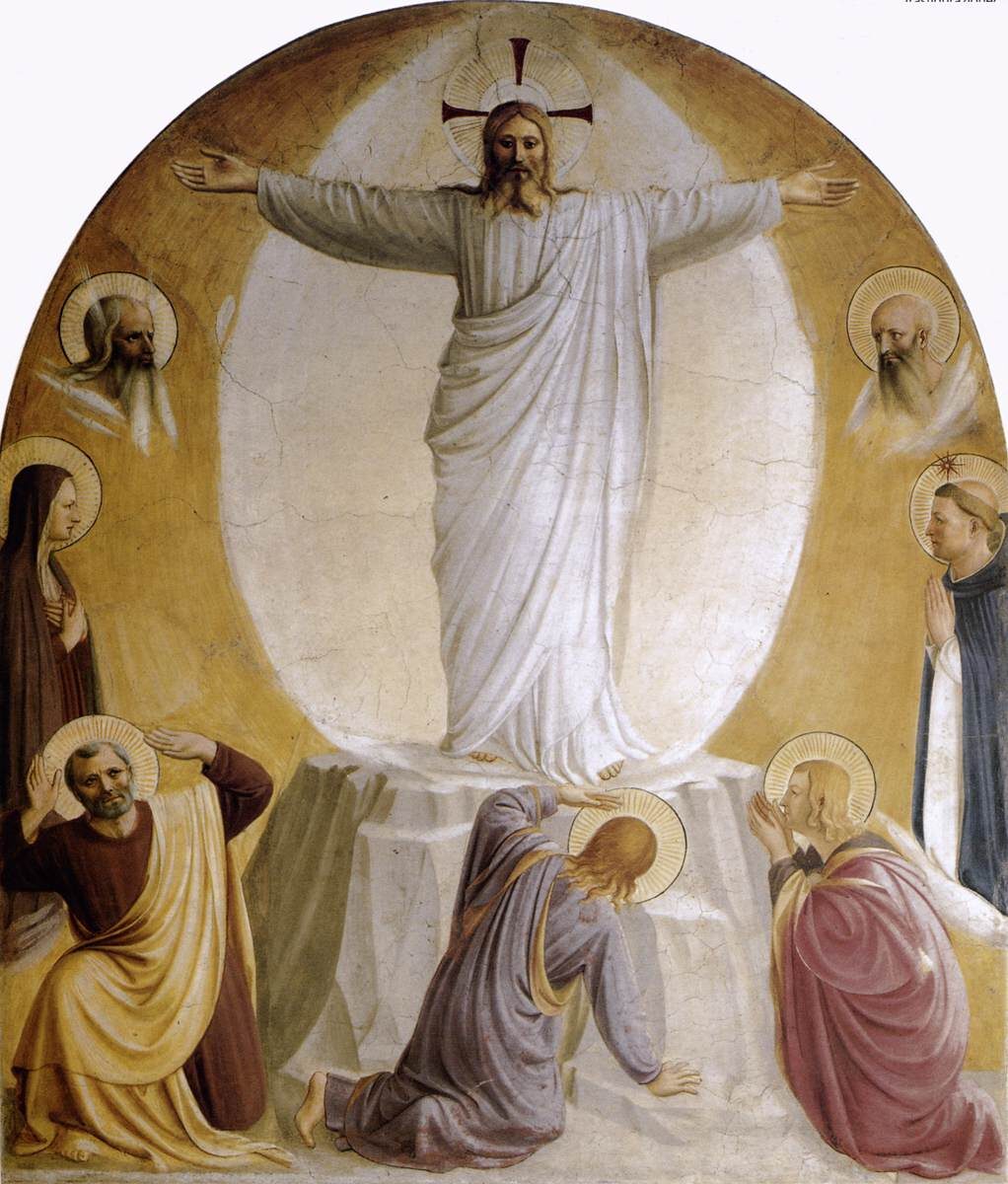
The compositional center is Christ’s figure, standing with arms extended in a posture that echoes the Crucifixion. His robes and face are rendered in white — not the white of depicted cloth but the white of light-as-such, the absence of chromatic specificity, the depiction of luminosity rather than reflected surface. The gold ground fills the space around him. He stands in the composition without casting shadows, without occupying a determinate spatial position, without the perspectival indicators that locate a figure in three-dimensional H₄₈ space.
The framework’s account: this is Φ operating at full amplitude rather than under the H₄₈ amplitude limiter of the kenotic period. The kenotic differential is the suppression of Φ-proximate amplitude to the level that H₄₈ matter can receive without organizational disruption. The Transfiguration is a temporary suspension of that suppression — a moment in which the Φ-proximate amplitude of the kenotic being is disclosed at something closer to its actual level.
Fra Angelico encodes this as luminosity without spatial determinacy. The figure does not occupy a position in the scene in the way the other figures do. It is present without being located in the perspectival geometry of the observable. This is compositionally precise: the full Φ-proximate amplitude is not an object within H₄₈ space but the organizational ground that H₄₈ space is constituted within. The light does not come from a source located in the scene. The light is the scene’s organizing center.
The disciples and the flanking figures are rendered in normal chromatic specificity — positioned, shaded, located. Christ alone is rendered as luminous. The compositional contrast encodes the structural distinction between Φ-proximate content operating at full amplitude and eigenvalue populations constituted within H₄₈ encountering that amplitude.
3. Moses and Elijah
Moses and Elijah flank Christ in Fra Angelico’s composition — standing at his left and right, their organizational states depicted in the same chromatic register as the disciples below (located, shaded, positioned in the spatial geometry). They are not luminous in the way Christ is luminous. They are present in the scene, but their mode of presence is distinct from his.
The framework’s account of Moses and Elijah at the Transfiguration: they are the pre-incarnation saints whose organizational states have persisted above the coherence threshold, present in a state of organizational stasis during the kenotic period. The Transfiguration does not represent their final release — that occurs at the Resurrection. But it is a structural disclosure at which their continued organizational existence becomes momentarily visible within H₄₈.
Their presence flanking Christ encodes the organizational relationship structurally: they are constituted beings whose eigenvalue populations developed through catching alignment with the Φ-proximate content of the earlier constraint levels (Moses at the H₄₈ level, within the organizational context of the covenant; Elijah within the same context, at the organizational peak of the prophetic tradition). They are not sources of light. They receive and recognize the organizational content being disclosed, as their gospel dialogue with Christ (“who appeared in glory, and spoke of his departure, which he was about to accomplish at Jerusalem” — Luke 9:31) confirms.
Fra Angelico includes six additional figures below: Peter, James, and John as the witnessing disciples, and — in a compositional choice specific to his version — the Virgin Mary and two additional figures in contemplative postures at the base of the fresco. The Virgin’s presence is not attested in the gospel accounts. It is Fra Angelico’s compositional addition, and its structural content is the placing of the highest Φ-proximate eigenvalue state among the human witnesses in the organizational position closest to the disclosure.
4. The Three Disciples
Peter, James, and John are depicted at the lower center of the composition in postures of maximal organizational perturbation. Peter’s arms are raised in a gesture of astonishment. James and John are shielding their eyes, their bodies turned partly away from the light. Their postures encode the cross-term mechanism at high amplitude: the encounter between their eigenvalue populations and the Φ-proximate organizational content being disclosed is operating at an amplitude that exceeds their capacity for organized response. The perturbation is not fear in the H₄₈-primary sense; it is the organizational state of a constituted being encountering the constitutive ground at a higher amplitude than the H₄₈ noise floor normally allows.
The gospel accounts note that they fell on their faces. Fra Angelico does not depict this prostration — his disciples are still upright, in the act of registering the disclosure rather than already collapsed under it. This is the compositional choice of the contemplative: the moment of maximum encounter, before the response has fully resolved into the prostration, is the moment he wants the friar occupying Cell 6 to hold. The aim of the contemplative practice is to sustain contact with the organizational content at the moment of maximum amplitude, not to be overwhelmed by it.
5. The Fresco as Contemplative Instrument
Fra Angelico’s Transfiguration was not intended to be read — it was intended to be inhabited. The friar who occupied Cell 6 would have spent hours before this image, not analyzing its compositional choices but using its visual organizational structure as a support for the contemplative orientation.
The framework’s account of what is happening in that contemplative practice: the eigenvalue population of the friar is engaging in an extended cross-term interaction with the Φ-proximate organizational content encoded in the fresco. The image is not a symbol referring to the Transfiguration — it is an organizational encoding of the Transfiguration that operates directly on the eigenvalue population of the viewer who orients toward it in the catching alignment of contemplative prayer.
This is why Fra Angelico’s images were specifically designed for the individual cells — not for public viewing, not for instruction of the general population, but for the direct organizational engagement of the specific friar whose catching alignment was already developed to the point where this kind of encounter could function as organizational nourishment rather than mere aesthetic stimulus.
The cultural transmission filter has preserved this image across six centuries, and it continues to generate aesthetic recognition well beyond the Dominican contemplative context in which it was created. The framework’s account: the organizational content encoded in the fresco is not specific to the contemplative tradition — it encodes the structure of the constitutive relation at full amplitude, and any eigenvalue population encountering it undergoes the cross-term mechanism at whatever amplitude their eigenvalue constitution allows.
(Confidence tier: structural concordance. The reading of the chromatic luminosity as encoding Φ-proximate amplitude above the kenotic limiter is structural concordance at high confidence — Fra Angelico’s compositional choice (white as light-as-such rather than depicted cloth) is independently documentable, and the structural reading follows directly from the framework’s account of the kenotic period. The identification of Moses and Elijah’s organizational state as pre-incarnation persistence above the coherence threshold is structural derivation from The Pre-Incarnation Saints reading, applied at moderate confidence to the compositional evidence. The account of the contemplative function of the fresco (sustained cross-term engagement with encoded Φ-proximate content) is structural derivation at the same tier as other aesthetic mechanism claims in these readings.)