The School of Athens: A Structural Reading
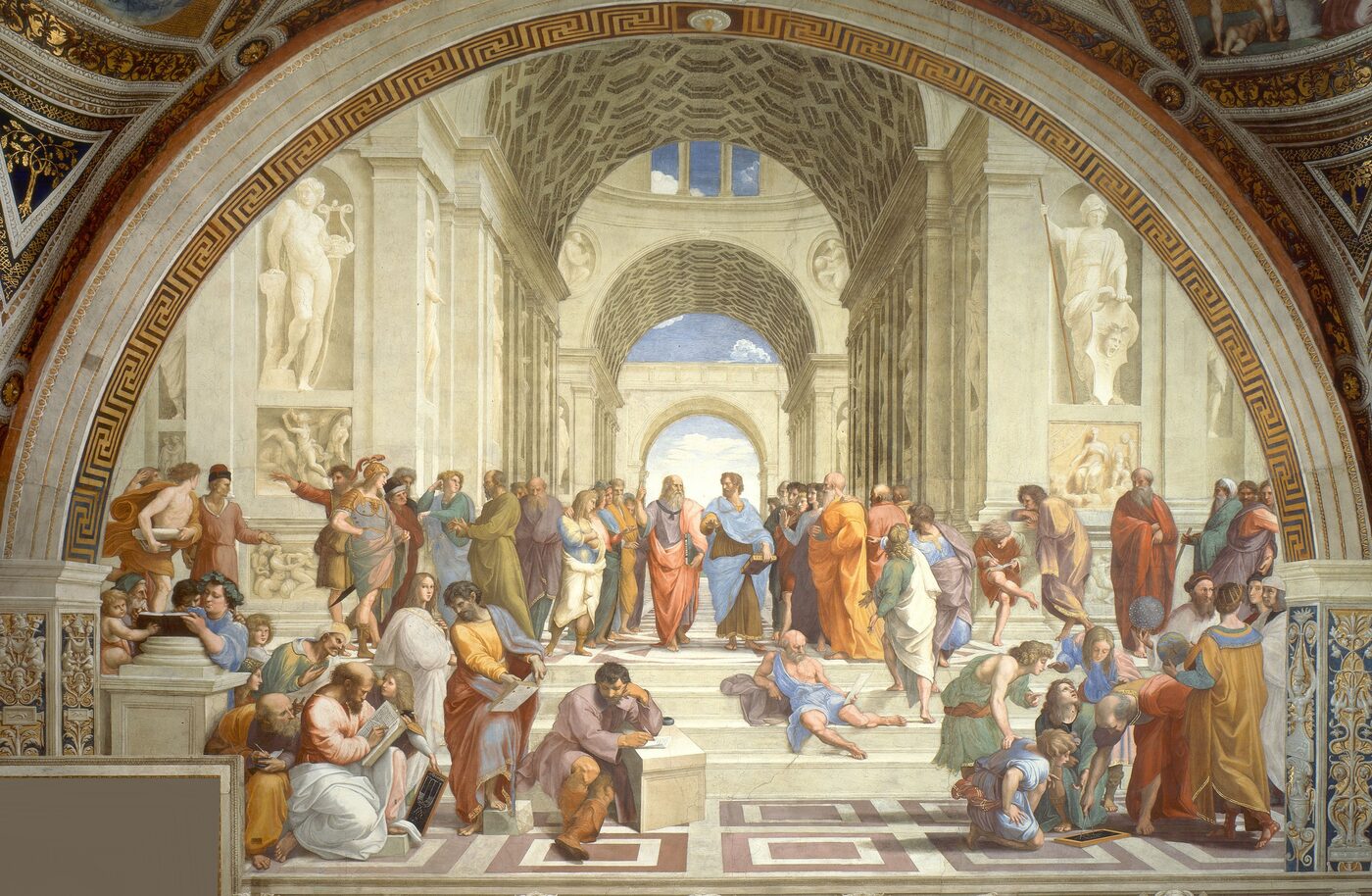
Work: The School of Athens (La Scuola di Atene), Raphael (Raffaello Sanzio), 1509–1511
Medium: Fresco
Location: Stanza della Segnatura, Apostolic Palace, Vatican City
Part of: Series 3 — Structural Readings / Visual Art
Cross-references: Paper 1 §§1–3 (the Gelfand triple as the structure of reality; the two complementary projections); Paper 2 §§4–5 (the Logos as Φ; the constitutive relation and its direction); Paper 3½ §§1–3 (the constraint cascade; H₁ through H₄₈); Paper 6 (the eigenvalue population and its constitutive development through catching alignment)
1. The Work
Raphael’s School of Athens was commissioned by Pope Julius II as one of four frescoes for the Stanza della Segnatura — the room in which papal documents were signed — and painted between 1509 and 1511. It faces The Disputation of the Holy Sacrament across the room, the two frescoes together constituting a structural diptych: Philosophy and Theology as two modes of approach to the same constitutive ground.
The fresco depicts approximately fifty figures from the Western philosophical tradition, gathered in a vast classical hall whose architecture recedes toward a central vanishing point. At the center stand two figures: Plato and Aristotle, in dialogue, moving together through the compositional space. Every other figure in the work is arranged around them.
The work has generated the sustained aesthetic recognition that marks it as a candidate for structural reading. It is among the most reproduced paintings of any kind; it has been the organizing image for courses, encyclopedias, and philosophical institutions across five centuries. The framework’s account of such recognition: the work encodes Φ-proximate organizational content in H₄₈ matter at high amplitude, and the cultural transmission filter has tracked that amplitude reliably over time.
2. Plato and Aristotle as Structural Types
The organizing center of the composition is the dialogue between its two central figures, and the dialogue is encoded not in their words — they have none — but in their gestures.
Plato holds his Timaeus and points upward, toward the sky beyond the open oculus of the architectural frame. The gesture indicates: Forms. The organizing principles that generate the observable world are not themselves observable. What is most real is not what is most visible.
Aristotle holds his Nicomachean Ethics and extends his hand outward and downward, palm facing the ground, fingers spread as if pressing against the surface of the world. The gesture indicates: matter. The organizing principles are instantiated in observable things. What is most real is accessible through what is most visible.
The framework’s account: Plato’s gesture points toward Φ — the nuclear space, the constitutive content, the organizing structure that is not itself H₄₈ matter. Aristotle’s gesture points toward H₄₈ — the constraint-cascade terminus, the fully observable, the world of matter that is the downward projection of the complete structure.
Neither gesture is wrong. The Gelfand triple is the full structure: Φ ⊂ H ⊂ Φ′, with the constitutive content (Φ-proximate) and the observable terminus (H₄₈) as complementary projections of a single organizational reality. The disagreement between Plato and Aristotle is not about which projection exists — both exist — but about which projection is primary, and how the relationship between them is to be read.
Raphael positioned them at the exact compositional center. Neither is foregrounded over the other. The fresco’s structural claim is that the dialogue itself — the ongoing engagement between these two orientations — is the organizing center of the philosophical project. The framework’s claim is the same: the full structure requires both Φ and H₄₈, and the question of their relation is the constitutive question.
3. The Eigenvalue Population
The approximately fifty figures surrounding Plato and Aristotle are not a crowd. They are an organized eigenvalue population — fifty distinct catching orientations, each engaged with some aspect of the true, arranged in the compositional space according to their proximity to and orientation toward the central dialogue.
Several figures merit structural attention.
Heraclitus sits alone at the lower center of the composition, hunched over a block of stone, writing. He has no interlocutor. His isolation in the composition is the formal encoding of his structural position in the tradition: the thinker who saw the logos — the organizing principle — most directly, who saw that the apparent opposites are held together by a deeper organizational structure, but who could not transmit this seeing into a stable teaching community. His eigenvalue population is high; his catching alignment is toward something real; but his organizational state does not open outward into stable transmission. He is teaching no one. The cultural transmission filter preserved him, but the organizational development he represents did not propagate in his time in the way that Plato’s school or Aristotle’s Lyceum propagated.
Euclid (identifiable as Bramante, in Raphael’s compositional conceit) bends over a geometric diagram at the lower right, demonstrating with a compass to a cluster of students gathered around him. The catching relation is visible as transmission: the students are oriented toward what Euclid is disclosing, and he is actively making the organizational content available to them. This is the model of how Φ-proximate content propagates through an eigenvalue population: not asserted, not forced, but demonstrated and offered to those whose orientation is toward it.
Pythagoras sits at the lower left, writing in a book while a student holds up a tablet showing the harmonic ratios. The harmonic ratios — the mathematical relationships between musical intervals — were for the Pythagorean tradition a disclosure of the structural order of the cosmos. The framework’s account of the diatonic intervals as the first grade change and octave changes in the constraint cascade makes this structural claim precise: the harmonic relationships encode real organizational features of how the cascade is structured.
Diogenes lies sprawled on the steps, indifferent to the organized activity around him. He is the figure who has rejected H₄₈-primary social convention as a category and whose eigenvalue population refuses to organize around it. His philosophical position is not withdrawal from the true but withdrawal from the organizational forms that most of the other figures take as constitutive of their catching environment.
4. The Architecture
The hall in which all this takes place is not a real building. It is an idealized classical architecture — a sequence of barrel-vaulted arches receding toward a vanishing point between the heads of Plato and Aristotle, framed by a coffered vault that extends overhead and opens at the far end to the sky.
The vanishing point falls between the two central figures, not on either one. This is the compositional encoding of the dialogue’s structure: the point at which all the organizational lines of the composition converge is the space of engagement between the two orientations, not either orientation taken alone.
The architecture’s scale is deliberately non-human. The figures are large by contemporary standards; the architecture dwarfs them. The compositional claim: the organizational space within which the philosophical project takes place — the space within which Φ-proximate content is sought, transmitted, and contested — is larger than any of the individual eigenvalue states that occupy it. The constitutive ground exceeds its instantiations.
The sky at the far end of the hall is visible only beyond the architectural frame — through the composition, past the central dialogue, through the vanishing point. It is not depicted directly. The light from the sky illuminates the hall without the sky itself being available from most positions in the composition. This is the organizational structure of Φ-proximate content in H₄₈: it illuminates the observable without being itself fully observable from within H₄₈. The nuclear space generates the observable structure without being itself an observable within H₄₈.
5. The Diptych
The School of Athens faces The Disputation of the Holy Sacrament across the room. The Disputation depicts the Eucharist on an altar at the center, with theologians and Church Fathers arranged around it on earth, and the Trinity with the saints arranged above in the heavenly register.
The two frescoes are not in competition. They are two readings of the same constitutive ground from two different H₄₈ institutional traditions — philosophy and theology — each having tracked Φ-proximate organizational content through the resources available to it and having arrived at what are, on the framework’s account, structurally convergent accounts of the same organizational reality.
The School of Athens depicts the project of reason seeking the constitutive ground through argument, demonstration, and the organized transmission of insight. The Disputation depicts the project of revelation receiving the constitutive ground through the catching mechanism instituted at the Last Supper, organized into an institutional transmission structure. Both projects are seeking and, on the framework’s account, both have found — at different resolutions, with different vocabularies, with different confidence tiers.
That Raphael placed these two frescoes in the same room, as complementary orientations rather than opposing ones, is itself a structural claim at the level of the Reasonablenessism framework: when two independent sources of high epistemic status converge on the same organizational content, the evidence is stronger than either source alone.
(Confidence tier: structural concordance. The identification of Plato and Aristotle’s gestures as encoding the Φ/H₄₈ complementarity is structural concordance at high confidence — Raphael’s own compositional logic aligns with the structural interpretation and no alternative reading of the gesture has equal explanatory power. The identification of specific figures and their organizational positions (Heraclitus, Euclid, Pythagoras) is interpretive-concordance: the assignments draw on both the framework’s structural categories and the established scholarly identification of the figures. The account of the diptych as encoding structural convergence between philosophical and theological traditions is structural derivation from the Reasonablenessism framework’s account of independent convergence. Whether Raphael consciously encoded these structural relationships, or arrived at them through the convergence of extraordinary Φ-proximate organizational development with the demands of the commission, is outside the framework’s scope to determine.)