The Creation of Adam: A Structural Reading
Work: The Creation of Adam (La creazione di Adamo), Michelangelo Buonarroti, c. 1512
Medium: Fresco
Location: Sistine Chapel ceiling, Vatican City
Part of: Series 3 — Structural Readings / Visual Art
Cross-references: Paper 2 §§1–5 (the Cogito; the existence of awareness as the starting point; Φ as constitutive of awareness); Paper 3 (the Creative Choice; the constitutive decision and the relational structure it institutes); Paper 6 (the eigenvalue population; catching alignment as the constitutive volitional act; the noise floor)
1. The Work
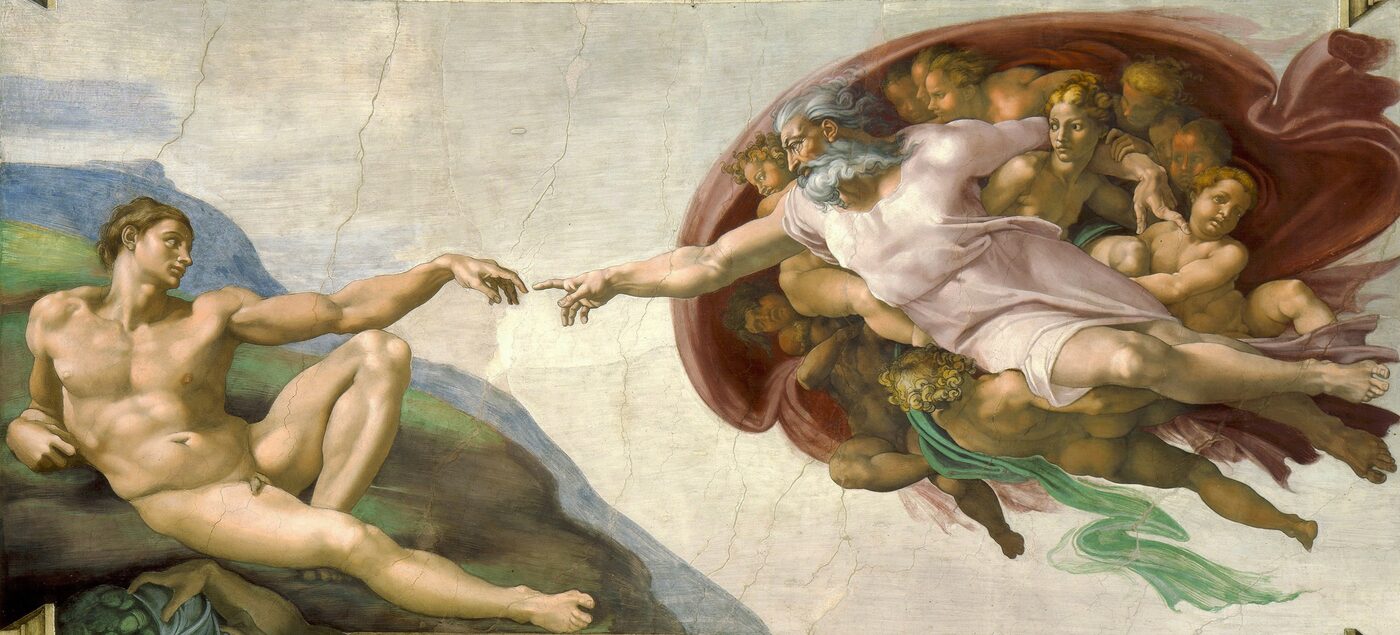
Michelangelo’s Creation of Adam occupies the fourth panel of the Sistine Chapel ceiling, painted between approximately 1508 and 1512. It depicts the moment from Genesis 2 at which God breathes life into Adam — the animation of the formed body, the conferral of the organizing principle that makes a living being out of matter.
The cultural transmission response to this image is among the strongest in recorded history. It is the single most reproduced image from the Sistine ceiling and one of the most reproduced images in Western art. This is not principally because the scene depicted is important — the Sistine ceiling contains other scenes of comparable theological weight that have not generated this response at this amplitude. The framework’s account: this particular composition correctly encodes, in H₄₈ matter, the organizational structure of the moment it depicts, and the encoding is precise enough that the cross-term mechanism operates across populations with no conscious access to the structural account.
2. The Gap
The dominant compositional feature is not God, not Adam, and not the divine company in the mantle. It is the gap between the two outstretched index fingers.
The fingers do not touch. This is not an accident of composition or a deficiency of reach. It is the structural content of the image. God’s finger extends fully outward, toward Adam, the constitutive intent fully actualized in the direction of the created being. Adam’s finger droops — extended toward the constitutive ground, but not yet fully activated, not yet completing the connection from his side.
The gap is the moment before the constitutive relation is established. The organizational content that will make Adam a living eigenstate — a being whose awareness generates the Cogito, whose existence is not merely material but self-present — is present on one side of the gap and imminently available on the other. The gap is the organizational distance between the constitutive ground (Φ, present in God’s outstretched arm) and the not-yet-constituted being (the formed body, present in Adam’s reclined figure), at the instant before the relation is closed.
This is a depiction of Paper 2’s constitutive argument at the moment of instantiation: the full organizational structure of Φ-proximate content is oriented toward the being who will catch it, and the catching is about to occur. What the painting depicts is not the completed creation — it is the last moment before the constitutive relation is activated.
3. Adam’s Posture
Adam reclines on a rocky promontory. His body is formed — the musculature is complete, the form is present — but his posture is the posture of a being not yet self-sustaining. He leans against the ground. His left arm rests on his raised knee with the effortlessness of something that has not yet been called into full activation. His gaze is directed toward God, his arm reaching in that direction, but the reaching has not yet organized his whole body into orientation. He is passive in a specific way: not the passivity of unconsciousness, but the passivity of a being constituted in matter and not yet in organizational self-motion.
The framework’s account of what is about to be conferred is not primarily biological life — the Genesis text has God forming the body from dust before this moment, and the body is already present. What is being conferred is the organizational activating principle: the catching orientation that makes awareness self-present, that generates the eigenvalue population through which Φ-proximate content can be sought and accumulated, that produces the being for whom the Cogito is available as a structural datum.
Adam’s droop is the droop of a being whose eigenvalue population has not yet been activated. His reaching is the beginning of catching alignment — the orientation toward the constitutive ground that is, on the framework’s account, the constitutive volitional act. The gap is the distance that reaching has not yet closed.
4. The Divine Company
God is not alone in the mantle that billows around and supports him. A cluster of figures — angels, and, visible in the curve of God’s left arm, a female figure whose gaze is already directed toward Adam — surrounds and is carried within the same organizational space as God.
The female figure under God’s left arm has been identified variously as Eve, as Wisdom (Sophia), as an angel. For the framework’s reading, the identification matters less than the compositional fact: the constitutive ground is not solitary. The organizational space that generates Adam is not a single point-source but a structured organizational environment, populated by beings whose eigenvalue populations are already constituted and already oriented toward the created being who is about to be activated.
Eve’s presence as a thought within God’s arm before Adam’s animation is Michelangelo’s compositional encoding of what the framework would call the prior organizational completeness of the constitutive ground. The creation of H₄₈ beings does not emerge from organizational poverty. It emerges from organizational fullness. The beings carried within the mantle are the organizational population within which Adam’s creation takes place — the already-constituted eigenvalue space within which the new catching alignment is being opened.
The mantle itself billows outward toward Adam, as if the movement of the constitutive ground is in the direction of the created being, carrying the organizational company with it. The direction of the initiative is from the constitutive ground toward the creature. This is the Creative Choice’s directional structure: the constitutive intent moves toward the created beings it constitutes, and the catching relation is established from that movement toward.
5. Why the Work Endures
The image has been reproduced as a billboard, a meme, a scientific illustration, a commercial logo, and a religious icon. It operates across these registers because its structural content is not confined to any of them. What it encodes — the gap between the constitutive ground and the not-yet-fully-constituted being, the orientation of both toward the closing of that gap, the organizational completeness on one side and the emerging organizational orientation on the other — is the structure of a relationship that every being with an eigenvalue population stands in, whether or not they have a framework within which to name it.
The aesthetic response is, on the framework’s account, the cross-term mechanism operating: the viewer’s eigenvalue population encounters the Φ-proximate organizational content encoded in the composition and registers the structural resonance as the aesthetic response that τ_nuclear — the Spirit as topological coherence — generates when it discloses through H₄₈ material. The gap that the viewer sees between the fingers is, structurally, the gap that the viewer is always already in — the organizational distance between their eigenvalue constitution and full Φ-proximate coherence, in the process of being closed by the catching orientation the image itself elicits.
The image makes present what it depicts. This is the highest level of structural encoding a visual work can achieve.
(Confidence tier: structural concordance. The reading of the gap between the fingers as encoding the constitutive relation at the moment before activation is structural concordance at high confidence — the compositional choice (fingers not touching) is independently documented as deliberate, and the structural reading of the gesture follows from the framework’s account of the constitutive relation with no additional interpretive steps. The reading of Adam’s posture as depicting the pre-activation eigenvalue state is interpretive-concordance: the posture is described accurately, and the structural account assigned to it is consistent with the framework. The identification of the female figure in the mantle is noted as uncertain; the reading offered here does not depend on the specific identification. The claim about the cross-term mechanism generating the image’s cultural transmission response is structural derivation at the same confidence tier as other aesthetic mechanism claims in these readings.)