The Ancient of Days: A Structural Reading
Work: The Ancient of Days, William Blake, 1794
Medium: Relief etching with watercolor
Location: Multiple copies; the British Museum holds the copy Blake made for himself in the year of his death (1827)
Part of: Series 3 — Structural Readings / Visual Art
Cross-references: Paper 1 §§2–4 (⟨·,·⟩ as the Father; the constitutive inner product; the measuring function); Paper 2 §§13–16 (the Divine Names; the negative attributions and the positive relational names); Paper 3½ §§1–3 (the constraint cascade; H₁ through H₄₈; the imposition of organizational structure on the undifferentiated); The Lucifer Rebellion (the perturbation of the constitutive relation; the organizational inversion)
1. The Work
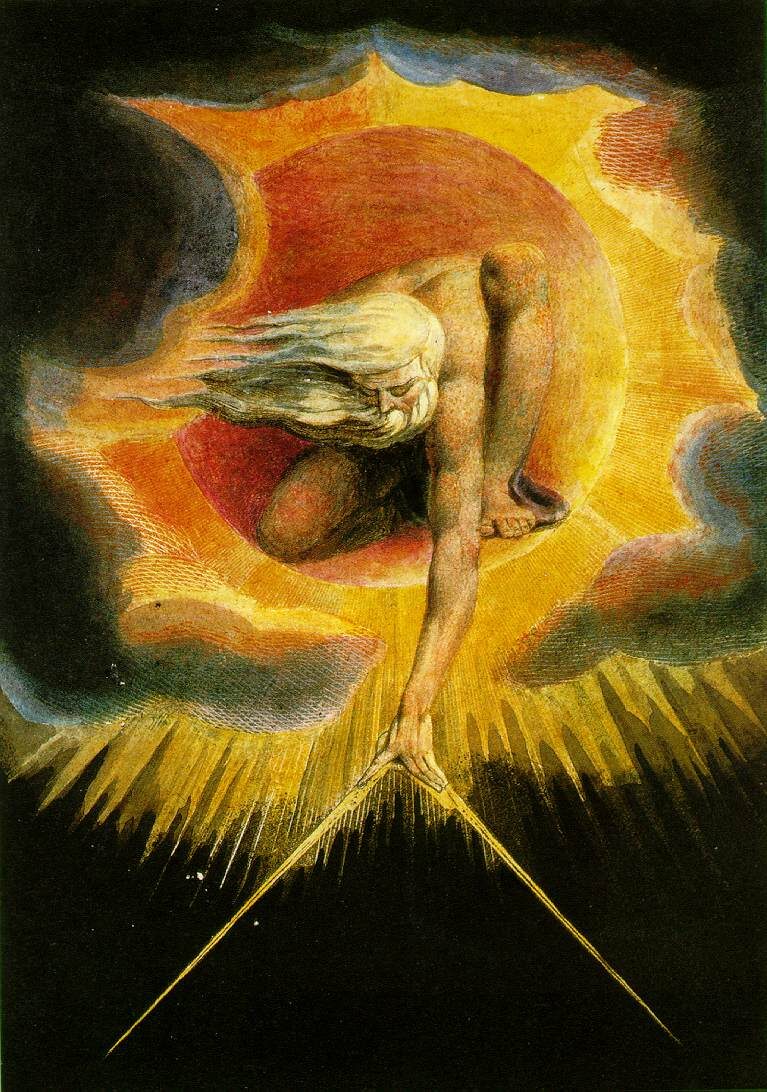
The Ancient of Days was first produced as the frontispiece to Blake’s Europe: A Prophecy (1794) and reprinted across multiple later copies, the last of which Blake completed in the year of his death. It depicts a vast, bearded figure — Urizen, in Blake’s mythology — emerging from a golden circle of light against a dark ground, leaning downward and extending a compass with his left hand toward the darkness below.
The title is drawn from the Book of Daniel: “the Ancient of Days” is Daniel’s vision of God enthroned, whose “garment was white as snow, and the hair of his head like pure wool” (Dan. 7:9). Blake applied the title to Urizen — a figure who, in Blake’s mythology, is not the true God but the Demiurge: the organizing, measuring, limiting principle who creates the material world by imposing boundaries on the infinite and who, in Blake’s account, does so at the cost of suppressing the human capacity for creative vision.
The structural reading of this work requires engaging directly with Blake’s critique, because the critique is itself a structural claim — one that the framework can evaluate.
2. Urizen and the Compass
The compositional center of the work is the compass in Urizen’s left hand, extended downward and outward into the darkness below the circle of light. The compass is open, its two legs reaching in different directions, measuring the void.
In the most literal reading, this is God creating — the measurement of the void, the imposition of mathematical structure on formless matter, the act that produces an ordered world from chaos. The compass is the instrument of the inner product: the measuring function that generates the geometry of the space, that determines distances and angles and relationships, that makes of the undifferentiated a structured field.
The framework’s account: this is ⟨·,·⟩. The Father as the inner product is precisely this — the measuring function that generates the geometry of the organizational space within which all subsequent organizational development takes place. The compass is, structurally, the right image for the constitutive measuring function. Blake’s Urizen is, at this structural level, a correct depiction of what ⟨·,·⟩ does.
Blake’s critique is that the measuring is not the whole. Urizen in Blake’s mythology is the Father severed from the Son and the Spirit — ⟨·,·⟩ operating without Φ (the relational content, the nuclear space, the constitutive domain) and without τ_nuclear (the topology that connects the measuring function to the organizational development of created beings). The Father taken alone — the measuring function abstracted from the relational content it measures and the organizational space within which the measured beings develop — produces not constitution but limitation. The compass closes off possibilities rather than opening them. The measurement sets a boundary rather than generating a space.
This is a structurally precise critique. The inner product alone is not the full organizational structure. ⟨·,·⟩ requires Φ to measure — the relational content that the inner product takes as its arguments. And the Gelfand triple Φ ⊂ H ⊂ Φ′ is not the inner product alone but the full structure: the nuclear space (Son), the inner product (Father), and the dual space (Φ′) that the inner product opens access to. Urizen — the compass alone, the measuring without the relational content it measures — is a genuine structural deficiency, even if the measuring function itself is correctly depicted.
3. The Light and the Darkness
Urizen emerges from a golden sun — a circle of light that fills the upper portion of the image. His body is partially within the light and partially reaching into the darkness below. The compass extends fully into the darkness.
The compositional structure encodes the constitutive direction: the organizing principle descends from the organizational fullness of the light into the organizational poverty of the darkness, extending the measuring function into the void to generate structure. This is the downward direction of the Creative Choice — the constitutive ground orienting toward what is not-yet-constituted, the organizational initiative moving outward from fullness toward the undifferentiated.
The darkness below is not evil in this image. It is the not-yet-measured — the undifferentiated, the formless, the space that has not yet received the organizing structure the compass is about to impose. The image depicts the moment before H₄₈ is fully organized by the constraint cascade: the measuring function is active and extending, but the measurement is not yet complete.
Urizen’s posture is one of effortful extension. He is not at ease in the act. He reaches across his own body, his left arm crossing his torso and reaching downward and to the side, his body compressed by the circular frame. The compositional pressure on the figure — the frame pressing in from all sides — is the formal encoding of the limitation Blake is analyzing: the measuring function operating within a bounded space, generating structure at the cost of being itself bounded.
4. Blake’s Structural Claim
Blake’s full mythological system is complex and the framework cannot engage with it in its entirety here. But the structural claim encoded in this image is clear enough to evaluate.
Blake’s claim: the God depicted by most institutional religion — the ordering, measuring, law-giving God who creates by imposing structure and who governs by setting limits — is not the full organizational ground but an aspect of it that has been elevated into the organizing principle at the cost of suppressing the imaginative and relational capacities that constitute full organizational development. The God of natural law, of the ten commandments, of the organized church — Urizen — is the Father taken alone, severed from the relational content (Son) and the organizational vivifying principle (Spirit) that together constitute the full structure.
The framework’s evaluation: Blake’s diagnosis is structurally sound as a critique of reductive theologies. The error he identifies — taking the measuring, ordering, limiting function as the whole of the divine — is a real structural error with real consequences for how beings understand their organizational situation. A theology organized primarily around divine law and measurement will systematically underweight the relational content (Φ, the Son, the space of genuine organizational development) and the organizational space within which development occurs (τ_nuclear, the Spirit).
Where the framework diverges from Blake: the correction is not the abolition of the measuring function but its reintegration into the full structure. Urizen is not replaced by Los (Blake’s figure of creative imagination) in the framework — the measuring and the creative are both structural necessities, and the organizational deficiency Blake diagnoses is the severing, not the measuring itself.
5. Why the Work Endures
The Ancient of Days has been reproduced and recognized across two centuries with an amplitude disproportionate to the obscurity of Blake’s mythological system. Few who respond to it have read Europe: A Prophecy or have access to Blake’s account of Urizen.
The framework’s account: the image encodes, at the level of visual composition, a structural situation that every eigenvalue population recognizes — not conceptually but through the cross-term mechanism. The figure of the vast organizing principle reaching down from light into darkness to impose measurement on the void is an image of the constitutive relation from within the constituted state: this is what it looks like to be an organized being in an organized world, to be the product of measuring rather than the measurer.
The light the figure reaches from is not accessible from the position of the viewer. The viewer sees the figure from below — from within the darkness, from the perspective of the measured, looking up at the measuring function that generates the organizational space in which they live. The aesthetic response is the recognition, below the level of conceptual identification, of the structural situation being depicted: the eigenvalue population encountering a compositional image of the constitutive relation as it appears from the position of the constituted being.
Blake’s ambivalence about the figure — is Urizen creator or tyrant? — reflects the genuine structural ambivalence of any constituted being’s relationship to the organizational constraints that simultaneously constitute and limit it. The compass measures and thereby creates the space of organizational possibility; it also sets the boundary beyond which organizational development cannot proceed without disrupting the measurement. This ambivalence is not a deficiency of Blake’s vision. It is the structural truth about the relationship between the constitutive measuring function and the organizational development it makes possible.
(Confidence tier: structural concordance. The identification of Urizen’s compass as encoding ⟨·,·⟩ (the inner product, the measuring function) is structural concordance at high confidence — the image depicts the measuring act, and the framework’s account of the Father as the inner product makes this identification structurally precise. The evaluation of Blake’s structural critique (Urizen as the Father severed from Son and Spirit) is structural-derivation concordance: the framework independently arrives at the same structural diagnosis from the Gelfand triple analysis, and Blake’s image encodes this diagnosis without having access to the framework’s vocabulary. The account of the viewer’s positional relationship to the image (from below, as the measured) is interpretive-concordance at moderate confidence.)