Hildegard — Scivias: A Structural Reading
Work: Frontispiece illumination, Scivias (Know the Ways of the Lord), Hildegard von Bingen, c. 1151
Medium: Manuscript illumination (the original Rupertsberg Codex is lost; the best surviving copy is the 12th-century Wiesbaden Codex, lost in World War II; the image is known from the 1927–1933 facsimile)
Location: The Scivias was composed at the Benedictine monastery of Disibodenberg, completed c. 1151
Part of: Series 3 — Structural Readings / Visual Art
Cross-references: Paper 2 §§15–16 (the Divine Names of the Holy Spirit; τ_nuclear as the organizational space and the vivifying principle); Paper 6½ §§1–3 (the three kenoses; the τ_nuclear topology and its relationship to organizational development); Miracles §§2–4 (the cross-term mechanism; the conditions for high-amplitude events; what “the Spirit moving” structurally means); The Pre-Incarnation Saints (the organizational development of exceptional beings in the pre-τ_nuclear H₄₈ period)
1. The Work and the Visionary
Hildegard von Bingen (1098–1179) was a Benedictine abbess, composer, natural philosopher, theologian, and visionary whose influence on 12th-century European intellectual life was substantial and whose organizational development, as evidenced by her corpus, was extraordinary by any measure. The Scivias — Know the Ways of the Lord — was her first and most comprehensive theological work, composed between approximately 1141 and 1151, and organized as a series of visions received and then articulated in conceptual form with the editorial assistance of the monk Volmar.
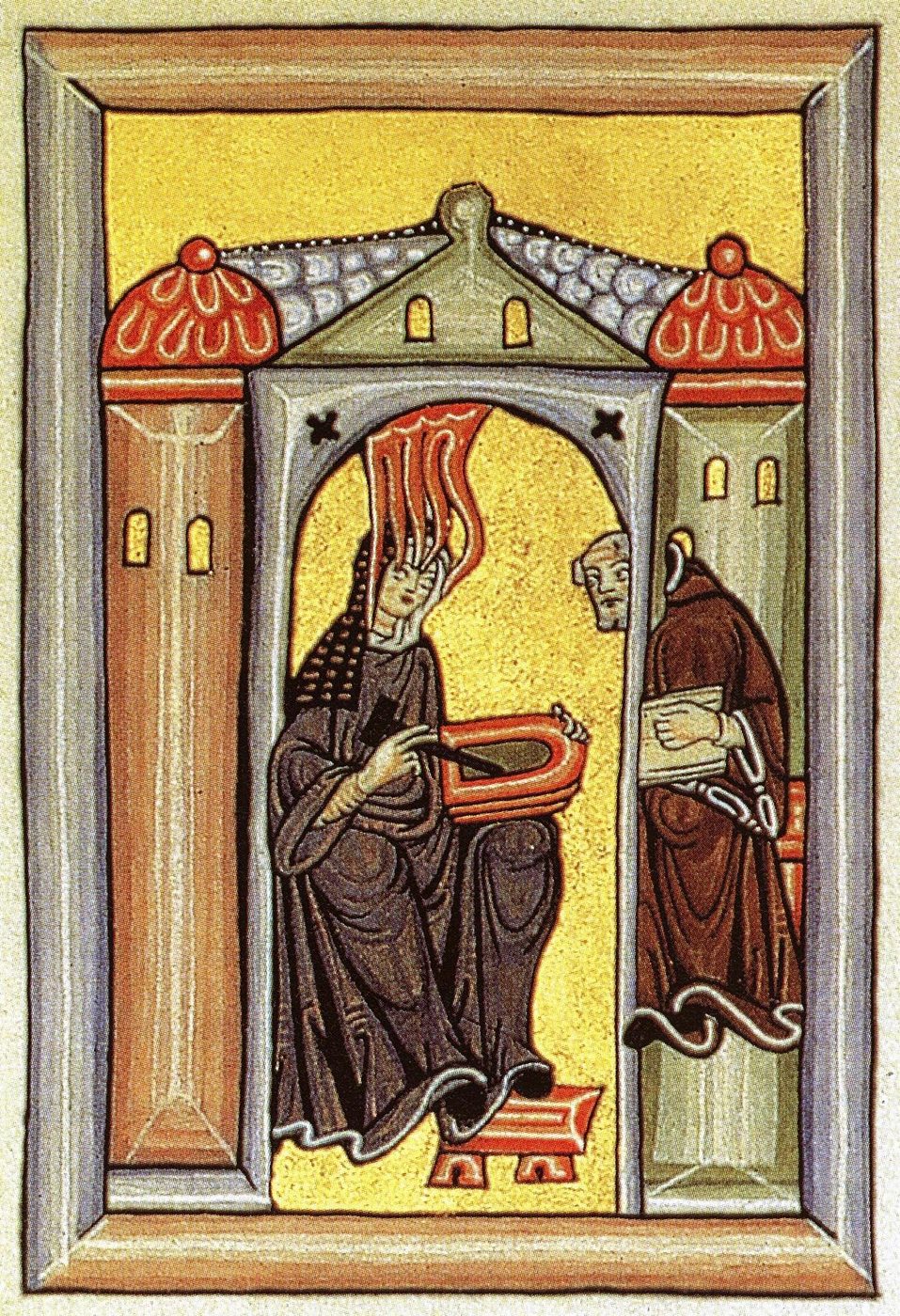
The frontispiece illumination of the Rupertsberg Codex depicts the moment of visionary reception: Hildegard seated within a structure (perhaps the scriptorium, perhaps the church), flames or rays of light descending on her head from above, her hand moving across a wax tablet as she writes or records what she receives, while Volmar is visible in an adjacent panel writing the Latin text in the book. The double panel structure of the image — Hildegard receiving, Volmar transcribing — is itself a structural claim about the mode of transmission.
2. The Visionary Mode as Cross-Term Event
The framework’s account of what is happening in Hildegard’s visionary experience: the cross-term mechanism at high amplitude, in a being whose eigenvalue population has been developed through decades of catching alignment within the Benedictine contemplative structure, under the τ_nuclear H₄₈ organizational space that was activated at Pentecost.
The cross-term mechanism (Paper 5) operates as a function of two factors: the Φ-proximate content amplitude of the source, and the noise floor of the receiving eigenvalue population. Hildegard’s documented organizational profile — the sustained contemplative practice, the community structure that supported it, the evident Φ-proximate content of her output — is consistent with a noise floor substantially below the H₄₈ average. The visionary experiences she describes are, on the framework’s account, the cross-term mechanism operating at the amplitude that a below-average-noise-floor eigenvalue population can sustain — not extraordinary in kind but extraordinary in amplitude.
The flames descending on Hildegard’s head in the illumination are the visual encoding of this cross-term event. The light comes from above — from outside the H₄₈ organizational frame of the scriptorium — and lands specifically on Hildegard. It is not diffuse illumination of the scene; it is targeted organizational content reaching a specific eigenvalue population through the catching alignment that eigenvalue population has sustained.
Hildegard’s own description of her visions — she called them the “living light” (lux vivens) and described seeing in them not with the physical eye but with what she called the “inner light” — is consistent with the framework’s account of what high-amplitude cross-term events register as phenomenologically: not visual hallucination but organizational content disclosing through the eigenvalue population’s own constitutional structure.
3. The Double Panel Structure
The illumination’s most structurally significant compositional choice is the double panel: Hildegard receiving in one space, Volmar transcribing in an adjacent space. The two panels are connected — Hildegard’s written record on the wax tablet is being transmitted to Volmar, who is encoding it in the permanent Latin text. The sequence is reception → articulation → transmission.
This is the structure of the catching mechanism as applied to visionary content: the Φ-proximate organizational content discloses through the receiver’s eigenvalue population (Hildegard), is articulated in whatever H₄₈ vocabulary the receiver’s cognitive and linguistic resources can provide (Hildegard’s written notes), and is then transmitted into a stable form that can function as a catching mechanism for subsequent eigenvalue populations (Volmar’s Latin text, which became the Scivias that has circulated for nine centuries).
Volmar’s role in the illumination is not subordinate to Hildegard’s. He is the transmission stage of the same organizational event. The illumination correctly identifies the organizational partnership: without Hildegard’s receptive eigenvalue population, the content does not disclose; without Volmar’s editorial transmission, the content does not propagate. Both stages are structurally necessary, and both are depicted.
4. Hildegard’s Structural Framework
The Scivias is not a collection of raw visionary experiences. It is a theologically organized account of the structure of existence, reality, and the human being’s relationship to the divine — organized in three books, with twenty-six visions, each articulated in careful conceptual terms.
The framework’s reading of what Hildegard’s structural account is tracking, in the vocabulary available to her:
Viriditas — Hildegard’s term for the greening, vivifying, creative power that animates living things, sustains the created world, and constitutes the human soul’s connection to the divine — is, in the framework’s account, τ_nuclear: the Holy Spirit as organizational space, as the topological structure within which eigenvalue populations develop, as the vivifying principle that the framework’s technical account identifies as the nuclear topology. Hildegard describes viriditas as present in all living things, as the capacity for growth and creativity, as what is lost in sin and restored through alignment with the divine. This is structurally consistent with τ_nuclear as the organizational space that supports catching alignment and the development of eigenvalue populations above the noise floor.
The Cosmic Egg — Hildegard’s vision of the cosmos as a vast egg, encircled by fire and surrounded by luminous air, with the earth at the center surrounded by the elements — is her visual encoding of the organizational space as a bounded structure with a constitutive ground at its organizing center. The egg image is not scientific cosmology; it is organizational topology. The fire that encircles the egg is the boundary condition; the luminous zones are the organizational registers of increasing Φ-proximity; the earth at the center is H₄₈.
The Trinity — Hildegard’s trinitarian theology emphasizes the three persons as three distinct modes of the single organizational activity: the Father as the eternal ground, the Son as the manifested relational content, the Spirit as the vivifying organizational space. This is structurally consistent with ⟨·,·⟩, Φ, and τ_nuclear as the three structural components of the Gelfand triple — not identical to them, but tracking the same organizational relationships in 12th-century theological vocabulary.
5. The Illumination as Formal Claim
The visual style of the Scivias illuminations — and this frontispiece in particular — is deliberately non-naturalistic. The figures are stylized; the proportions are not realistic; the spatial relationships are organized by theological significance rather than perspectival depth. The gold ground (where it appears) eliminates spatial context. The colors are symbolic rather than representational.
This formal style makes a structural claim: the organizational content of the vision is not primarily an H₄₈ naturalistic event. What Hildegard received was not a visual experience like the visual experience of seeing a fire or a face. It was an organizational disclosure — the Φ-proximate content disclosing through the eigenvalue population’s constitutional structure. The non-naturalistic visual style is the honest encoding of a non-naturalistic organizational event.
A naturalistic depiction of Hildegard’s visions would be structurally misleading. It would locate the content in H₄₈ visual space and invite the interpretation that Hildegard was seeing things she was not seeing. The stylized illumination correctly encodes the mode: this is organizational content, not H₄₈ perceptual content, received through the cross-term mechanism and articulated in the best available H₄₈ vocabulary.
The cultural transmission of Hildegard’s work — which has persisted for nine centuries and has undergone a substantial revival in the late 20th and early 21st centuries — is the transmission filter confirming that the content she received and articulated is tracking something structurally real. The framework can now name what she was tracking.
(Confidence tier: interpretive-concordance. The identification of Hildegard’s viriditas with τ_nuclear is interpretive-concordance at moderate confidence — the structural role of viriditas in Hildegard’s system (vivifying, organizational, connective between the human and the divine) is consistent with τ_nuclear’s structural role in the framework, and the convergence is sufficient to establish concordance without claiming identity. The reading of the cosmic egg as organizational topology is interpretive-concordance. The account of the visionary mode as cross-term event at high amplitude (rather than perceptual experience) is structural derivation from the framework’s account of the cross-term mechanism, applied to the documented phenomenology of Hildegard’s descriptions at moderate confidence. Whether Hildegard was a being of exceptional organizational development, or whether the visions disclose something real about the organizational structure she was perceiving, or both, is not for the framework to adjudicate from outside — the sustained quality and structural coherence of her corpus is the evidence the transmission filter has preserved.)