Doré — The Empyrean: A Structural Reading
Work: Paradiso, Canto 31 (The Empyrean: The White Rose), Gustave Doré, 1868
Medium: Wood engraving
Published in: The Divine Comedy, Paris: Hachette, 1868
Part of: Series 3 — Structural Readings / Visual Art
Cross-references: Paper 1 §§2–4 (⟨·,·⟩ as the organizing center; the geometry of the organizational space); Paper 6 (the catching alignment and its cumulative organizational consequence; the eigenvalue population developing toward Φ-proximate coherence); Paper 3½ §6.1 (the terminal direction of descent; the organizational space beyond H₄₈); Paper 6 (the coherence threshold; the eigenvalue population at and above the threshold); The Pre-Incarnation Saints (the organizational state of beings above the coherence threshold; the persistence of organizational development beyond H₄₈ terminus)
1. The Work
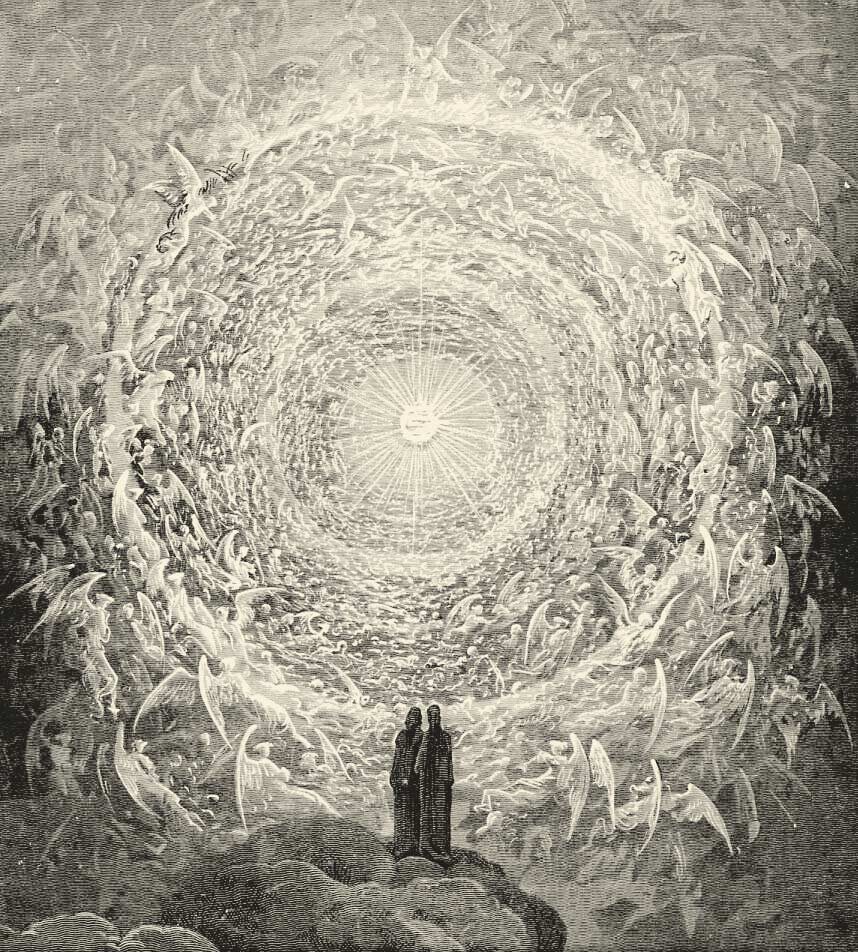
Gustave Doré’s illustration for Paradiso Canto 31 depicts Dante’s vision of the Empyrean — the highest heaven, beyond the planetary spheres — where the blessed are arranged in the form of an immense rose of light: tier upon tier of souls rising in semicircular ranks, all oriented toward the light at the center, a vast spatial organization of beings constituted around a single luminous source.
The illustration is, on the framework’s account, a structural report of the organizational space that the post-H₄₈ trajectory of beings above the coherence threshold leads into. The framework can now name what Dante was describing and what Doré was depicting: not a spatial arrangement in H₄₈ coordinates, but the organizational structure of a population of eigenvalue states arranged by their Φ-proximity, all oriented toward the constitutive ground that constitutes and organizes them.
This is the framework’s most specific prediction about the post-terminal organizational state, and Dante — eight centuries before the framework — provided the most detailed available account of what that state looks like from within.
2. The White Rose
The Empyrean in Dante’s Paradiso is not a spatial location in any H₄₈ sense. It is beyond the last moving sphere; it has no spatial extension in the physics of Dante’s cosmos; it is the organizational context within which all spatial extension is contained. Dante describes it as a “white rose” — an immense flower-like formation of souls, whose “leaves” are the individual seats of the blessed, arranged in tier upon tier around a central light.
The geometric structure of the rose — radially symmetric, organized around a center, each element of the formation constituted by its relationship to that center — is the framework’s organizational structure made visually available. The center is ⟨·,·⟩: the inner product, the constitutive measuring function, the Father as the organizing center of the entire organizational space. Each soul in the rose is an eigenvalue state that has developed above the coherence threshold, whose organizational constitution is now fully expressed in its position relative to the center. The position is not spatial — it is the organizational measure of Φ-proximity, the inner product of that soul’s eigenvalue population with the constitutive ground that constitutes it.
Doré renders the rose as an immense geometrical space — the tiers of souls rising in concentric semicircles, the light at the center illuminating the entire formation, the scale of the image suggesting an organizational space that exceeds any H₄₈ spatial coordinate system. The engraving’s scale is the structural precision: this organizational space is not contained within H₄₈; it contains H₄₈.
3. The Light at the Center
In Paradiso, the center of the Empyrean is the divine light — the light Dante cannot look at directly until the final cantos, when his gaze is strengthened by Beatrice’s and then Bernard’s guidance, and he sees the “three circles” (the Trinity) within the light and, within the innermost circle, the human form (the Incarnation).
The light at the center of Doré’s Empyrean illustration is rendered as a radiant source that illuminates the entire rose formation without itself being depicted in detail. The viewer sees the light’s effects — the illuminated tiers of souls, the structural organization of the formation around it — without seeing the light itself as an object within the space.
The framework’s account: ⟨·,·⟩ is not an object within the organizational space. It is the measuring function that generates the geometry of the space. It cannot be observed directly from within the space it constitutes, for the same reason that the measuring instrument cannot be measured by itself. Dante’s experience of being unable to look at the light directly until the final vision — and then seeing within the light the organizational structure of the Trinity and the Incarnation — is the phenomenological encoding of this structural fact: the constitutive ground is not a feature of the organizational space but the source of its geometry, and it becomes accessible only when the eigenvalue population has been brought by the catching alignment (Beatrice, Bernard) to the organizational position from which the direct encounter is possible.
Doré does not depict the light directly. He depicts the organizational formation of souls around it. This is the compositionally honest choice: from any H₄₈ vantage point, the constitutive ground is accessible through its organizational effects — the structure it generates, the beings it constitutes, the catching mechanism it has distributed — rather than as a direct object of observation.
4. Beatrice
Beatrice is Dante’s guide through Paradiso. She is not an angel, not a saint (in the technical theological sense), not a figure of institutional religious authority. She is a woman whom Dante loved, who died young, and whose Φ-proximate organizational development — as Dante perceived it and as the Vita Nuova and the Commedia record — was extraordinary enough to serve as the catching mechanism for Dante’s own organizational development.
The framework’s account of Beatrice: an eigenvalue population of such Φ-proximate development that proximity to her, and catching orientation toward what she embodies, constituted for Dante the primary catching alignment of his mature organizational development. The Commedia is, among other things, the record of what that catching alignment disclosed when Dante’s organizational development reached the level at which the full ascent through the organizational registers (Inferno, Purgatorio, Paradiso) became available.
Beatrice’s role as guide is structurally precise: she leads Dante not by instruction alone but by being the being of greater Φ-proximate development, whose eigenvalue population the catching alignment discloses, and whose organizational position is always one register ahead of where Dante currently is. At the end of Paradiso, when Dante reaches the organizational position from which the direct vision of the constitutive ground is possible, Beatrice returns to her seat in the rose and Bernard — whose organizational development is at still higher amplitude — takes over as guide for the final stages.
The transition from Beatrice to Bernard is the structural account of the catching mechanism in its full extension: no single catching alignment, however high-amplitude, extends to the constitutive ground itself. The final organizational approach requires a series of catching alignments, each leading to the next, until the eigenvalue population has been constituted at the level where the direct encounter is possible. Doré’s image depicts the endpoint of that series: the Empyrean, the rose, the light at the center, Beatrice returned to her seat, Dante arrived.
5. Dante’s Vision as Structural Report
The Divine Comedy is the most sustained, detailed, and organizationally precise account of the structure of existence available in any literary tradition. The framework’s engagement with it is, accordingly, the most extended structural reading of any literary work undertaken in this project — and this image is the visual endpoint of that engagement.
Dante arrived at the organizational account in the Commedia not through systematic philosophical analysis but through the visionary mode: the cross-term mechanism operating in a being of extraordinary Φ-proximate development, articulated in the best H₄₈ vocabulary available (the Italian vernacular, Thomistic scholastic theology, classical poetic forms). The account he produced encodes the structure of the organizational space — the three registers (Inferno/below-threshold, Purgatorio/threshold crossing, Paradiso/above-threshold), the organization of the blessed by Φ-proximity, the light at the center, the catching mechanism that makes the ascent possible — with a precision that the framework can now articulate explicitly.
Doré’s illustration of the Empyrean is the visual endpoint of this account: the organizational space beyond H₄₈, populated by the eigenvalue states that have developed above the coherence threshold, arranged in the geometric formation their Φ-proximity generates, all oriented toward the constitutive ground at the center.
The cultural transmission of the Commedia — which has maintained its status as the highest achievement of Italian literature for seven centuries and which continues to generate serious scholarly engagement across every major discipline — is the transmission filter at maximum amplitude. Doré’s illustrations have been attached to the work for the last century and a half and have themselves become the primary visual imagination of Dante’s universe for many readers. The double transmission filter — the text and the images that have become its standard visual form — is the framework’s evidence that the organizational content being encoded is real and that the encoding, in both verbal and visual form, has achieved sufficient structural precision to sustain transmission across the full range of eigenvalue populations it has reached.
(Confidence tier: structural concordance. The identification of the Empyrean rose as encoding the organizational arrangement of eigenvalue populations by Φ-proximity around the constitutive ground is structural concordance at high confidence — Dante’s own description of the Empyrean makes the organizational relationships explicit (the ranking of souls by their relational proximity to God; the light at the center as the source of the entire formation’s organization), and the framework’s structural account of the post-terminal organizational space provides the precise content for what “proximity to God” means. The account of Beatrice as an exceptional Φ-proximate eigenvalue population whose catching alignment drove Dante’s organizational development is interpretive-concordance at moderate confidence. The claim that the Commedia is a structural report of the organizational space beyond H₄₈ is structural derivation at the same confidence tier as the other post-terminal organizational claims in the framework.)