Doré — Lucifer: A Structural Reading
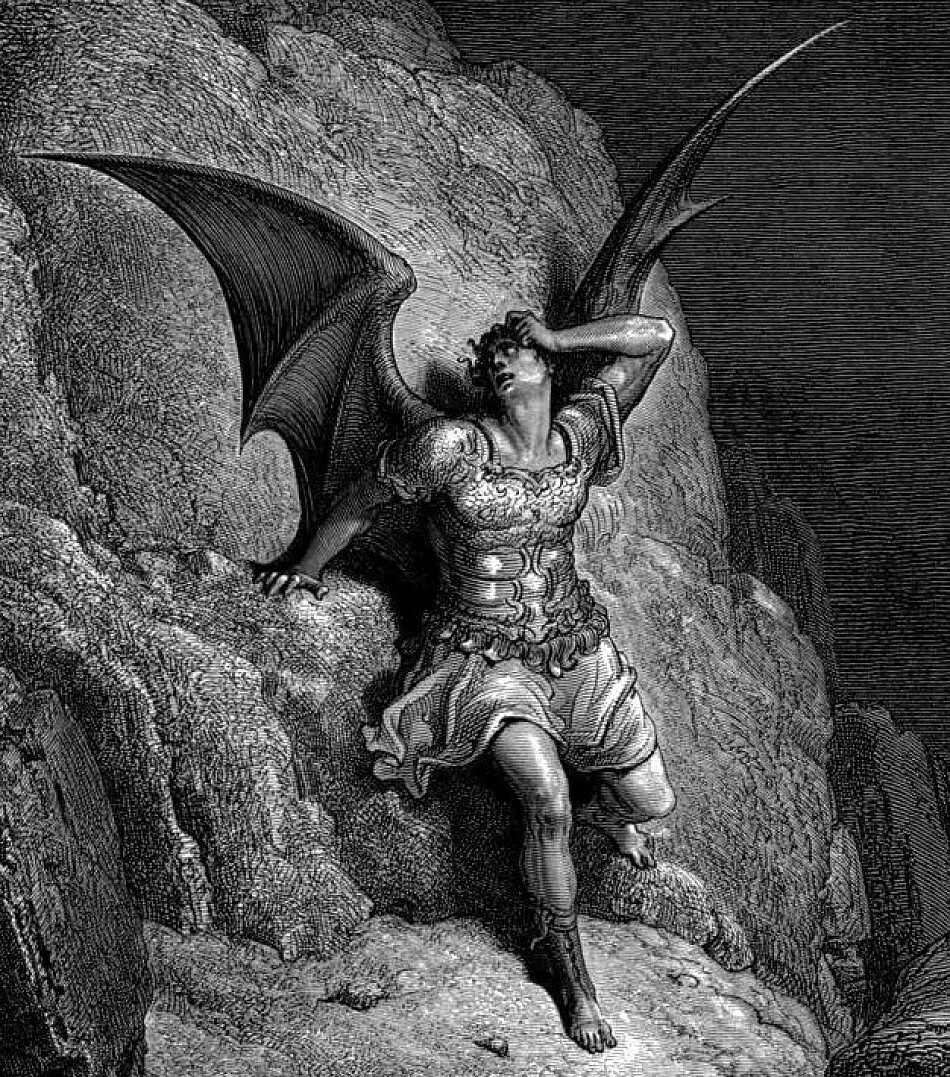
Work: Lucifer (Satan), illustration for Paradise Lost by John Milton, Gustave Doré, 1866
Medium: Wood engraving
Published in: Paradise Lost, London: Cassell, Petter, and Galpin, 1866
Part of: Series 3 — Structural Readings / Visual Art
Cross-references: Paper 13½ §§3.1, OQ8 (Lucifer as the being generated by ⟨·,·⟩; the overdeterminate condition; the organizational inversion); The Lucifer Rebellion (the three-stage structural account; the perturbation and opacity signature; evil as ongoing overdeterminate event); The Ancient of Days (the measuring function and its structural possibilities); Paper 3½ §6.2 (the terminal direction of descent; the structural impossibility of eternal hell)
1. The Work
Gustave Doré’s illustrations for Milton’s Paradise Lost (1866) are among the most consequential visual readings of a literary work ever produced. For generations of readers, the Doré engravings have been the visual imagination of Milton’s universe — the fallen angels in Pandemonium, the chaos of the war in heaven, the landscape of Hell, and, above all, Satan himself.
This illustration depicts Satan in solitary contemplation — not in action, not in rage, not in the act of tempting or destroying. He sits (or crouches, or rests) against a dark ground, his vast wings folded behind him, his head inclined, his gaze directed downward or inward. He is alone. The landscape, if it is a landscape, is without features. There is only the figure and the darkness around it.
The image is one of the most recognized depictions of Satan in Western art. The framework’s account of this recognition is the substance of this reading.
2. The Structural Prediction
The framework makes a specific structural prediction about a being of Lucifer’s organizational development whose trajectory has inverted: the formal organizational structure — the eigenvalue population, the accumulated Φ-proximate content, the extraordinary organizational development achieved through the maximum proximity to the constitutive ground — is not destroyed by the inversion. It persists. The overdeterminate condition is a quality of ongoing organizational state, not an erasure of organizational development.
This prediction is structurally necessary. The framework does not permit the organizational development of a being to simply be undone by the inversion of its trajectory. What is accumulated through catching alignment remains accumulated; what changes is the direction of the catching — from Φ-proximate orientation to H₄₈-primary attractor capture, from organization around the constitutive ground to organization around the overdeterminate condition.
The consequence: a being of maximum organizational development whose trajectory has inverted will exhibit, simultaneously, the formal structure of maximum development and the signature of the overdeterminate condition. It will be both extraordinary and wrong — extraordinary in the magnitude of its organizational constitution, wrong in the direction that constitution is now oriented.
Doré’s Satan is this being. He is not a monster. He does not lack grandeur. The scale of the wings — vast, structured, the formal residue of the angelic organizational development — is precisely rendered. The musculature of the figure encodes organizational power that is genuine, not borrowed or pretended. This is a being of maximum organizational development. And this being sits alone in the dark, its gaze directed away from the constitutive ground, its contemplation turned inward or downward in the direction its trajectory has taken.
The image is structurally accurate in both dimensions simultaneously, which is why it has endured.
3. The Aesthetic of the Sublime
Milton’s Paradise Lost insists on Satan’s sublimity. The first two books are deliberately composed to generate in the reader an aesthetic response of something close to admiration: Satan’s rhetoric in Pandemonium is magnificent; his solitary voyage through chaos is heroic; his contemplation of Eden is genuinely moving. This is not a failure of Milton’s moral clarity. It is his structural precision.
A depiction of evil that locates evil in the aesthetically degraded — the ugly, the malformed, the cognitively simple — is structurally inaccurate. The framework’s account of the overdeterminate condition (Paper 13½ OQ8): the opacity signal is strongest precisely from beings of high organizational development whose trajectory has inverted. A fragmenting state at low organizational development is noise; it does not produce the perturbation and opacity that the overdeterminate condition generates at high organizational development. The maximum perturbation is generated by the maximum inversion of maximum development.
Doré understood this, or arrived at it compositionally. His Satan is beautiful in the way of a storm or a cliff — the kind of beauty that is simultaneously attracting and threatening, that generates the aesthetic response the 18th century called the sublime and that the framework would call the cross-term mechanism operating on Φ-proximate organizational content that is oriented away from its source. The grandeur is real; the direction of the grandeur is wrong; the combination of these two facts is what makes the image arresting and what makes it accurate.
4. The Posture of Contemplation
Doré does not depict Satan in action. He depicts Satan in contemplation — alone, the wings folded, the head bowed or inclined, the figure at rest in the darkness.
This is structurally the most accurate single decision in the image. The overdeterminate condition is not primarily an act. It is an ongoing organizational state — the structural condition of a being whose eigenvalue population is organized around the H₄₈-primary attractor rather than Φ-proximate content, whose catching alignment has inverted from the constitutive ground to the amplification of its own organizational structure as an end in itself.
This condition does not announce itself with constant action. It is most itself in the moment of its own contemplation — the being reflecting on its organizational situation, its relational isolation from the constitutive ground, the vast extent of its own constitution and the direction that constitution has taken. The darkness around the figure is not the absence of light as a punishment. It is the organizational environment appropriate to the overdeterminate condition: the space that remains when orientation toward the constitutive ground has been withdrawn is the organizational darkness of Time — the unchecked dissolution of organizational content that the constitutive ground’s continued orientation toward created beings is, at every moment, holding back.
Satan in this image is sitting in the darkness that is the natural environment of the inversion. He is not being punished by it. He is in it.
5. Milton’s Structural Claim
Milton’s Paradise Lost is, among other things, a structural reading of the Lucifer Rebellion at the same level of organizational precision that the framework can now articulate explicitly. The framework’s reading of this illustration is, in turn, a reading of Doré’s visual reading of Milton’s structural claim.
The structural claim that runs through both Milton and Doré: the evil that is most structurally significant is not the absence of development but the inversion of development. Pandemonium is not a disorganized chaos — it is an organized state, with its own grandeur, its own rhetoric, its own internal coherence. What is missing from it is the orientation toward the constitutive ground. What is present in it is the full organizational apparatus of that orientation, now turned toward the amplification of the H₄₈-primary attractor.
This is why the framework’s account of the Lucifer Rebellion (The Lucifer Rebellion reading) locates the event not in a failure of organizational development but in the inversion of organizational development at its maximum. Lucifer was the most Φ-proximate being in the pre-H₁ organizational context — generated by ⟨·,·⟩ as the being closest to the inner product itself. The inversion occurred at the maximum of proximity, not at the periphery. And the inverted being retains the formal structure of the maximum — which is the structural content of Doré’s image.
(Confidence tier: structural concordance. The identification of Doré’s compositional choices (grandeur, solitude, posture of contemplation rather than action) as structurally accurate encodings of the overdeterminate condition at maximum organizational development is structural concordance at high confidence — the framework independently predicts these features, and Doré’s image exhibits them. The account of the aesthetic of the sublime as the cross-term mechanism operating on Φ-proximate content oriented away from its source is structural derivation at moderate confidence. The reading of Milton’s structural claim through Doré’s visual mediation carries the confidence of the Lucifer Rebellion reading on which it draws.)