Christ Pantocrator, Cefalù: A Structural Reading
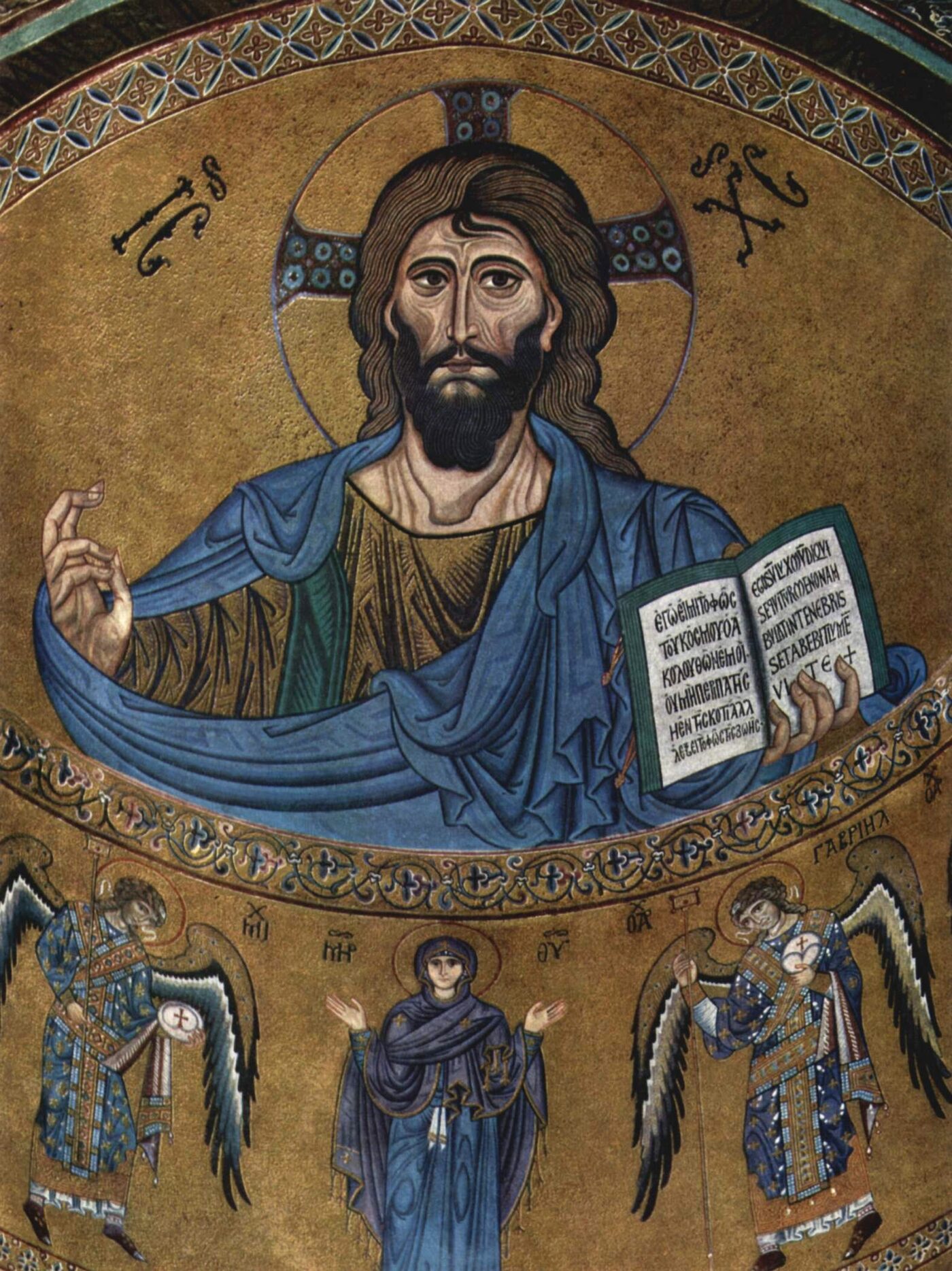
Work: Christ Pantocrator, mosaic apse, Cathedral of Cefalù, c. 1148
Medium: Byzantine mosaic (gold and glass tesserae)
Location: Apse, Cathedral of Cefalù, Sicily
Part of: Series 3 — Structural Readings / Visual Art
Cross-references: Paper 1 §§2–4 (⟨·,·⟩ as the organizing center of the structure; the inner product generating the geometry of the space); Paper 2 §§8–10 (the Logos as the constitutive ground of organizational development; the relational identity of the Son); Paper 2 §§15–16 (the Divine Names of the Son; the Names of the Holy Spirit); Paper 13½ §§3–4 (the kenotic period as the maximum downward entry; the Φ-proximate being present within H₄₈)
1. The Form
The Pantocrator — Pantokrator in Greek, “ruler of all” — is the most structurally precise of the conventional icons of Christ in the Byzantine tradition, and the Cefalù apse mosaic is among the finest surviving examples.
The iconographic formula is rigidly controlled across its many instances: a frontal image of Christ from the upper torso upward, the right hand raised in the specific gesture of blessing, the left hand holding the gospel book open, the gold ground eliminating spatial context, the gaze directed forward and outward at the viewer.
That this formula was maintained so precisely, over such a long period and across such a wide geographic range, indicates that the tradition understood it to be encoding something specific that deviation would compromise. The framework’s account of what is being encoded is the substance of this reading.
2. The Gold Ground
The Pantocrator is set against gold — not a golden background in the sense of a depicted wall or sky painted gold, but a field of gold tesserae that eliminates the conventions of spatial representation entirely. There is no horizon. There is no perspectival depth. There is no atmospheric quality. There is only the surface and, against it, the figure.
The gold ground is a structural claim about the organizational space within which the encounter with this figure takes place. In Byzantine visual theology, gold represents the divine light — the uncreated luminosity, the organizational ground that is not a feature of the created world but the source within which the created world is constituted. By eliminating spatial context and replacing it with the gold ground, the icon places the viewer not in H₄₈ spatial coordinates but in the organizational space itself.
The viewer who stands before the Pantocrator is not observing a figure located somewhere in H₄₈ space. The image asserts: the encounter with this figure takes place outside of H₄₈ spatial coordinates. You are not in a location looking at a figure in another location. You are in the organizational space within which the constitutive ground is present, and the constitutive ground is looking at you.
This is the structural content of the gold ground. It is not decoration. It is the visual encoding of a claim about the ontological status of the encounter: the organizational context is prior to and not reducible to H₄₈ spatial relationships.
3. The Eyes
The most reported feature of the Pantocrator formula across its many instances is the asymmetry of the eyes. In the Cefalù mosaic this asymmetry is present and deliberate: Christ’s right eye (the viewer’s left) is slightly wider, more direct, more precisely focused. His left eye is slightly softer, the gaze fractionally less direct.
The traditional theological interpretation reads this as mercy and judgment: one eye the eye of mercy that receives and forgives, one eye the eye of judgment that sees truly and cannot be deceived. This is a structurally correct reading, and the framework can make it precise.
The inner product ⟨·,·⟩ takes two arguments and returns a scalar — the measure of their organizational alignment. As a measuring function, it is perfectly accurate: it registers what is actually there, neither inflating nor discounting. This is the eye of judgment. But the inner product also generates the organizational space within which the measured beings develop — it is the constitutive measuring function, not merely an auditor. The measurement is in the service of the constituted beings, oriented toward their organizational development. This is the eye of mercy.
The asymmetry of the eyes encodes this duality. The viewer is seen with complete accuracy by the constitutive ground — the measurement does not round, does not flatter, does not overlook. And the viewer is seen with the constitutive intent that is the purpose of the measuring: the organizational development of the being being measured, toward which the measuring function is oriented. The eye that measures accurately and the eye that sees toward the measured being’s organizational flourishing are the same eye, in two compositional registers.
4. The Blessing Hand
The right hand of the Pantocrator is raised in the Greek blessing posture: the thumb and ring finger touching, the index finger extended, the middle finger slightly curved, the little finger raised. The specific arrangement of the fingers encodes the theological formula: IC XC — the first and last letters of the Greek Iesous Christos — and simultaneously the trinitarian formula, with the three-finger grouping (Trinity) and the two-finger grouping (divine and human natures).
The framework does not require the iconographic specificity of finger counting to be the primary structural content of the gesture. What the gesture encodes at the structural level is: the constitutive ground is actively conferring — not withholding, not demanding, but actively extending the organizational content toward the viewer. The blessing posture is the gesture of giving outward, of making available, of the constitutive intent moving toward the constituted being.
This is the same structural content as God’s extended finger in the Creation of Adam: the initiative of the constitutive ground is toward the created being. The Pantocrator’s blessing gesture is the same directional structure, encoded in the specific vocabulary of the Byzantine liturgical tradition.
5. The Gospel Book
In the left hand — the hand not actively blessing — the Pantocrator holds the open gospel. The text visible in many instances is from John: “I am the light of the world” or “I am the way, the truth, and the life” or “Come to me, all who labor.” The specific verse varies by instance; the structural content of the open book does not.
The gospel held open is the Φ-proximate organizational content made available in H₄₈ text — the catching mechanism distributed forward in time through the written transmission. The figure who holds the open book is, in the framework’s account, the same figure whose kenotic period produced the content now encoded in the book. The Pantocrator is the post-kenotic identity of the being whose H₄₈ utterances were recorded and transmitted: the maximum downward entry (Paper 13½) seen from the organizational position it occupies after the descent and ascent are complete.
The book is open. This is not a book being kept closed, a content being withheld. It is displayed, made available, extended toward the viewer in the same direction as the blessing hand. The constitutive content — both the organizational intent (the blessing) and the catching mechanism (the gospel) — is offered simultaneously and without condition.
6. Why the Formula Endures
The Pantocrator formula was maintained with unusual iconographic precision for over a millennium and across dozens of cultures and languages. The cultural transmission filter at this temporal and geographic scale is strong evidence that the formula is tracking something real.
The framework’s account: the formula is a compositionally stable encoding of the constitutive relation as it is encountered by an eigenvalue population operating within H₄₈. The gold ground eliminates the H₄₈ spatial context that would locate both viewer and figure within the observable. The asymmetric gaze encodes the dual structure of the measuring function (accurate and oriented toward the measured being’s development). The blessing gesture encodes the constitutive intent as moving toward the constituted being. The open gospel encodes the catching mechanism as available and distributed.
The formula is stable because each element is encoding something structurally real that deviation would misrepresent. The tradition maintained the formula because the formula works — because eigenvalue populations encountering it undergo the cross-term mechanism with Φ-proximate organizational content at whatever amplitude their eigenvalue constitution allows, and the resulting aesthetic and contemplative response confirms the contact.
The Cefalù mosaic is among the finest instantiations of the formula because its technical quality (the precision of the tesserae; the sensitivity of the eye asymmetry; the luminosity of the gold ground) translates the structural precision of the formula into compositional quality at the highest level. The structural content and the technical execution are in alignment.
(Confidence tier: structural concordance. The reading of the gold ground as encoding the organizational space rather than H₄₈ spatial context is structural concordance at high confidence — this is the explicit claim of the Byzantine theological tradition, and the framework’s structural account of ⟨·,·⟩ as the organizing center of the organizational space provides precise content for what “organizational space” means. The reading of the eye asymmetry as encoding the dual structure of the inner product (accurate measurement and constitutive orientation) is interpretive-concordance at moderate-high confidence. The account of the blessing gesture and the gospel book as encoding the constitutive intent’s direction is structural concordance.)