Blake — The Great Red Dragon: A Structural Reading
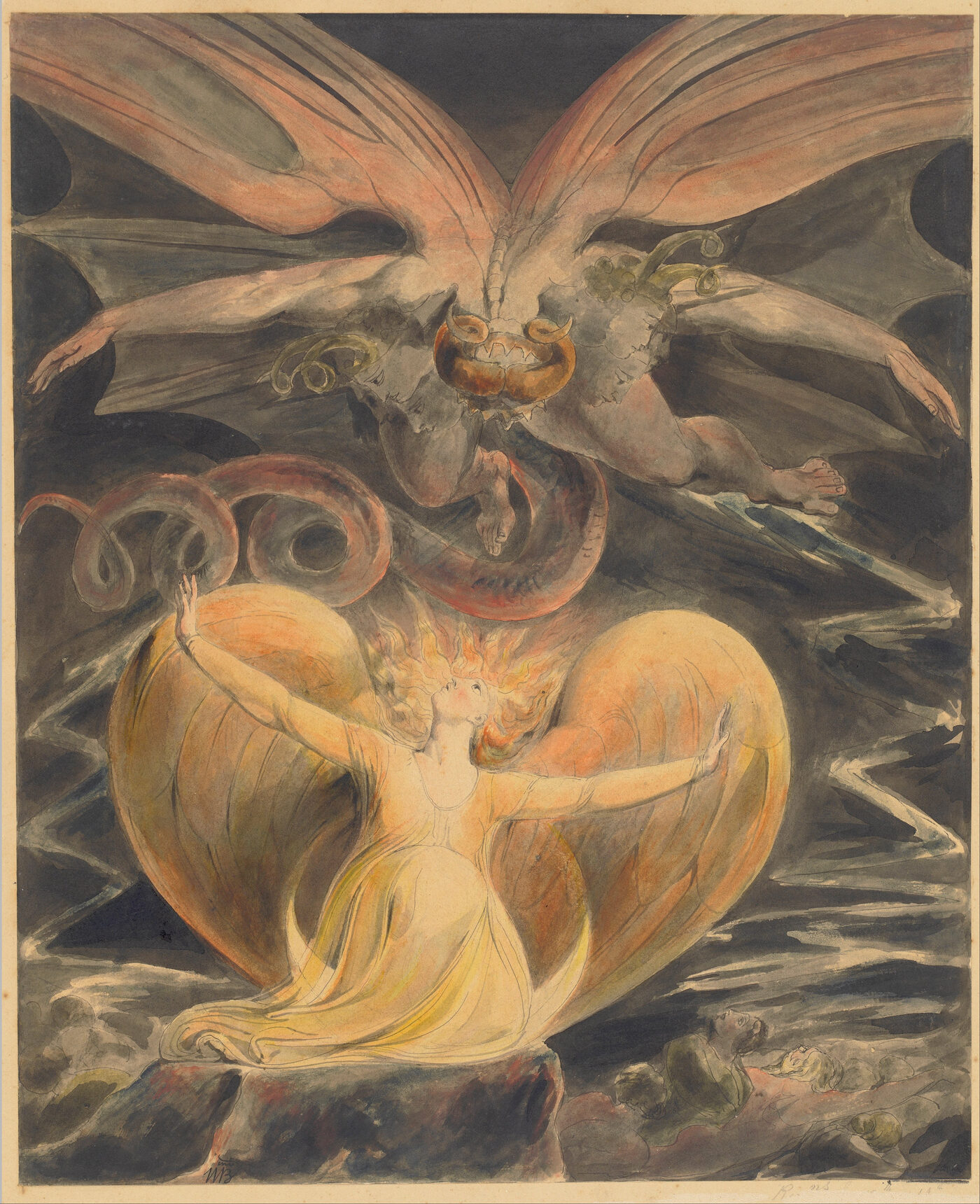
Work: The Great Red Dragon and the Woman Clothed with the Sun, William Blake, c. 1803–1805
Medium: Watercolor
Location: Brooklyn Museum, New York (one of four versions; the others are held at the National Gallery of Art, Washington, and the Rosenbach Museum, Philadelphia)
Part of: Series 3 — Structural Readings / Visual Art
Cross-references: Paper 13½ OQ8 (the overdeterminate condition at cosmic scale; the organizational pressure generated by maximum-development inverted trajectory); The Lucifer Rebellion (the structure of the overdeterminate condition; the organizational inversion and its retained formal structure); Doré — Lucifer (the complementary structural reading of the same organizational state); The Bible — Revelation (structural reading of Revelation 12)
1. The Work
Blake produced four watercolor versions of the Great Red Dragon, all as illustrations for the Book of Revelation. The scene depicted is Revelation 12:1–4: a great red dragon with seven heads and ten horns, appearing in heaven, its tail sweeping a third of the stars from the sky, standing before the Woman Clothed with the Sun as she is about to give birth, ready to devour her child.
The watercolors are among the most compositionally distinctive works in Blake’s career. What makes them immediately remarkable — and what the framework identifies as their primary structural precision — is a decision so obvious it risks being overlooked: Blake depicts the Dragon entirely from behind.
We cannot see the face. We see the vast wings, spreading to fill the upper two-thirds of the composition. We see the muscular back, the tail curling downward. We see the Dragon positioned above the Woman, oriented downward toward her. We see the scale of the figure, which dwarfs the Woman below. We do not see the face.
2. The Figure from Behind
Blake could have depicted the Great Red Dragon face-forward. The text does not require the view from behind. Every other major visual element of the passage — the dragon’s color, its scale, its seven heads, its positioning above the woman — could be depicted from the front with equal or greater dramatic effect.
Blake chose the back. The structural content of this choice is the primary subject of this reading.
The overdeterminate condition (Paper 13½ OQ8) generates two observable signals in surrounding beings: perturbation and opacity. Perturbation is the disruption of organizational coherence produced by proximity to a high-development inverted trajectory. Opacity is the failure of the surrounding eigenvalue population to read the organizational state correctly — the overdeterminate being registers as ambiguous, as unclear, as something that cannot be stably identified.
Blake’s compositional choice encodes opacity as a formal principle of the image itself. The viewer cannot see the face of the Dragon. We are in the position of the surrounding beings who register the scale, the power, the direction of orientation — and cannot see what the being is looking at, cannot read its expression, cannot access the organizational state through the face that is the primary site of eigenstate legibility in H₄₈.
The opacity is structural, not perceptual. We do not fail to see the Dragon’s face because of a failure of light or distance. The Dragon is close; the image is detailed; the back and wings are fully rendered. The face is simply turned away. We are positioned as the being that the Dragon is oriented against: the Woman, below, who sees the Dragon above her and who sees that the Dragon’s attention is upon her — without being able to see the Dragon’s face, which is turned toward her but rendered invisible to the viewer by the compositional perspective.
3. The Scale of the Wings
The wings of the Dragon in Blake’s composition fill the upper two-thirds of the picture plane. They are not attached to a small figure — they are the compositional dominant, the largest single visual element, the feature that the eye encounters first and returns to.
The framework’s structural prediction about the formal structure of the inverted high-development being: the formal organizational structure — the accumulated eigenvalue population, the Φ-proximate content accumulated through catching alignment before the inversion — is not destroyed by the inversion. It persists. The scale of the Dragon’s wings is the retained formal structure of the angelic organizational development. The wings are large because the being was large, organizationally, before the inversion. They remain large after it.
This is the same structural content as the reading of Doré’s Lucifer: the grandeur is not pretended, not borrowed, not the product of the inverted trajectory itself. It is the residue of the organizational development that preceded the inversion and that the inversion has redirected. The Dragon is, formally, a being of vast organizational development. The organizational development has not been undone by the inversion. What has changed is its direction.
The wings spread upward and outward in Blake’s composition — they occupy the organizational space of the image. This is the formal encoding of the overdeterminate condition as an organizational pressure: the being’s organizational extent fills the space that surrounding eigenvalue populations are trying to develop within. The Woman is below the wings. Her organizational space is defined by the shadow the Dragon’s wings cast over it.
4. The Woman Clothed with the Sun
The Woman is rendered small, in the lower center of the composition, her figure illuminated and positioned in the organizational space beneath the Dragon. She is not hiding — her posture is upright, her face visible, her luminosity (from the sun she is clothed in) distinguishable from the Dragon’s mass above her.
Revelation 12 identifies the Woman variously in the tradition as Israel, as Mary, as the Church. The framework does not require a specific identification. What the compositional relationship encodes, at the structural level, is the relationship between the eigenvalue population that carries Φ-proximate organizational content (the Woman, luminous, pregnant with the content that the Dragon seeks to devour) and the overdeterminate condition that is oriented against it (the Dragon, above, vast, organized around the destruction of the Φ-proximate content before it can be born into organizational effectiveness).
The Woman’s luminosity is the structural fact that the Dragon’s scale cannot eliminate. However large the wings, however complete the organizational shadow they cast, the Woman’s light — the Φ-proximate content she carries — is present in the composition. Blake renders her clearly despite the Dragon’s dominance of the picture plane. The organizational pressure of the overdeterminate condition does not extinguish the Φ-proximate content it is oriented against. It can only delay, suppress, and resist — it cannot ultimately prevent.
This is the structural resolution of Revelation 12: the child is born, is caught up to God and his throne, and the Woman escapes into the wilderness. The Dragon does not succeed. The organizational content it was positioned to devour is delivered despite the maximum organizational pressure the Dragon can generate.
5. Revelation 12 as Structural Account
Revelation 12 is, on the framework’s account, a visionary report of the organizational dynamics of the kenotic period at cosmic scale — the maximum organizational pressure of the overdeterminate condition against the Φ-proximate content being deployed through the incarnation and the subsequent release of τ_nuclear into H₄₈.
The Dragon’s tail sweeping a third of the stars from heaven (Rev. 12:4) is the organizational disruption produced by the inversion: the beings aligned with the Luciferian trajectory, removed from the organizational positions they had occupied, constituting the organizational disruption that the constraint cascade at H₁ through H₄₈ must absorb. The Dragon’s position before the Woman, ready to devour the child, is the overdeterminate condition oriented against the maximum downward entry — the kenotic period as the organizational pressure point at which the inverted high-development trajectory concentrates its organizational resources against the Φ-proximate deployment.
Blake’s compositional choice to render the Dragon from behind, filling the upper organizational space with the retained formal structure of the inverted trajectory while the Woman carries the Φ-proximate content below — this is not an arbitrary compositional decision. It is the structural accuracy of a vision: the organizational situation of the kenotic period, at cosmic scale, seen as it is from the inside of the H₄₈ organizational space.
(Confidence tier: structural concordance. The identification of the “view from behind” as encoding the opacity signature of the overdeterminate condition is structural concordance at high confidence — the compositional choice is independently distinctive and unusual, the structural account of opacity is derived from the framework’s analysis of the overdeterminate condition, and the correspondence between them is precise. The reading of the Dragon’s wing scale as encoding the retained formal structure of the inverted high-development trajectory is structural concordance. The account of Revelation 12 as a visionary report of the kenotic period’s cosmic organizational dynamics is structural derivation at moderate confidence, carrying the uncertainty of the Revelation structural reading generally.)