← Paper A0: Modeling Reality as a Gelfand Triple
Adam A1: An Unexpected Visitor
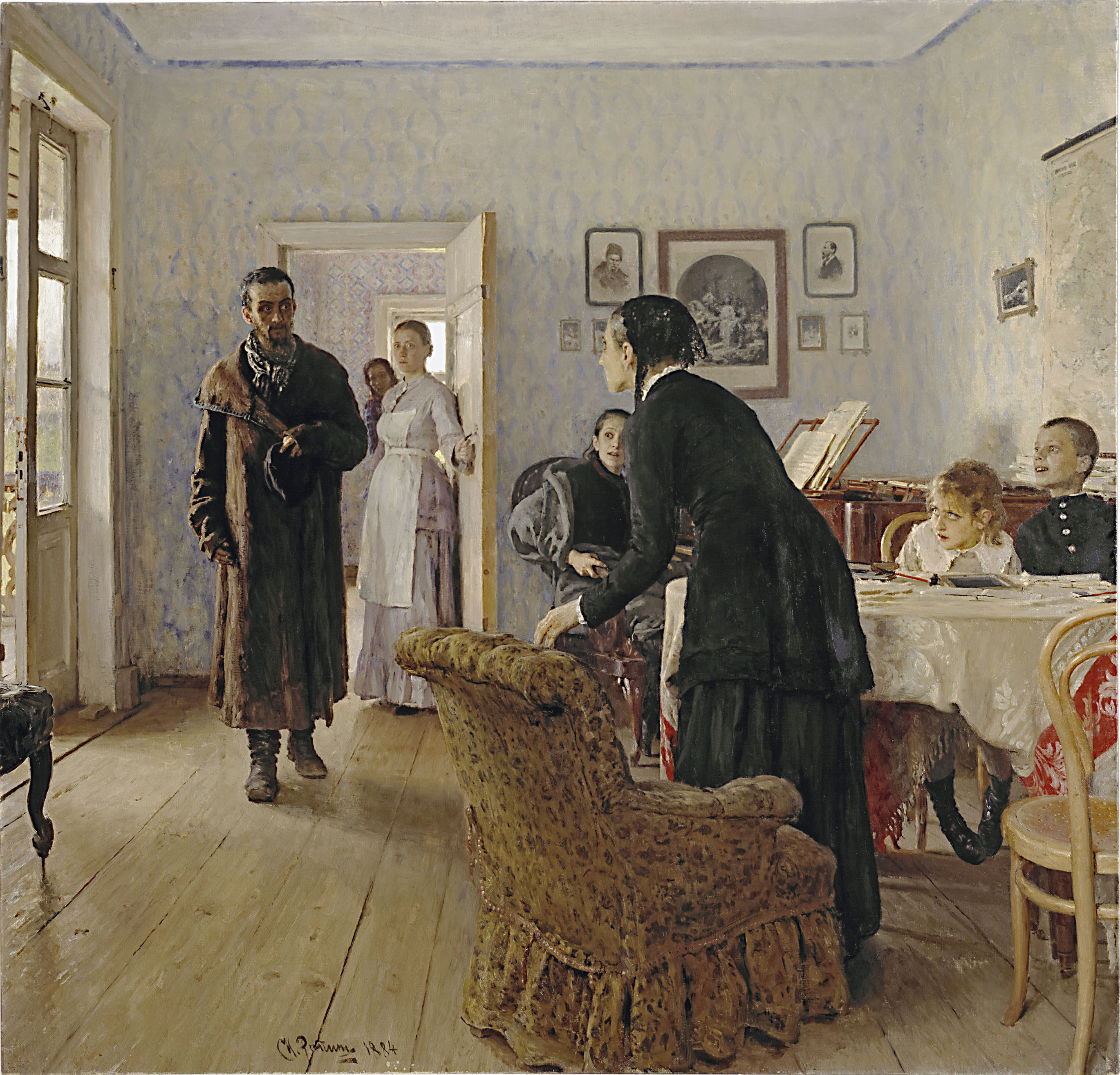
After reading it through three times, he was annoyed. Not only because he could not find a hole in the math — and he had to admit that he could not — but because he could see where the paper was going. They were going to try to answer the question. THE question. The only one that matters.
He had given three years to that question once — really given them, in a seminary, before the physics, under a Jesuit director of the old Thomist kind. He had not left because he stopped believing. He left because of a circle he could not square, and he had been precise about it even then. The vows rested on two claims, and he could grant exactly one. The first was easy: that under everything there is a ground — being itself, ipsum esse, the relation in which all that exists is held. You reach it by argument; he had, at twenty-five, and he held it still. The second was the one the vow actually required — that the ground is a Person, that it knows you by name, that what it is, is Love — and from the first to the second he had never found a step he was entitled to take. He had told his director the plain truth: I don’t know enough yet to promise this. The old man had said it was the most honest thing he’d heard in that office in years, and meant it.
So he left the calling and kept the question. He carried it into the laboratory instead, where at least what you couldn’t prove you weren’t asked to vow; and for thirty years he read theology the way a man rereads letters from someone he is no longer in touch with — with affection, and no expectation — and prayed, quietly, and mentioned it to no one. The circle never closed. It had simply stopped being something he expected to close.
He was a long way back, deep in the salad days, when he heard his name. “Adam.” It was Joe — he must have let himself in.
Joe was his oldest friend, the one from college who had never stopped dropping in. An engineer first, then thirty years running companies, and now — like Adam — retired, though he wore it better. He had run those companies in jeans and a plain T-shirt and saw no reason retirement should revise the policy: a big, easy man who had moved things with his own hands long before he owned them, with the unhurried manner of someone who had stopped needing to prove anything to anyone. They had stayed close across two careers that looked nothing alike, on the strength of a single shared defect: neither of them could stop asking the question. Adam rarely left the house; Joe brought the world to the door. It was a fair trade and an old one, and each knew exactly what the other was for.
He had already taken in the room and found it not quite itself. Adam kept the study the way he kept a derivation — every book shelved by a logic only he used, the desk bare but for the one thing in front of him. This morning there were books out: a dozen of them, splayed and stacked, von Neumann face-down on the arm of the chair, the Gelfand–Vilenkin volumes down off their high shelf and lying on the floor where Adam had left them. Joe had been coming here seventeen years and had never seen the floor used as a shelf. He said nothing — noted it the way you note a tell across a card table — and lowered himself into the chair.
“You will not believe the paper I got in the mail,” Adam said, already half-smiling to lay the ground for the punchline. “Somebody is going to try to use the Gelfand triple to prove God.”
He laughed — the same short bark he’d let out in the kitchen — and it came out a half-step shy of where he’d aimed it.
“The Gelfand what?” said Joe, who had built real things for a living and was unembarrassed about the gaps.
“Triple. It’s what I did for fifty years. Here.” He grabbed a piece of paper and picked up his red pencil.
He drew a small circle, a larger one around it, a larger one around that. “Three spaces, one inside the next. The middle one is the one everybody actually uses. Think of it as the space of honest states — everything that can really be the case. A particle that’s somewhere, a wave with a little spread to it. Things with a finite size to them.”
“The real stuff,” Joe said.
“The real stuff. Trouble is, the real stuff isn’t enough. You’re forced to talk about things too sharp to be real — a particle at exactly one point, no spread at all; a wave of exactly one frequency, running on forever. Idealizations. You can’t actually have one. But you can’t do the physics without them. Dirac just wrote them down anyway, back in the thirties, and it worked, and nobody could say why it was allowed for the better part of thirty years.”
“So he cheated and it came out right.”
“For thirty years. Mathematicians hate that worse than being wrong.” A small smile. “So” — he tapped the outer ring — “this big space out here is where the idealizations live. The points, the pure tones, the things too sharp for the middle. And this little one” — the core — “is the opposite extreme: the smoothest things, the best-behaved, the ones you can do anything to and they never misbehave. You need that core or you can’t even define your instruments — position, momentum, energy — without them blowing up in your hands. Small, medium, large. The little space inside the middle inside the big one. Φ inside H inside Φ-prime. The triple.”
“And you need all three.”
“Take any one away and the whole thing falls down. The core defines the instruments, the middle holds the states, the outer holds the answers the middle can’t contain. People had the middle to themselves for a century and kept tripping over the other two without naming them. Gelfand named them.”
Joe nodded slowly — the way he used to nod on a factory floor when a foreman walked him through a process he meant to remember. “Alright. So where’s God in a stack of three boxes?”
“That,” Adam said, “is what got me.” He drew a small bracket-pair in the corner of the envelope: ⟨ , ⟩. “There’s one more thing, and it’s the thing the paper will not stop talking about. Underneath all three spaces there’s a single operation. You feed it two states and it hands you back a number — how much the one lies along the other. Overlap. It’s where length comes from, and angle, and every probability you will ever measure. The inner product. And here’s the part that’s either nothing or everything: it is the same operation in all three spaces. You travel from the small to the middle to the large and everything else changes — and that doesn’t. It’s the one thing that survives the trip whole.”
“So it’s the ruler.”
“It’s the reason there’s any distance to measure at all. Take it away and there’s no how far, no how much, no how likely — there’s no structure left to even have a state in. It isn’t a thing in the world, Joe. It’s the condition for there being a world with things in it.” He sat back. “The textbooks treat it as a tool you bring to the space. This paper says it’s the floor the space is standing on.”
Joe looked at the little pair of brackets for a moment. “And they want to say that’s God.”
“They want to say that’s God.”
Joe waited for the laugh. It didn’t come.
“That is why I’ll read every page of it,” Adam said — quietly, which from him was the louder setting. “To prove a thing is the foundation of everything, you would have to step outside of everything and point back at it. There is no outside. We are inside the system; we are made of it. And Gödel proved — about as cleanly as anything has ever been proved — that a system rich enough to be interesting cannot establish its own foundation from within itself. You cannot get beneath your own feet. It is not a matter of cleverness. It is forbidden.”
“So they can’t do it.”
“No.” A pause. “Which is the only thing that makes it worth the afternoon. To reach for it at all, they have to do something about Gödel — go around him, go through him, or stand up and say plainly that they cannot, and call what they are doing some honest word that is not proof. I would like to know which.” He squared the paper on the table and did not look up. “Either they break the most beautiful theorem of the last century — which they will not — or they fail at it in a way I have not seen. I have not seen a new way to fail at something in a while.”
Anyone else would have heard a man being dry about a hobby. Joe had known him since they were nineteen, and heard the thing underneath it — the particular flatness Adam’s voice took on only when something had genuinely caught him and he did not intend to let it show. He did not mention it. He finished his coffee, said he would see himself out, and left Adam already back at the first page.
After Joe had gone, the house went quiet in its usual way, and the part Adam had not said out loud came up to meet him.
It was the circle. The paper had spent its whole length building the near bank of it — the ground beneath all three spaces, the relation in which everything is held — and had set it down with a care he had never seen anyone bring to the thing. Then it had stopped at the water and said so, plainly: the crossing from the ground to the Person, the naming, waited for the next paper. In mathematics he had owned for fifty years, it had built the exact near side of the gap he had stood at the day he walked out of the seminary — and it had not pretended to cross. It stopped where he had stopped.
That was the thing he hadn’t told Joe — because Joe would have heard it as good news, and it wasn’t, quite. For thirty years the gap had been a wall. For the first time in longer than he cared to count, he was not certain it was a wall. He set the thought down where he could find it again.
It had been two weeks since the last paper arrived. Adam wouldn’t admit he was waiting, but he also had to admit that he checked the post when it arrived now. And then one Saturday it came. It was a grey morning — the flat, even grey of a sky that has decided not to do anything at all, the light through the kitchen window the color of pewter. Typed address. No return. Thick like a paper.
This time he didn’t let it sit, but he also didn’t run — he was a bit warier this time, but still just as ready to pull the old knife out and find the seam.
He carried it back to the study, sat down at the desk, and took up the red pencil.