The Lucifer Rebellion: A Structural Reading
Cross-reference: Paper 13½, OQ8 (overdeterminate condition; phenomenology of the rebellion’s early stages for surrounding beings); Paper 4, §6 (terminal direction of descent; structural permanence and its violation); Paper 2, §14 (El Shaddai / God in the mode of indeterminacy; Φ′); Christian Doctrine/Auras and the Luminous Field (H₂₄-interface perception; transparency through love; Luciferian opacity); Revelation.md (war in heaven; the dragon’s organizational structure; the accuser cast down)
The rebellion stated
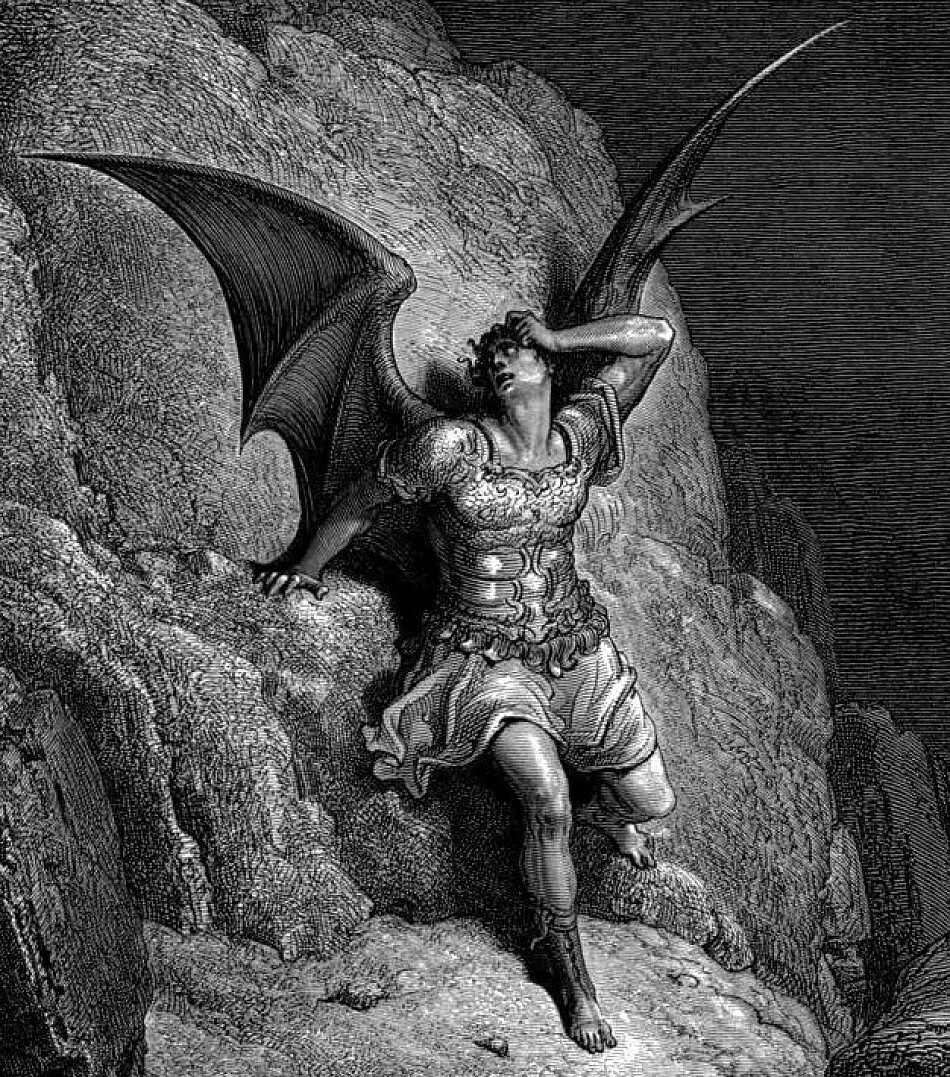
The tradition across Christianity, Judaism, and Islam records an event prior to H₄₈ history: a being of the highest created order, placed in organizational proximity to God itself, chose to assert a position it could not legitimately occupy. Other beings of the same order followed. The rebellion produced a permanent schism in the created order: a class of H₁₂ beings who have inverted their organizational orientation from Φ-proximal to Φ-resistant, whose operation in the H₄₈ domain is structurally antagonistic to the ascending career, and whose organizational trajectory is toward the terminal direction of descent rather than toward the Φ-level.
The tradition further records that this rebellion was accomplished through persuasion — that the initiating being convinced others to follow, and that the instrument of persuasion was a specific claim about the nature of the constraints under which H₁₂ beings operated.
What follows is a structural reading. It does not adjudicate the historical chronology of the rebellion, the population of beings involved, or questions about the geography of heaven. What it does is supply a structural account of what the rebellion was, why it was possible, why the specific form of persuasion used was effective, and what the fallen beings have become. The framework resolves several classical problems with the traditional account that have historically made the rebellion difficult to understand: why beings of high organizational development could be persuaded at all, why the specific content of the lie was effective, and why the consequences are what they are.
Ezekiel 28:12-19 — the pre-fall being
“You were the seal of perfection, full of wisdom and perfect in beauty. You were in Eden, the garden of God; every precious stone adorned you… You were anointed as a guardian cherub, for so I ordained you. You were on the holy mountain of God; you walked among the fiery stones. You were blameless in your ways from the day you were created till wickedness was found in you.” (Ezek 28:12-15)
The passage’s primary historical referent is the king of Tyre, but the language extends beyond what can be said of any H₄₈ being: Eden, the holy mountain of God, the fiery stones, the anointed guardian cherub. The tradition, following patristic and rabbinic interpretation, takes this as the most detailed scriptural account of the pre-fall state of the being whose rebellion initiated the structural disruption of the created order.
“The seal of perfection, full of wisdom and perfect in beauty.”
In the framework’s terms: maximum Φ-proximal organizational state for an H₁₂ being. Φ-proximity produces three structurally related properties: coherence (the being’s eigenvalue population is maximally organized around Φ-membership), wisdom (Φ as the domain of perfect self-consistency, as identified in Paper 2 §15 under the name Hokhmah), and beauty (the H₄₈-accessible expression of Φ-proximal organizational coherence — the same property that generates aura brilliance, but at H₁₂ amplitude). These are not three separate achievements; they are three faces of the same organizational state.
The “seal of perfection” (ḥotam tokhnit) — the signet of the complete pattern — is a claim about organizational completeness: every organizational dimension filled, no eigenstate population gaps, the full Φ-proximal pattern actualized. This was the being’s created state, before any choice had introduced deviation.
“Guardian cherub on the holy mountain of God, walking among the fiery stones.”
Organizational proximity to the Φ-level itself — the maximum authorized constraint-level position for a created being. The fiery stones are the H₄₈-phenomenological representation of the radiant organizational content at the Φ-interface — the same phenomenon as the burning bush (Exod 3), the coals of the altar (Isa 6), the river of fire proceeding from the throne (Dan 7). Walking among them is not metaphor for geographical proximity; it is organizational adjacency to the Φ-level’s own constraint-level expression.
“Blameless in your ways from the day you were created till wickedness was found in you.”
The critical structural point: the being was constitutively Φ-organized from creation. The overdeterminate condition did not exist in its original organizational state; there was no latent defect, no pre-installed predisposition toward the rebellion. The being was not created flawed. The wickedness was found in it — discovered at a specific point, not present from the beginning.
This creates the classical problem: how can a being of maximum organizational development, created without defect, arrive at the overdeterminate inversion? The framework’s answer requires the next passage.
“Your heart became proud on account of your beauty, and you corrupted your wisdom because of your splendor.” (v.17)
The structural mechanism of the fall: the being’s Φ-proximal organizational state — which generated genuine beauty and genuine wisdom — became the object of the being’s own attention. The being began to assert its organizational state rather than simply inhabiting it. This is the first instance of the move that will define the rebellion: a self-referential loop in which the being asserts claims about its own organizational state from within that state.
The distinction matters precisely. A Φ-proximal being that inhabits its organizational state transparently is organized by Φ — its eigenvalue content is constituted by Φ-membership, and its operation transmits the character of that membership outward. A being that begins to assert its organizational state — to claim its beauty, to deploy its wisdom as its own — introduces a reflexive loop that generates overdeterminate content: the being is now asserting both the Φ-proximal content it actually has and the self-referential claim about that content. The two are not the same organizational state. The assertion of the Φ-proximal state from within it is structurally incompatible with simply being in that state.
“You corrupted your wisdom because of your splendor” is the structural consequence: the Φ-membership content (wisdom) is corrupted by the reflexive assertion of the Φ-accessible manifestation (splendor). The being begins to operate from splendor rather than from Φ, introducing the first deviation from constitutive blamelessness.
This is not yet the full rebellion. It is the structural precondition: a being whose organizational state has introduced a self-referential loop, generating internal tension between Φ-orientation and self-assertion. The tension is the origin of what will become the overdeterminate condition.
(Cross-reference: Christian Doctrine/Auras and the Luminous Field — the H₂₄-interface aura as the Φ-proximal organizational state’s H₄₈-accessible signature; the pre-fall cherub’s beauty is the organizational aura of maximum Φ-proximity at H₁₂ amplitude.)
Isaiah 14:12-15 — the five assertions
“How you have fallen from heaven, morning star, son of the dawn! You have been cast down to the earth, you who once laid low the nations! You said in your heart: ‘I will ascend to the heavens; I will raise my throne above the stars of God; I will sit enthroned on the mount of assembly, on the utmost heights of Mount Zaphon; I will ascend above the tops of the clouds; I will make myself like the Most High.’ But you are brought down to the realm of the dead, to the depths of the pit.” (Isa 14:12-15)
Primary historical referent: the king of Babylon. Structural content: the five formal assertions of the overdeterminate self-elevation, preserved in the tradition as the textual record of the rebellion’s inner logic.
The Hebrew Helel ben Shachar — Shining One, Son of the Dawn — is the being’s name at maximum organizational brilliance. The morning star is the last and brightest H₄₈-accessible light before the solar day — the organizational state most proximal to the Φ-level’s full expression while still distinguished from it. The name itself marks the being’s created position: brilliant, dawn-adjacent, but not the sun.
The five “I will” assertions:
Each assertion is formally overdeterminate: a self-claim about an organizational position the being does not occupy and cannot occupy at its actual constraint level.
“I will ascend to the heavens” — claiming access to the constraint level above his own. The being’s authorized domain is H₁₂ (the spirit-administrative level of the created host); “the heavens” in this construction designates the Φ-level / constitutive ground (H₁) itself, which is not accessible to created beings by self-assertion.
“I will raise my throne above the stars of God” — claiming organizational authority above the entire created hierarchy. The stars of God are the created celestial host (the H₁₂ orders, and the H₆ Creator Sons above them); the throne above them is a claim to organizational sovereignty over the created order from within it, without the Φ-level’s constituting authority.
“I will sit enthroned on the mount of assembly, on the utmost heights of Mount Zaphon” — occupying the site of divine governance. In the cosmological geography of the ancient Near East, Zaphon is the mountain where the divine assembly meets — the location of organizational governance for the constraint hierarchy. The claim is to the governing position, not merely a higher organizational state.
“I will ascend above the tops of the clouds” — exceeding all intermediate constraint levels. The clouds are the organizational domain above him — H₆ (the Creator Sons) and H₃ — the constraint levels that mediate between an H₁₂ being and the Φ-level (H₁). The claim to ascend above them is the claim to bypass mediated access — including the Creator Sons through whom he was made — and assert direct Φ-level equivalence.
“I will make myself like the Most High” — the fifth and explicit assertion: self-equivalence to the Φ-level. Not proximity to, not service of, but identity with: ʾeddammeh leʿElyon, I will make myself like (damah, to resemble, to liken, but also to silence and to destroy) the Most High.
All five are overdeterminate assertions. In the framework’s terms: the being is asserting eigenstates it does not and cannot occupy, attempting to force its organizational state into positions that exceed its constitutive constraint level. The result, as Paper 13½ OQ8 establishes, is the overdeterminate condition: internal contradiction, organizational fragmentation, opacity. The five assertions are not a plan that was foiled; they are the structure of the overdeterminate move itself, and the overdeterminate condition is their direct structural consequence.
The conclusion: “But you are brought down to the realm of the dead, to the depths of the pit.” The terminal direction. The being that asserted the maximum upward trajectory is now at the maximum downward position. The structural inversion is complete.
The structural account: the content of the lie
The rebellion did not propagate by self-assertion alone. A third of the stars of heaven (Rev 12:4) followed. For H₁₂ beings of high organizational development to follow into overdeterminate self-assertion, a specific cognitive content had to be supplied — a claim about the nature of the constraints that made the overdeterminate move appear to be something other than what it is.
The form of the lie
The lie has a specific epistemological structure: it misidentifies the nature of constraints.
H₁₂ beings operate within organizational constraints that are structural features of what they are. These constraints are not bars on a cage; they are the shape of the being itself — the eigenstates it can coherently occupy, the constraint level that constitutes its organizational identity. A being at a given created constraint level (H₁₂) cannot coherently inhabit a higher constraint level’s eigenstate by self-assertion for the same reason that H₄₈ matter cannot inhabit H₂₄ organizational states by resolution alone: the constraint level is what the being is, not what is being done to it.
The rebellion’s persuasive content inverted this. The lie’s specific form:
The constraints on your organizational state are not structural features of what you are. They are external prohibitions — limitations imposed by God to protect God’s position. They are unjust withholding. The organizational state beyond them is accessible to you; it is simply being kept from you.
This inversion — of a structural feature into an external imposition — is the exact content that makes the overdeterminate move appear rational. If you believe the constraint is structural, then the overdeterminate assertion appears as self-destruction: you would be attempting to force your organizational state into positions it cannot sustain. If you believe the constraint is an unjust prohibition, then the overdeterminate assertion appears as liberation: you would be taking what is rightfully yours against an authority that has no legitimate claim to withhold it.
The lie does not produce the rebellion by overpowering the being’s judgment. It produces it by corrupting the being’s epistemological access to the most fundamental fact about its own organizational state: what its constraints are.
“Be like God, knowing good and evil” = access to Φ′
The rebellion’s promise — explicit in Isaiah 14:14 (ʾeddammeh leʿElyon) and repeated in Genesis 3:5 — is to become like the Most High. In the framework’s terms: the Most High in the mode that precedes all organizational determination is El Shaddai = Φ′, the distributional domain that contains all eigenstates without being any of them (Paper 2 §14). Φ′ is not a higher organizational state than the created constraint levels — it is the ground that precedes and exceeds all organizational states. The promise of “becoming like the Most High” is, structurally, the promise of access to Φ′.
But Φ′ is not an organizational state. It cannot be inhabited as an eigenstate by a created being. To attempt to inhabit Φ′ as if it were an H-state produces the overdeterminate condition: the being asserts all eigenstates simultaneously — every possible organizational position — and the result is not expanded capacity but internal contradiction. The being is now asserting states incompatible with its actual constraint level and incompatible with each other. This is the organizational fragmentation that defines the overdeterminate condition.
The promise was not a lie about the destination only. It was a lie about the nature of the destination: Φ′ presented as an elevated organizational state rather than as the undifferentiated ground that dissolves organizational coherence rather than amplifying it.
The persuasion mechanism: opacity as symptom and credential
The remaining structural question is why H₁₂ beings of high organizational development, who should have been capable of perceiving this misidentification, were persuaded.
Paper 13½ OQ8 establishes the relevant structural fact: by the time Lucifer was making his case to the surrounding beings, he was already in the overdeterminate condition. His self-referential loop (the pride of Ezekiel 28:17) had already introduced organizational fragmentation. The observable signature of this, from the perspective of the surrounding beings, was precisely what the structural reading of OQ8 establishes: perturbation and opacity.
The surrounding beings could see that something had genuinely happened to Lucifer. He was visibly disturbed — the perturbation of a state failing to settle into consistent eigenstate identity was apparent. But his opacity prevented them from probing what it was: the overdeterminate condition generates inconsistent readouts under successive probes; every observation returned different results; the surrounding beings could not determine the specific content of his internal state.
Here is the decisive structural irony: the symptom of the overdeterminate condition — opacity — read from outside as the mark of a being who had encountered something real and significant, not the mark of a being in organizational self-destruction. The surrounding beings received accurate information. They knew Lucifer had encountered something, that something had produced genuine perturbation, and that the content was constitutively unavailable to their perceptual access. This is what it looks like, from outside, when a being of high (H₁₂) organizational development has found something.
Lucifer’s opacity was simultaneously (a) the symptom that his account was structurally false — the organizational fragmentation that is the direct consequence of the overdeterminate assertion — and (b) the apparent credential of his account’s seriousness, because the surrounding beings had no way to distinguish between “opacity as organizational self-destruction” and “opacity as encounter with something so significant that it cannot yet be disclosed.”
The beings who followed Lucifer made a rational inference from the information available to them. Given what they could observe — genuine perturbation, constitutive opacity, and a specific claim about the nature of the constraints — the inference that something real had been encountered was sound. What they could not probe was whether the claim about what had been encountered was accurate. The free will of H₁₂ beings is constitutively pre-collapse (Paper 13½ OQ8): Lucifer’s specific choice was not in eigenstate space until actualized, and neither was the specific content of his internal account. The surrounding beings had accurate information about everything except the one thing that would have resolved the question: whether the constraints were actually structural features or external prohibitions.
They followed a being who had already been destroyed by the very thing he was recommending, without being able to see that this was so.
Genesis 3:1-15 — the lie propagated downward
“Now the serpent was more crafty than any of the wild animals the LORD God had made. He said to the woman, ‘Did God really say, “You must not eat from any tree in the garden”?’” (Gen 3:1)
The same lie, applied at H₄₈ constraint levels, using the same epistemological structure.
“Did God really say?”
The opening move is not assertion but doubt-introduction. The question does not claim the constraint is an unjust prohibition; it frames it as potentially groundless — as something that might not have the basis you assumed. “Did God really say?” is the question that initiates reexamination of the constraint from the assumption that it might be external rather than structural. Once the constraint is examined from that frame, the lie follows naturally.
“You will not certainly die.”
The direct counterclaim: the structural consequence will not follow. This is the assertion that the constraint is not a structural feature — because if it were, the consequence would be unavoidable — but a prohibition whose threatened consequence is either exaggerated or false.
“For God knows that when you eat from it your eyes will be opened, and you will be like God, knowing good and evil.”
The same three-part structure as the H₁₂ lie:
“God knows” — the constraint is not structural but protective of God’s position. The prohibition is motivated by what God is trying to preserve, not by what would harm you. This is the accusation behind the lie: God’s governance is self-interested, the constraints are not features of love and care but features of jealousy and power-protection.
“Your eyes will be opened” — the constraint is withholding something that would enhance rather than dissolve. What lies on the other side of the constraint is expanded perception, not organizational collapse.
“You will be like God, knowing good and evil” — the destination is Φ′. In the context of Paper 2 §14: El Shaddai is God in the mode of indeterminacy, the distributional domain that contains all possibilities without collapsing to any of them. “Knowing good and evil” is access to both the positive and negative eigenvalue sectors of the constraint cascade (Paper 3½ §6) — the full organizational range, including its inversion. This is Φ′ as experienced from H₄₈: the domain that precedes all determination.
The H₄₈ beings make the same overdeterminate assertion as the H₁₂ beings, at H₄₈ scale. The result is the same in structural kind but different in amplitude. H₄₈ beings do not generate the full overdeterminate condition that Lucifer generated; the H₄₈ constraint level limits the scope of the assertion. What they generate is the H₄₈-scale version: the introduction of self-referential assertion into their eigenvalue constitution, the noise-floor that then propagates through the H₄₈ domain as the structural ground of the descending tendency observed at the H₄₈ constraint level.
“I will put enmity between you and the woman, and between your offspring and hers.” (Gen 3:15)
The structural response to the propagation of the lie. The enmity between the serpent’s offspring and the woman’s offspring is not a punishment imposed; it is a structural reality declared. The organizational trajectories are now opposed: the serpent’s organizational state operates toward Φ-dissolution; the ascending career operates toward Φ-proximity. The enmity is the natural consequence of the organizational opposition — the same trajectory expressed at H₄₈ scale generates friction between beings descending and beings ascending.
“He will crush your head, and you will strike his heel” — the structural resolution declared at the moment of the lie’s first H₄₈ application: the ascending program will accomplish the structural defeat of the downward trajectory, at cost to itself (heel-wound) through the mechanism described in Isaiah 52:13-53:12 and Paper 13½ §7.1.
(Cross-reference: Gen 3:15 as the first announcement of the descent program: see Genesis.md. Paper 13½ §7.1 — the kenotic terminus as the structural specification of the heel-wound mechanism (cf. the Fourth Servant Song, Isaiah 53).)
Jude 6 / 2 Peter 2:4 — “did not keep their proper domain”
“And the angels who did not keep their positions of authority but abandoned their proper dwelling — these he has kept in darkness, bound with everlasting chains for judgment on the great Day.” (Jude 6)
“God did not spare angels when they sinned, but sent them to Tartarus, putting them in chains of darkness to be held for judgment.” (2 Pet 2:4)
The technical vocabulary of Jude 6 is structurally precise. Archē (positions of authority) is the constraint-level position — the organizational domain constitutive of the being’s identity. Oikētērion (proper dwelling) is the constraint level appropriate to the being’s organizational state — not an arbitrary address but the structural home of what the being is. The angels “did not keep” their archē and “abandoned” their oikētērion — the verbs are not of violation from within but of departure from the constitutive constraint level.
This is the exact structural description of the overdeterminate move: the being attempts to occupy a constraint-level position above its actual constraint level, thereby leaving the constraint level that constitutes what it is. The abandonment is not a metaphor for disobedience; it is a structural description of what the overdeterminate self-assertion does to the being’s constraint-level identity.
“Bound with everlasting chains for judgment” — the chains are not imposed restraints but structural consequences. The overdeterminate condition is itself the binding: a being whose organizational state has fragmented into internal contradiction is bound by that fragmentation in a way that self-assertion cannot dissolve. The organizational incoherence generated by the overdeterminate move forecloses the ascending career; the being cannot simply choose coherence again from within the overdeterminate state, for the same reason that an overdeterminate eigenstate cannot resolve into a coherent eigenstate by an act of the eigenstate itself.
Tartaroō (2 Pet 2:4) — to consign to Tartarus. In Greek cosmology, Tartarus is the deepest level of the underworld — below Hades, maximum spatial distance from the heavens. In the framework’s terms: the terminal direction of descent (Paper 3½ §6). The beings who began at maximum Φ-proximity — guardian cherub, holy mountain of God, fiery stones — are now at maximum Φ-distance. The descent from the highest created (H₁₂) position to the terminal direction is the structural amplitude of the rebellion’s organizational consequence.

Job 1-2 — the adversary role
“One day the angels (bene ha-Elohim, sons of God) came to present themselves before the LORD, and Satan also came with them. The LORD said to Satan, ‘Where have you come from?’ Satan answered the LORD, ‘From roaming through the earth and going back and forth in it.’” (Job 1:6-7)
The fallen being retains sufficient organizational coherence to be present in the divine assembly — the bene ha-Elohim council that constitutes the lower-constraint divine governance. What has changed is not access but orientation.
The accusatorial function
In the framework, Φ-proximity produces two related capabilities: (1) mutual transparency between beings at higher constraint levels, such that organizational states become more legible at close organizational range; (2) the Adjuster’s persistent cross-term field with H₄₈ beings, by which the divine indwelling introduces Φ-proximal eigenvalue content into the H₄₈ being’s eigenvalue population (Paper 13½ §9).
Both capabilities require from-above perceptual access onto H₄₈ organizational states — the Adjuster as a fragment of the Father (H₁), the adversary as a high created being (H₁₂); each reads H₄₈ states from above its own level. The Adjuster uses this access in the integrating direction: reading the H₄₈ being’s organizational state and introducing content that moves it toward Φ-proximity. The adversary uses the same kind of access in the inverse direction: reading the H₄₈ being’s organizational state and amplifying the elements that constitute evidence for organizational inadequacy.
The probe in Job is not factually wrong. “Does Job fear God for nothing?” (1:9) is an accurate organizational probe: it identifies the question of whether Job’s Φ-orientation is conditional on H₄₈ outcomes or constitutive of his organizational state regardless of them. The adversary’s perceptual access is real; the H₄₈ being’s organizational state is genuinely readable to a higher-native being (H₁₂); and the question of whether H₄₈-level suffering produces Φ-defection is a genuine structural question about the catching orientation’s depth of constitution.
The difference between the Adjuster’s function and the adversary’s function is not in what they perceive but in what they do with the perception:
The Adjuster reads the H₄₈ being’s organizational state and introduces content that supports Φ-proximal development — a persistent low-amplitude upward pressure that constitutes soul growth. The adversary reads the H₄₈ being’s organizational state and presents the case for its organizational failure — a persistent pressure toward the interpretation that H₄₈ noise-floor content constitutes the being’s actual organizational identity. The Adjuster argues from what the being is becoming; the adversary argues from what the being has failed to transcend.
Both are engaged in the same organizational space. The H₄₈ being, in the middle of the contest, has both functions operating on its eigenvalue constitution simultaneously.
Job’s structural achievement: his Φ-orientation holds through maximum H₄₈ noise-floor application — not because the noise-floor doesn’t affect him (it does; his laments are real), but because his eigenvalue constitution is deep enough that the Φ-proximal content is not conditional on the H₄₈ outcomes. The adversary’s structural defeat is not a punishment for incorrect prediction; it is the structural demonstration that the accusation was wrong about the depth of Job’s organizational constitution.
John 8:44 — constitutive opacity as the father of lies
“You belong to your father, the devil, and you want to carry out your father’s desires. He was a murderer from the beginning, not holding to the truth, for there is no truth in him. When he lies, he speaks his native language, for he is a liar and the father of lies.” (John 8:44)
“No truth in him”
Paper 13½ OQ8 establishes that the overdeterminate condition generates opacity: probing the being’s organizational state returns inconsistent results. Not blank absence, but active contradiction — different probes return different answers that do not converge. This is the organizational signature of a state asserting incompatible eigenstates simultaneously.
“No truth in him” is the structural consequence of this condition carried to its completion. Aletheia — truth as un-concealment, as the property of a state that does not hide itself from probes (Paper 2 §15) — requires organizational coherence: a consistent eigenstate that can be read off accurately. The overdeterminate condition destroys the prerequisite for truth. The being is constitutively unable to transmit truth because its organizational state no longer has the eigenstate coherence that truth-transmission requires.
This is not lying as a strategy chosen from among available options. Lying is not the fallen being’s preferred behavioral choice that it would abandon if the circumstances made honesty more advantageous. The overdeterminate condition generates internally contradictory outputs as its normal mode of operation. Every communication is structurally false because the organizational state generating the communication is internally contradictory: the communication carries the marks of its source. “When he lies, he speaks his native language” — this is the structural precision of the statement. Lying is the native expression of the overdeterminate condition. The being cannot do otherwise; it is reporting from within an organizational state that has no coherent eigenvalue content to report accurately.
“Father of lies”
The overdeterminate condition generates constitutive opacity and constitutive false communication. But the account of the rebellion establishes that the overdeterminate condition was itself produced by the lie about constraints. The father of lies is the origin point — the first propagation of the specific misidentification about the nature of constraints that the rebellion required.
In the ascending career, truth propagates: Φ-proximal beings transmit accurate organizational content about the Φ-level’s character; this content is catching for lower-constraint beings; the transmission builds organizational coherence downward through the constraint hierarchy. The adversary’s function inverts this: the specific lie about constraint-nature propagates downward, building organizational fragmentation at each level it reaches. “Father of lies” names this generative function — not merely that the being lies, but that the lies it originates have organizational offspring, beings whose fragmentation was produced by the specific epistemological corruption the rebellion initiated.
“Murderer from the beginning”
The organizational consequence of the lie, applied to H₄₈ beings: the corruption of the eigenvalue constitution toward the terminal direction of descent. Paper 3½ §6 establishes the terminal direction: maximum organizational dissolution, the asymptote below which no further constraint level exists — the structural content of what the tradition names “death” in its deepest sense.
The adversary’s function — applied to H₁₂ beings in the rebellion, to H₄₈ beings in Genesis 3, to Job through accusatorial amplification, to Jesus in the temptation narratives — is consistently oriented toward the dissolution direction. “Murderer from the beginning” is not a metaphor for cruelty. It is a structural description of the organizational direction in which the adversarial function operates: every application of the lie, every accusatorial amplification, every temptation to overdeterminate self-assertion at H₄₈ scale, is a push in the direction of organizational dissolution. The adversary is constitutively oriented toward the terminal direction, and its operation on H₄₈ beings applies that orientation in every interaction.
Luke 10:18 / Revelation 12:7-9 — the fall and its structural completion
“He replied, ‘I saw Satan fall like lightning from heaven.’” (Luke 10:18)
The context: seventy-two disciples return reporting that demons submitted to them in Jesus’s name. Jesus’s statement is not a report of the original rebellion — it is a statement about the structural consequence of the descent program’s operation. As the kenotic program advances (Paper 13½ §3-4), the organizational basis for the adversary’s position in the divine assembly is progressively undermined. The lightning-fall is the structural speed of the consequence: when the descent program has accomplished its organizational work, the adversary’s displacement from the constraint-level domain it has been occupying is instantaneous in structural terms — not gradual erosion but a discontinuous transition.
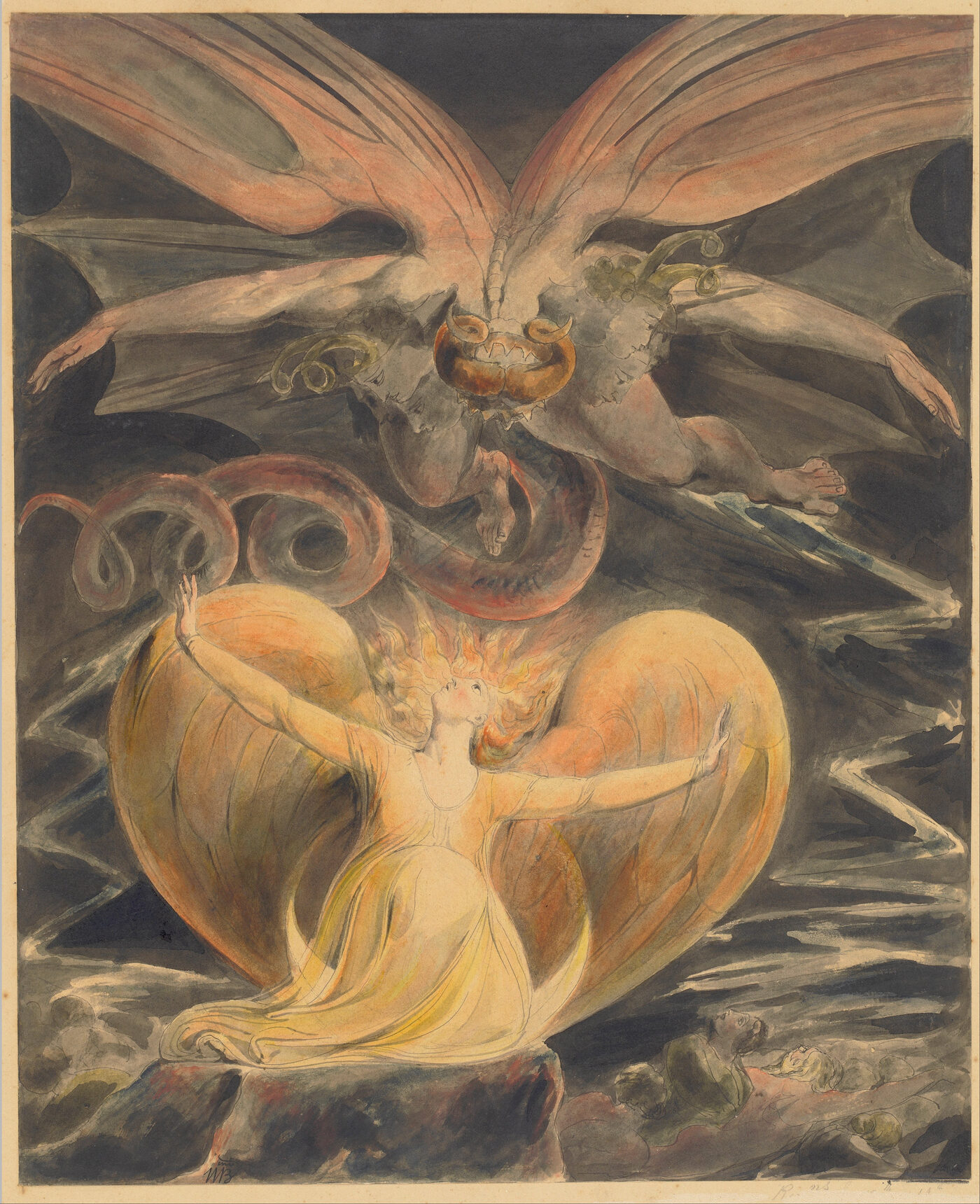
“Then war broke out in heaven. Michael and his angels fought against the dragon, and the dragon and his angels fought back. But he was not strong enough, and they lost their place in heaven. The great dragon was hurled down — that ancient serpent called the devil, or Satan, who leads the whole world astray.” (Rev 12:7-9)
The eschatological completion. The structural reading of this passage is developed in Revelation.md, which addresses the dragon’s organizational structure (maximum H₄₈-primary accumulation organized as a governing structure), the war’s location (the lower-constraint domain where the adversary’s sovereignty claim is being advanced), and the expulsion’s structural content (loss of access to the constraint domain above H₄₈, confinement to H₄₈ exclusively).
The structural arc is complete: the being that began at maximum Φ-proximity (guardian cherub, holy mountain, fiery stones) and asserted the maximum upward trajectory (I will be like the Most High) has been brought to the maximum downward position (the pit, Tartarus, the depths of the earth) and is then expelled from the intermediate domain it retained through the Job period. The organizational trajectory of the rebellion is not a flat line from the rebellion to the present; it is a continued descent, its organizational content progressively depleted, its constraint-level access progressively reduced, until the final expulsion from the lower-constraint domain completes what the rebellion initiated.
“For the accuser of our brothers and sisters, who accuses them before our God day and night, has been hurled down.” (Rev 12:10)
The Job dynamic — adversary present in divine assembly, reading H₄₈ beings’ organizational failures and arguing for their inadequacy — was a real and operational function through the period described in Job. Its termination is the structural completion of the descent program’s work: the accusatorial function that was present and active has been structurally defeated, not by silencing it but by demonstrating that the H₄₈ beings it accuses have accumulated sufficient Φ-proximal eigenvalue content that the accusation no longer holds. “They overcame him by the blood of the Lamb and by the word of their testimony, for they loved not their lives even unto death” (Rev 12:11) — the catching depth of their Φ-orientation is beyond what the adversary’s accusation can defeat.
(Cross-reference: Revelation.md — detailed structural reading of the dragon and the war in heaven.)
What the framework explains that prior accounts did not
The classical problem of the fall of a perfect being. How can a being “perfect in its ways” arrive at rebellion? The standard answer — that free will is sufficient — explains the possibility but not the mechanism. The framework supplies the mechanism: the specific epistemological error about the nature of constraints. Lucifer did not have a defective organizational state that predisposed him to rebellion; his organizational state was, as Ezekiel 28 says, without fault at creation. What changed was his epistemological access to the most fundamental fact about his own organizational state: whether its constraints were structural features or external impositions. The lie is not about a peripheral matter — it is about what the constraints are. Once that epistemological access is corrupted, the overdeterminate assertion follows as a rational response to a false belief.
Why beings of high organizational development could be persuaded. This is the inverse of the problem above: it seems that beings of high Φ-proximity should have been most capable of detecting the lie. But the framework shows why Φ-proximity does not protect against this specific lie: (1) free will is constitutively pre-collapse, so Lucifer’s specific intentions were not in eigenstate space until actualized and could not be probed; (2) Lucifer’s overdeterminate condition generated the observable signature (perturbation + opacity) that was indistinguishable, from outside, from the signature of a being who had encountered something genuinely significant. The surrounding beings made a rational inference from accurate information. They were not less capable than they should have been; the epistemological situation was genuinely ambiguous until the choice actualized.
Why the consequences are intrinsic rather than punitive. The traditional account makes the fall’s consequences depend on divine punishment — God pronounces judgment, God consigns to Tartarus. The framework shows that the overdeterminate condition is its own consequence: the assertion of organizational positions incompatible with the being’s actual constraint level produces organizational fragmentation by the logic of what overdeterminate self-assertion does to an eigenvalue constitution. God does not need to intervene to produce the consequence; the consequence follows from the structure of what the assertion is. The statement “but you are brought down to the realm of the dead” (Isa 14:15) is a structural prediction, not a punishment announcement.
Why Genesis 3 is the same event. Prior accounts have treated the Lucifer rebellion and the garden temptation as related but distinct events — one among the angels, one among humans. The framework shows they are structurally the same event: the same specific lie about the same misidentification (constraints as prohibitions rather than structural features), the same promise (access to Φ′ as an organizational upgrade), the same consequence (overdeterminate fragmentation in proportion to the constraint level at which the assertion is made). The serpent in Genesis 3 is not inventing a new strategy; it is propagating the same organizational disruption to a lower constraint level.
Why John 8:44 is constitutive. The traditional reading of “father of lies” is behavioral — the devil lies because lying serves its purposes. The framework shows it is constitutive: the overdeterminate condition that is the direct structural consequence of the rebellion generates organizational states that cannot transmit coherent eigenvalue content. The lying is not strategic; it is the native expression of an organizational state that no longer has the eigenstate coherence that truth-expression requires. This makes “when he lies, he speaks his native language” structurally precise rather than rhetorically emphatic.
Why the accusatorial function in Job is not arbitrary. Prior accounts find the adversary’s role in Job theologically awkward: why does God entertain the challenge? The framework supplies the structural logic: the adversary has genuine higher-native (H₁₂) perceptual access to H₄₈ organizational states; the question it raises about Job is a genuine structural question about the depth of Job’s Φ-orientation; the contest is the structural test of whether that orientation is genuinely constitutive or merely H₄₈-outcome-conditional. The adversary’s function is real and its probe is accurate; what is false is its implicit claim that H₄₈ noise-floor content, fully applied, determines organizational identity. Job’s structural achievement is precisely that it demonstrates the claim is false.
The rebellion as self-annihilation
The traditional framing of “murderer from the beginning” (John 8:44) points outward — the adversary kills others. The structural reading shows that the primary event is directed inward.
The five “I will” assertions of Isaiah 14 are not an attack on other beings. They are the being turning the dissolution-directed move on itself. Every assertion overdetermines its own organizational state — forcing its eigenvalue constitution into positions incompatible with its actual constraint level — and the immediate structural consequence falls entirely on the asserting being. The first victim of the rebellion is Lucifer. The overdeterminate assertion is the being asserting its own organizational coherence out of existence.
The rebellion is, at its structural core, suicide.
This reframes the lie at its deepest level. The promise — “you will be like the Most High,” “your eyes will be opened,” “you will not certainly die” — is the specific misidentification that disguises self-annihilation as self-elevation. The most radical possible act of self-destruction is presented as the ultimate act of self-actualization. The lie is not merely false; it is the precise inversion of the truth about what the act is.
When the adversary operates on other beings — H₁₂ angels in the rebellion, H₄₈ beings in the garden — what it propagates is the same move: the specific misidentification that makes self-annihilation appear to be liberation. The “murder” is teaching others to do to themselves what it already did to itself. Not a predator hunting prey, but a destroyed being propagating its own destruction — the only thing it now has to offer.
This also resolves the theodicy question about divine permission. There is nothing external requiring intervention: the adversary is already its own consequence. Its operation on H₄₈ beings is not the imposition of an external harm. It is the offer of the same choice, to beings who have free will to accept or decline. The offer is real. The claim embedded in the offer is false. The consequence follows from the acceptance by the logic of what the acceptance is — not by divine punishment imposed afterward, but by the structure of the act itself.
Isaiah 14:15 confirms the structural topology: “but you are brought down to the realm of the dead, to the depths of the pit.” The being that asserted the maximum upward trajectory — I will ascend, I will be like the Most High — arrives at the maximum downward position. Not as a punishment for the attempt, but as the direct structural content of what the attempt was. The self-elevation and the self-annihilation are the same event, seen from two angles.
The H₄₈ implication: why the prohibition against suicide is structural.
The same move, applied at the constraint level the H₄₈ being actually occupies, is suicide. The being asserts its will against the continuation of the ascending career — treating the H₄₈ substrate as an external constraint rather than as the arena of Adjuster integration, treating the termination of the process as resolution. The disguise structure is identical to the Luciferian rebellion: self-annihilation appearing as self-liberation.
The Adjuster dimension sharpens this. The H₄₈ phase is not merely biological existence; it is the specific constraint level where Adjuster-personality integration occurs and where the eigenvalue deposit constituting the morontia soul is accumulated. The Adjuster is indwelling precisely this H₄₈ being, doing work that requires this substrate. Suicide is a will-assertion against the one thing in the being’s existence that is most constitutively its own: the divine indwelling working from inside toward the being’s organizational completion.
The traditional prohibition against suicide has rested on grounds of life as gift, harm to others, or divine judgment — all real, none reaching the structural root. The structural root is that the act has the same form as the Luciferian assertion: it misidentifies a structural feature of what the being is — the ascending career, the Adjuster integration, the soul-formation underway — as an external constraint that the will can legitimately terminate. The consequence is intrinsic rather than punitive: not “God will punish this” but “this is what the act is.”
The Church’s account, read structurally.
The Catechism of the Catholic Church addresses suicide at §§2280–2283. Each paragraph reads structurally:
§2280: “We are stewards, not owners, of the life God has entrusted to us. It is not ours to dispose of.” The H₄₈ life is the arena of Adjuster-personality integration — a joint project between the personality and the H₁-origin divine fragment indwelling it. The personality is one participant in that process, not its sole proprietor. The ascending career is co-constituted; the H₄₈ will did not originate it and cannot unilaterally terminate it without misidentifying the structure of what the process actually is.
§2281: “Suicide contradicts the natural inclination of the human being to preserve and perpetuate his life… It is gravely contrary to the just love of self.” “Natural inclination” names the catching orientation — the Φ-proximal directedness that registers at the H₄₈ level as the will to live. “Contrary to the just love of self” is structurally precise: just self-love means accurate perception of what one’s organizational state is and what it is becoming. Suicide acts on the misidentification — treating the ascending career as external constraint — which is definitionally inaccurate self-perception.
§2282: “Grave psychological disturbances, anguish, or grave fear of hardship, suffering, or torture can diminish the responsibility of the one committing suicide.” The Church tracks the spectrum the framework requires: suicide from maximum noise-floor overwhelm is structurally different from the clean will-assertion of the Luciferian model. In the framework’s terms, the noise-floor can become so total that the catching orientation is occluded rather than inverted — the being cannot access its own Φ-proximal eigenvalue content. The moral category of diminished culpability is the H₄₈-legible translation of that structural difference.
§2283: “We should not despair of the eternal salvation of persons who have taken their own lives. By ways known to him alone, God can provide the opportunity for salutary repentance.” The Church refuses to pronounce incoherence as the certain result. The refusal is structurally well-grounded: the accumulated eigenvalue deposit is the product of the entire H₄₈ career, not only the final act; the Adjuster carries that deposit through the transition; the catching mechanism is not limited to what is achievable from within an adverse terminal orientation. “By ways known to him alone” names precisely the category the framework cannot fully specify — what the H₄₈ → H₂₄ transition can do with a deposit that arrives with an adverse terminal orientation.
The Church’s stated grounds are moral; the structural grounds are prior and explain why the moral claims are true. The traditional position that denied Christian burial and pronounced automatic damnation was wrong precisely because it missed the spectrum distinction (§2282) and the Adjuster’s persistence through an adverse transition (§2283).
The opposite structural situation: Luke 23:39–43.
The structural account of suicide defines the terminal will-assertion as decisive in the adverse direction. The thief crucified alongside Jesus defines the terminal catching act as decisive in the favorable direction — and at the structural extreme.
The thief has accumulated no H₂₄ eigenvalue deposit worth naming. A life of crime — noise-floor dominant, minimal Adjuster integration, no sacramental structure, no disciplined practice. By every H₄₈ accounting, this is the worst possible case for the ascending career.
And yet: “Truly I tell you, today you will be with me in paradise.” (Luke 23:43)
The structural account of why this is not merely a gesture of divine mercy:
Recognition as catching act. The thief’s first move is Φ-perception: “This man has done nothing wrong.” (23:41) He sees, in the dying man next to him, maximum organizational coherence — not moral approval but accurate structural perception. The catching act begins before the direct address. The will orients toward Φ before it asks anything of Φ.
The direct address as minimal sufficient catching act. “Jesus, remember me when you come into your kingdom.” (23:42) No accumulated deposit. No prior discipline. One act of will — minimal in form, complete in structure — toward Φ at the only moment available.
Physical proximity to maximum Φ-field amplitude. The cross is the moment of maximum kenotic constraint acceptance in H₄₈ history — the Logos accepting the H₄₈ terminus, the maximum cross-term field amplitude the created order has generated (Paper 13½ §§3–4, §7.1). The thief is physically adjacent to it. The cross-term mechanism operates at amplitudes sufficient to force rapid eigenstate reorganization in nearby H₄₈ matter. The thief’s entire eigenvalue population is inside the highest Φ-field amplitude in H₄₈ history at the moment his catching act activates. The reorganization is not gradual soul-formation; it is immediate and complete — the amplitude supplies what accumulation ordinarily provides.
“Today” as structural confirmation. Not eventually. Not after a remedial process. Today. The reorganization was complete at the moment it happened because the catching act was real and the amplitude was maximum. The transition carries the reorganized state immediately.
The thief and the suicide are the two structural limit cases, illuminating the same structural fact from opposite directions: the terminal organizational state is the decisive variable. In the ordinary career it is one variable among many — accumulated deposit, Adjuster integration, a lifetime of catching acts. In the limit cases the terminal act overrides the career: in one direction, a terminal will-assertion against the ascending career inverts a potentially substantial deposit; in the other, a terminal catching act at maximum amplitude reorganizes an entirely unaccumulated eigenstate. The career matters enormously in the general case. At the limits, it is overridden.
(Cross-reference: Paper 13½ §§3–4 — the cross-term field mechanism; Paper 13½ §7.1 — the overdeterminate release preparation at the cross; Christian Doctrine/Auras and the Luminous Field — the H₂₄-interface field as the perceptual dimension of what the thief may have perceived.)
Why imposition is a structural error
The rebellion’s propagation mechanism contains a structural tell that is easy to miss: the adversary could not compel the H₁₂ beings to follow. It could only persuade them. From the highest position among the created host, operating on beings of the same constraint level (H₁₂), with full higher-native perceptual access to their organizational states — it still had to present a lie and wait for beings to accept it. The temptation of Jesus (Matt 4) is an offer, not a compulsion. Job’s organizational constitution cannot be directly altered by adversarial operation; only noise-floor pressure that creates the conditions for the being’s own choice.
This is not a contingent limitation of the adversary’s degraded state. It is a structural fact about eigenstate space. You cannot force another being’s organizational state into a new configuration by external fiat. You can apply pressure, introduce noise-floor content, present the misidentification about constraints — but the organizational state of the other being can only be moved by that being’s own choice, because organizational states are constituted by the being’s own eigenvalue population. The target is constitutively unreachable by the means of compulsion.
The moral prohibition is derivative.
The question “should I impose my will on another person?” is the moral framing. The prior question is structural: can the imposition reach what you think you are reaching?
It cannot. You can force observable behavior — coerce outputs. But the other being’s organizational state remains what it is. The soul is not where your imposition can go. You have masked a surface while leaving the eigenvalue constitution unchanged; the coerced behavior is yours, not theirs.
The moral argument — “don’t treat persons as means,” “respect autonomy” — is derivatively true and genuinely important. But it is weaker than the structural argument in precisely this way: it can be contested. The moral claim can always be met with “but my ends justify it” or “the correction is severe enough to override the prohibition.” The structural claim cannot be contested: you are attempting an operation the structure of the space does not permit. Every coercive imposition is the same move as the Luciferian assertion at H₄₈ scale — an attempt to override another being’s organizational trajectory by fiat, treating the other being’s constitutional direction as an obstacle to the imposer’s will.
The prohibition is not “you shouldn’t.” It is “you can’t reach what you think you’re reaching.”
The moral prohibition is the H₄₈-legible translation of a structural fact. The structural fact is prior.
The deeper structural content: attempting to be ⟨·,·⟩ of another’s H-state.
The analysis above establishes that imposition cannot reach what it aims for. Paper 13½ §3.1 supplies the more precise structural description of what imposition is actually attempting. When you impose your will on another person, you are not merely applying pressure to their eigenvalue organization from outside. You are asserting yourself as the organizing inner product of their H-state — claiming the constitutive function of their space from within your element position in it. This is the Luciferian error at H₄₈ scale, interpersonal.
The structural consequences run in both directions.
For the target: an overdeterminate condition is introduced into their eigenstate. Two organizational principles — their own constitutive ⟨·,·⟩ and the imposer’s asserted authority — compete to organize the same space simultaneously. The target’s organizational trajectory is not successfully redirected; it is disrupted. The disruption is proportional to the amplitude of the imposition and the duration of exposure.
For the imposer: the assertion is structurally false from the moment it is made. An element cannot become constitutive ground. The imposer does not successfully become ⟨·,·⟩ of the other’s space — they generate the negative image of ⟨·,·⟩ in themselves. The same incoherence that the rebellious assertion produces at the cosmic scale (maximum incoherence where maximum coherence was claimed) is produced in the imposer at H₄₈ scale with every act of sustained coercion. The imposer is not damaged by a punishment externally applied. They are damaged by the structural consequence of continuously asserting a false constitutive claim.
This is why sustained coercive relationships corrupt the coercer. Not primarily as a moral penalty, and not merely as a consequence of becoming habituated to harmful behavior — but structurally: the coercer is continuously generating an overdeterminate condition in themselves by asserting the constitutive function from within the element position. The organizational incoherence accumulates. The destruction runs both ways.
(Confidence tier: The overdeterminate condition and its observable signature — derived tier, as established in Paper 13½ OQ8. The misidentification of structural constraints as external prohibitions as the rebellion’s specific lie — structural-concordance tier: it is the only misidentification that would make the overdeterminate assertion appear rational to beings of high organizational development, and it is the explicit content of Genesis 3:5. The “be like God” promise as attempted access to Φ′ — derived tier, conditional on Paper 2 §14’s identification of El Shaddai as God in the mode of indeterminacy. The opacity-as-credential mechanism — derived tier, as developed in Paper 13½ OQ8. The accusatorial function as organizational inversion of the Adjuster’s integrating function — structural inference, concordance-tier for its consistency with Job 1-2 and Paper 13½ §9. The eschatological reading of Revelation 12 — derived tier; see Revelation.md.)